
PU Flooring for Cold Storage and Freezer Rooms
PU mortar systems for freezer rooms, cold storage, and transition zones. Thermal shock, condensation, and slip resistance covered.
The short answer
Specify the right polyurethane flooring cold storage malaysia solution for cold-chain conditions, with transition-zone detailing called out explicitly.
We recommend a heavy-duty pu mortar freezer system for sub-zero environments to guarantee long-term durability.
For a complete specification breakdown, see our PU flooring service.
What this guide covers
You know how quickly a standard epoxy floor fails when exposed to the daily thermal shock of a Malaysian cold room.
Our team at Epoxy Ninja Johor Bahru sees standard epoxy floors fail rapidly across local food processing facilities. The main thing to understand first: Sub-zero service temperature ranges by PU system.
We will break down the specific thickness requirements, tackle the spalling risks, and outline the exact transition details you need. Let’s look at the data and explore a few practical ways to protect your facility.
Sub-zero service temperature ranges by PU system
The service temperature of a cold room floor material directly dictates the required thickness, with standard freezers needing at least a 6mm PU coat to handle -18°C. We start every project by auditing your facility’s operational thermal range.
Standard polyurethane concrete systems, like Ucrete HF or Vebrocrete, provide exceptional thermal shock resistance. Our site visits across Malaysia reveal that thicker 9mm systems are absolutely essential for blast freezers hitting -40°C.
This physical thickness provides the necessary thermal barrier to stop the underlying concrete slab from freezing and cracking. We use the following baseline requirements for sub-zero environments:
| Cold Storage Type | Typical Temperature Range | Recommended PU Mortar Thickness |
|---|---|---|
| Chiller Rooms | 0°C to 10°C | 4mm to 6mm |
| Standard Freezers | -18°C to -25°C | 6mm to 9mm |
| Blast Freezers | -40°C | 9mm to 12mm |
Condensation and spalling risks at ambient-to-cold transitions
High ambient humidity in Malaysia creates extreme condensation at ambient-to-cold transitions, which seeps into unsealed concrete and freezes. We always prioritise aggressive moisture management at these critical junctions to stop spalling.
Moisture scans using tools like the Tramex CMEX5 often reveal hidden moisture pockets right outside the freezer door. Our application process requires sealing these porous zones before applying the final coat.
If water penetrates the substrate and freezes, the resulting expansion physically breaks the floor from the inside out. We mitigate this risk by enforcing three non-negotiable moisture controls:
- Deep Sealing: Blocking porous concrete before the final coat.
- Zero-Absorption Materials: Installing high-density PU mortar with a 0% water absorption rate.
- Vapour Barriers: Stopping rising moisture from the ground slab.
Transition detailing between freezer and anteroom
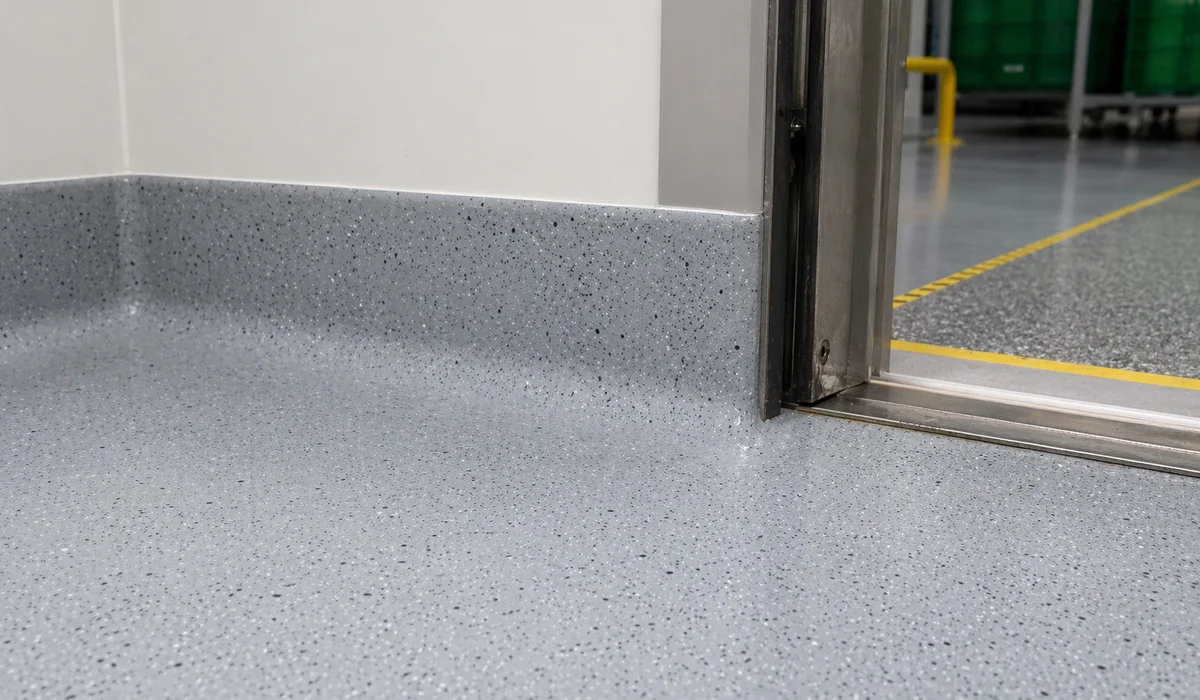
Proper transition detailing between a freezer and anteroom requires cutting anchor chases and installing coving to create a watertight seal. We cut specific grooves into the concrete, typically 3mm wide and 5mm deep, just inside the perimeter and around drains.
This mechanical interlocking prevents the polyurethane concrete from curling when exposed to severe temperature drops. Our application crews then install a dedicated coving base along the wall edges.
A continuous, gap-free transition prevents the dangerous ice buildup that causes forklifts to slip and damages the doorway threshold of your freezer room flooring. We find that poorly executed joints account for the majority of early floor failures in cold logistics. Specific transition details to enforce include:
- Thermal Breaks: Insulating the joint between the cold room slab and the ambient slab.
- Anchor Chases: Deep cuts that physically lock the resin into the concrete.
- Coved Skirting: Creating a curved, watertight “bathtub effect” up the wall.
- Flexible Sealants: Using low-temperature joint sealants that will not snap when the slab contracts.
Typical PU MF/HF thickness bands for freezer service
Heavy-duty (HF) and medium-duty (MF) polyurethane systems must be applied at specific thickness bands to survive heavy traffic and freezing conditions. We rely on heavy-build systems to protect the concrete slab from both thermal shock and heavy pallet jacks.
A 6mm PU MF (Medium Frequency) layer handles standard foot traffic and light hand-trucks inside a -15°C commercial kitchen freezer. Our specifications upgrade to a 9mm PU HF (Heavy Frequency) trowel-applied mortar for industrial facilities with steel-wheeled forklifts.
Upgrading to a 9mm or even 12mm thickness also allows the floor to withstand high-temperature steam cleaning up to 130°C. We assess several factors before recommending a final thickness:
- Operational Load: Steel-wheeled traffic requires a 9mm HF system to prevent crushing.
- Cleaning Regimen: Hot water washdowns demand a thicker profile to prevent thermal debonding.
- Base Insulation: Walk-in coolers resting on ground-level slabs without underlying PU panel insulation need thicker surface protection.
- Chemical Exposure: Concentrated food acids like lactic acid require the maximum density of a thicker mortar.
For a closer look at related considerations, read our When to Choose PU Over Epoxy in Wet and Thermal-Shock Environments guide.
What to do next
If you are weighing this decision for your facility, the fastest next step is a free site evaluation.
We bring a Tramex CMEX5 moisture meter, walk the substrate, document the chemical and thermal exposure, and hand you a written BQ with honest cost paths. There is no obligation, and you receive a same-day response across JB, Pasir Gudang, Skudai, Senai, and Iskandar Puteri.
Our Polyurethane (PU) Flooring service page covers the system specs in detail.
Fast answers.
Can epoxy be used in a freezer room instead of PU?
Epoxy struggles with thermal cycling and condensation; PU mortar is the industry-standard choice below +5°C operating temperature.
What's the minimum thickness for a freezer floor?
PU MF typically at 6mm; HF at 9-12mm where heavy pallet traffic is expected.
How is slip resistance handled on wet freezer floors?
R12 or R13 aggregate broadcast during the final coat — calibrated against the washdown cleaning regime.
More in this cluster.
How Long Does Industrial Polyurethane Flooring Last?
Industrial PU flooring lifespan by system type — with abrasion ratings, what shortens life, and recoat vs replace decision points.
Polyurethane Flooring Cost Guide for Malaysia (RM per Square Foot)
Polyurethane flooring prices in Malaysia — standard PU, PU mortar, urethane concrete. RM ranges and what drives quote variance.
PU Flooring Installation Process and Timeline (What to Expect)
Day-by-day PU flooring install — prep, primer, base, broadcast, topcoat, cure. Return-to-service windows for planning shutdown.
When to Choose PU Over Epoxy in Wet and Thermal-Shock Environments
When wet washdowns, steam cleaning, or thermal cycling force PU over epoxy — real decision rules with examples.
Ready for a real assessment? Free Tramex scan.
Guides are the general case. A site visit gives you the specific answer for your slab, your chemicals, and your operational conditions.