
PU Flooring Cost in Malaysia (RM per sqft)
Polyurethane flooring prices in Malaysia — standard PU, PU mortar, urethane concrete. RM ranges and what drives quote variance.
The short answer
Polyurethane flooring in Malaysia ranges from RM 3 to RM 35 per square foot.
The exact pu floor price malaysia depends entirely on the system type you need.
We regularly install everything from thin-coat standard PU to heavy-duty urethane concrete. Your specific operational requirements will dictate the final price tag.
For comprehensive technical specifications, see our PU flooring service.
What this guide covers
This guide outlines the exact RM per square foot ranges for the four primary polyurethane systems used in Malaysian facilities. You will learn the specific cost differences between standard PU, self-leveling PU, PU mortar, and urethane concrete MF/HF.
Our team created this resource to give facility managers transparent, actionable pricing data.
Understanding these tiers helps you budget accurately for chemical exposure and thermal shock resistance.
RM/sqft range
The baseline RM per square foot range for polyurethane flooring spans from RM 3.00 for standard coatings to over RM 35.00 for heavy-duty systems. This broad spectrum exists because different industrial environments demand vastly different levels of protection.
We provide clear pricing tiers so you can match the correct system to your facility operations. The actual cost delta depends heavily on your current concrete slab condition and required chemical resistance.
| Polyurethane System | Estimated Cost (RM/sqft) | Typical Thickness | Best Use Case |
|---|---|---|---|
| Standard PU Coating | RM 3.00 - RM 6.00 | 0.2mm - 0.5mm | Light foot traffic, dry zones |
| Self-Leveling PU | RM 8.00 - RM 15.00 | 1.0mm - 3.0mm | Medium duty, logistics aisles |
| PU Mortar | RM 18.00 - RM 25.00 | 3.0mm - 6.0mm | Wet processing, food plants |
| Urethane Concrete MF/HF | RM 25.00 - RM 35.00+ | 6.0mm - 9.0mm+ | Heavy manufacturing, thermal shock |
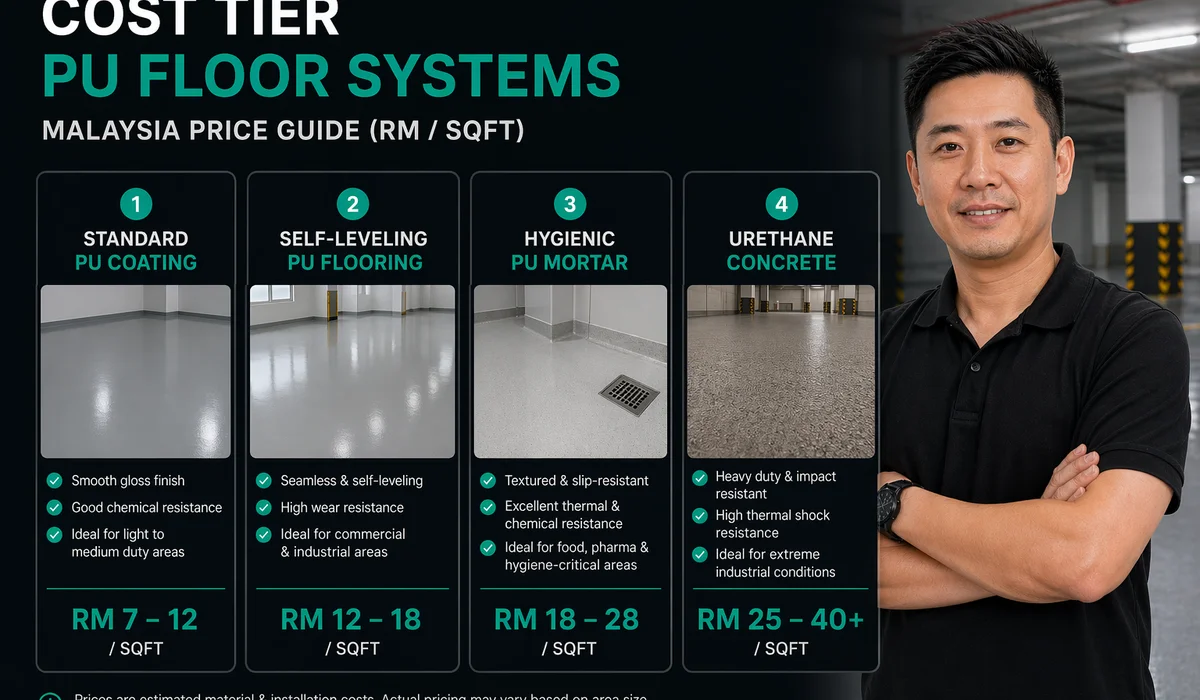
Each system offers a distinct level of durability and performance. Standard PU acts as a simple dust-proofer for light-traffic zones.
Our installers highly recommend stepping up to PU mortar for brutal daily washdowns in food plants. The pu mortar cost per sqft sits higher but handles these demanding wet conditions flawlessly.
Urethane concrete price reflects its unique ability to survive extreme thermal shock, like boiling water spills.
PU vs epoxy premium breakdown (~15-30% typical)
Polyurethane flooring typically carries a 15% to 30% price premium over standard epoxy systems in Malaysia. This added cost buys you significantly higher resistance to organic acids and sudden temperature changes.
We often see facility managers struggling to choose between these two distinct materials. Epoxy handles heavy stationary loads perfectly well in standard dry warehouses. Polyurethane absorbs heavy impacts better and resists the severe thermal shock that cracks rigid epoxy floors.
Here are the primary reasons polyurethane commands a higher price tag:
- Superior flexibility: Absorbs impacts from dropped tools without shattering.
- Thermal shock resistance: Survives rapid temperature swings from steam cleaning.
- Organic acid tolerance: Withstands lactic acids found in dairy and food processing.
- Faster curing speed: Reduces costly facility downtime during installation.
The decision threshold rarely comes down to just the upfront material price. A commercial kitchen pouring 90-degree Celsius water on the floor will destroy an epoxy surface in months.
We calculate the total lifecycle cost during site visits to show why the initial PU premium makes financial sense. Investing that extra 20% upfront prevents a complete, costly facility shutdown for floor repairs two years later.
Thickness and aggregate impact on price
Increasing floor thickness from 3mm to 6mm will nearly double your base material costs. Adding specialized anti-slip aggregates also increases the final price per square foot by RM 2.00 to RM 4.00.
Our team adjusts these variables based entirely on your specific safety standards and operational requirements. Thicker floors provide superior thermal protection and much better impact resistance.
A 9mm urethane concrete system requires massive amounts of specialized resin and heavy protective aggregates. The type of aggregate chosen directly affects the installation labor and final invoice.
Common aggregate choices include:
- Fine Silica Sand: Basic slip resistance for dry foot traffic areas.
- Coarse Quartz: Medium aggressive texture for wet processing zones.
- Aluminum Oxide: Extreme traction for heavy grease and oil exposure.
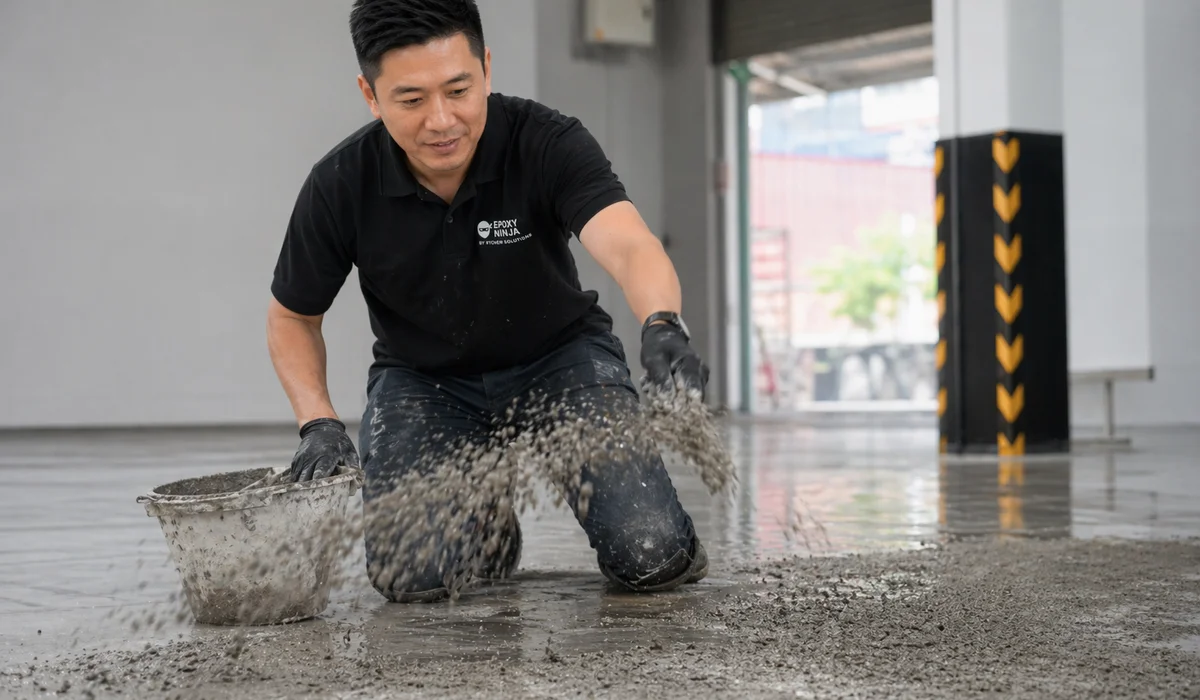
We typically broadcast fine quartz for basic slip resistance or aluminum oxide for extreme processing environments. Getting this exact specification right determines 60% to 80% of your floor’s actual service life.
Properly selected aggregates prevent workplace slip accidents while maximizing the coating’s durability.
What facility size does to per-sqft cost (small job premium)
Facilities under 1,000 square feet face a significantly higher per-square-foot cost due to baseline mobilization expenses. Equipment transport, heavy surface preparation, and crew deployment cost the same whether a job is 500 or 5,000 square feet.
We transparently factor these fixed setup costs into all smaller project quotes. A standard PU system costing RM 4.00 per square foot on a large factory floor might jump to RM 8.00 per square foot for a small utility room.
Economies of scale heavily favor massive warehouse spaces and expansive production lines. Installers can lay down hundreds of square meters a day once the heavy grinding equipment is actively running.
Our experts advise clients to group smaller flooring repair projects together whenever possible. Combining a small kitchen and an adjacent storage room into one single mobilization drops the blended rate considerably.
For a closer look at related considerations, read our How Long Does Industrial Polyurethane Flooring Last guide.
What to do next
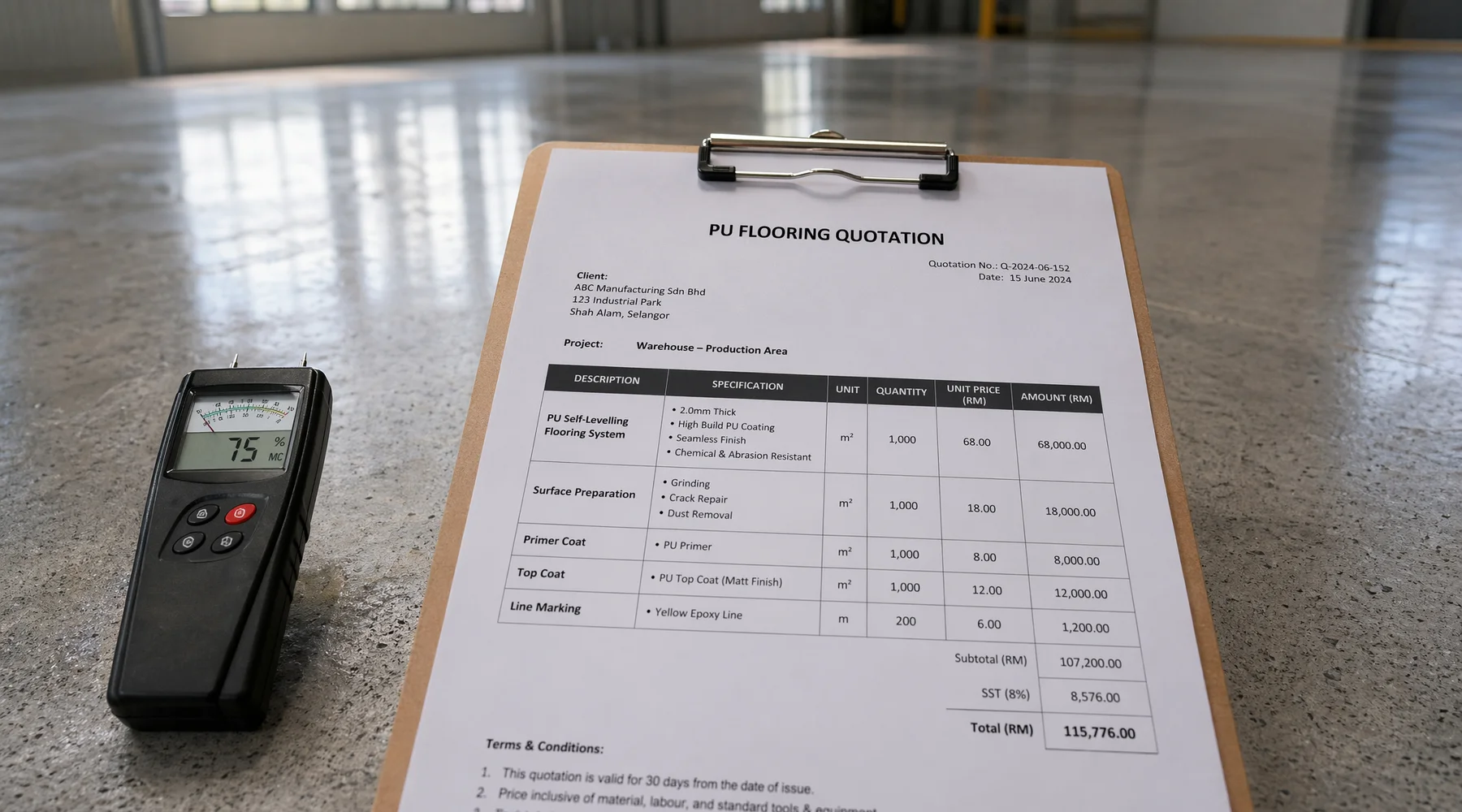
The fastest way to determine your exact flooring cost is to schedule a free technical site visit. An on-site evaluation allows for precise moisture testing and concrete condition assessment.
We bring a professional Tramex CMEX5 moisture meter to accurately measure your substrate before issuing any quotes. Documenting your exact chemical and thermal exposure is critical for selecting the correct PU system tier.
After the physical inspection, you receive a detailed written Bill of Quantities outlining the honest cost paths for your facility.
We provide same-day responses across JB, Pasir Gudang, Skudai, Senai, and Iskandar Puteri with zero obligation. Fast turnarounds are standard practice to keep your critical facility maintenance schedules perfectly on track.
For a full breakdown of the technical system specifications, view our Polyurethane (PU) Flooring service page.
Fast answers.
Why is PU mortar so much more expensive than standard PU?
Thickness (6-12mm vs 0.5-3mm), aggregate content, labor intensity, and higher-cost resin. Lifespan justifies the premium in heavy-duty zones.
Can I save by going thinner on PU mortar?
Only if the impact and thermal profile actually allows it. Under-spec'd mortar cracks under pallet drops — the rework costs more than the upfront savings.
Are quotes usually inclusive of GST/SST?
Commercial quotes in Malaysia typically quote ex-SST with SST added at invoice. Ask for the inclusive figure for easier budget comparison.
More in this cluster.
How Long Does Industrial Polyurethane Flooring Last?
Industrial PU flooring lifespan by system type — with abrasion ratings, what shortens life, and recoat vs replace decision points.
PU Flooring for Cold Storage and Freezer Rooms in Malaysia
PU mortar systems for freezer rooms, cold storage, and transition zones. Thermal shock, condensation, and slip resistance covered.
PU Flooring Installation Process and Timeline (What to Expect)
Day-by-day PU flooring install — prep, primer, base, broadcast, topcoat, cure. Return-to-service windows for planning shutdown.
When to Choose PU Over Epoxy in Wet and Thermal-Shock Environments
When wet washdowns, steam cleaning, or thermal cycling force PU over epoxy — real decision rules with examples.
Ready for a real assessment? Free Tramex scan.
Guides are the general case. A site visit gives you the specific answer for your slab, your chemicals, and your operational conditions.