
Passing HACCP & GMP Floor Inspections
What auditors check on your factory floor — non-conformances, documentation, pre-audit self-check. Get ready before the walk-through.
The short answer
Industrial flooring is a notorious failure point during any HACCP floor inspection in Malaysia.
Facility managers know that a cracked slab is an immediate red flag. We eliminate pre-audit anxiety by providing the exact flooring checks that local auditors run. Knowing these Ministry of Health requirements saves time and prevents costly closures.
Let’s explore the data behind common failures and outline exactly how to fix them. For a compliant installation, see our HACCP flooring service.
What this guide covers for a HACCP floor inspection Malaysia
Our team at Epoxy Ninja Johor Bahru knows exactly how stressful a GMP floor audit can be. Setting the standard for quality and reliability in the industrial flooring sector across the region is our core mission. Facility managers often struggle to decode the technical jargon in official guidelines.
This guide breaks down the practical realities of passing food audit flooring requirements. We will explain exactly what Ministry of Health inspectors look for. The core areas include surface integrity, coving, drainage, and proper documentation.
Key compliance areas we will cover:
- Decoding Ministry of Health documentation standards.
- Identifying physical floor defects.
- Reviewing temperature and chemical limits.
- Preparing for a fast self-inspection.
Understanding these specific criteria helps you choose the right materials. This knowledge protects your business from sudden closures or fines under the Food Act 1983.
What inspectors check: surface, cove, drainage, cleanability, documentation
The Malaysian Standard MS 1480 for HACCP and MS 1514 for GMP outline strict physical requirements. We see auditors strongly enforce these rules during site visits.
An inspector will immediately look for a continuous, joint-free surface. Joints and seams provide a breeding ground for bacteria. Your facility must use materials that block microbial growth entirely.
Essential physical criteria:
- Joint-free surface coating.
- Effective stainless steel drains.
- Properly curved wall coving.
Drainage is another critical checkpoint. We always ensure floors slope correctly toward stainless steel drains. A flat floor leads to ponding water.
Standing water is an automatic red flag for auditors. Inspectors will test this by pouring water to see if it drains completely.
The transition between the floor and the wall must feature smooth coving. A sharp 90-degree angle traps dirt and makes thorough cleaning impossible.
We recommend a gentle, curved cove base. This allows your cleaning crew to wash away debris effortlessly.
Common flooring-related non-conformances (gaps, cracks, porosity, missing coving…
Thermal shock damage is the leading cause of HACCP non-conformance flooring issues. We frequently inspect facilities where standard epoxy has cracked or blistered. Many commercial kitchens use boiling water or steam up to 120 degrees Celsius for sanitation.
Standard epoxy coatings usually fail when exposed to temperatures above 60 degrees Celsius. This rapid temperature change causes the coating to pull away from the concrete slab. Those resulting cracks become immediate violation points.
We know that bacteria thrive in these microscopic hiding spots. Auditors will fail a floor if they spot any delamination or porosity. An exposed concrete slab absorbs grease, blood, and chemical cleaners.
| Feature | Standard Epoxy | Polyurethane (PU) Screed |
|---|---|---|
| Thermal Resistance | Up to 60°C | Up to 120°C |
| Impact Resistance | Moderate | Very High |
| Typical Cost (RM/sq ft) | RM 15 to RM 30 | RM 25 to RM 40 |
Upgrading to a better system prevents these issues. We heavily recommend Polyurethane (PU) screed for high-heat environments. A high-quality PU floor withstands severe thermal shocks and heavy forklift traffic.
Installing a PU modified concrete system costs around RM 25 to RM 40 per square foot in Malaysia. This initial investment prevents a costly factory shutdown later.
Documentation the contractor should provide: PDS, cleanability test, install re…
Proper paperwork is just as important as the physical floor during an audit. We prepare comprehensive documentation for every installation. The auditor will ask to see the Product Data Sheet (PDS) for your flooring material.
This document proves that the chemicals used are food-safe and non-toxic. Without a PDS, you cannot prove the floor meets basic safety standards. You also need proof of a cleanability test.
We provide certificates showing the floor resists common food acids and harsh cleaning chemicals. The material should carry an official HACCP International Certification mark. This global recognition instantly tells the auditor that the surface is compliant.
Mandatory audit documents:
- Manufacturer Product Data Sheet.
- HACCP International Certification certificate.
- Chemical resistance and cleanability test results.
- Detailed contractor installation reports.
Installation records provide the final piece of the puzzle. We document the substrate preparation, moisture readings, and curing times.
An inspector wants assurance that the contractor applied the material correctly. Proper application prevents future failures and extends the service life of your floor.
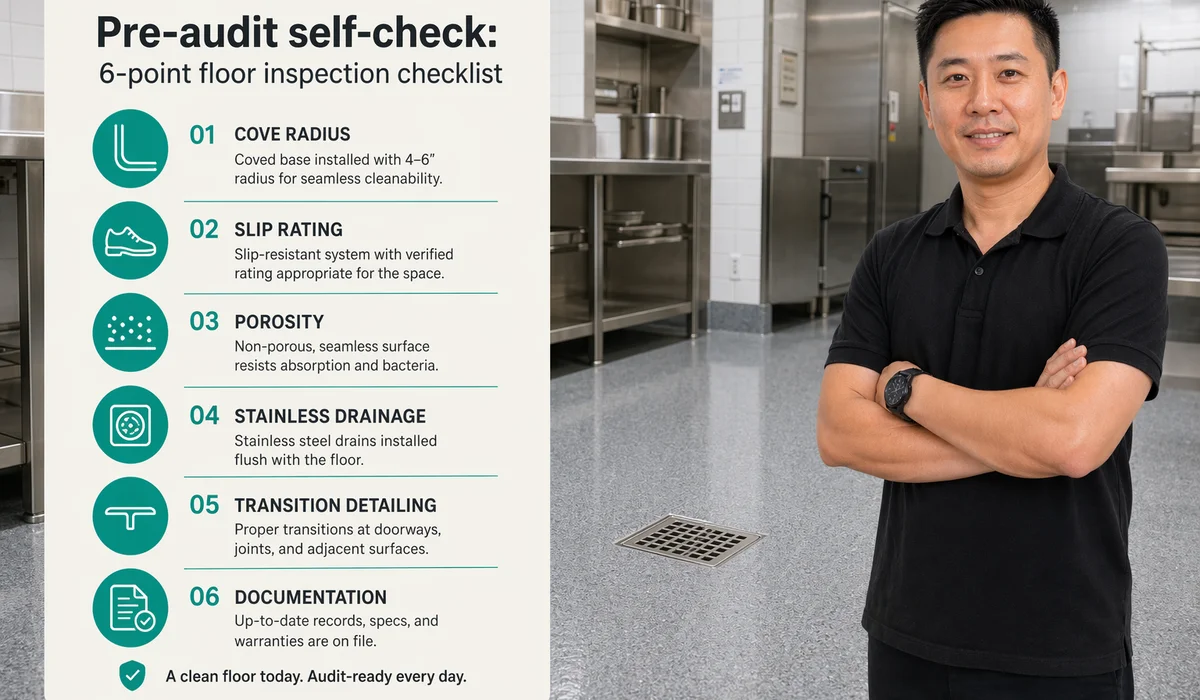
Pre-audit 30-minute floor self-check
You can catch major violations before the Ministry of Health inspector arrives. We recommend a simple, 30-minute walkthrough every month. Start by pouring a bucket of water near your main processing areas.
Watch closely to see if the water flows directly into the drain. Any pooling water requires immediate correction. Next, inspect the coving around the perimeter of the room.
”A routine 30-minute preventative check can save you from a complete factory shutdown under the Food Act 1983.”
We look for tiny gaps between the curved cove and the wall panel. Shine a bright flashlight along the baseboards to highlight cracks. These small fissures often hide pest activity or mold growth.
Finally, check the floor underneath heavy machinery and near doorways. We always find the most severe mechanical wear in these high-traffic zones.
Look for exposed concrete or flaking topcoats. Patching these areas early prevents a minor scrape from becoming a major non-conformance.
For a closer look at related considerations, read our HACCP-Compliant Flooring Cost Guide for Malaysia guide.
What to do next
Upgrading your facility to meet local regulations requires careful planning. We provide a comprehensive site assessment to help you start the process. A proper evaluation requires bringing a Tramex CMEX5 moisture meter to accurately check your current concrete slab.
This step identifies hidden moisture issues before they destroy a new coating. Next, the evaluation covers your specific chemical usage and thermal exposure levels. We hand you a written bill of quantities with transparent pricing options.
You receive a same-day response across JB, Pasir Gudang, Skudai, Senai, and Iskandar Puteri without any obligation. Review our Food-Grade / HACCP Hygienic Flooring service page to see the system specifications for passing your HACCP floor inspection Malaysia in detail.
Fast answers.
How often are HACCP floor audits done?
Annual re-audit is standard for HACCP-certified facilities, with unannounced spot checks possible depending on scheme.
What happens if I fail a floor-related finding?
Minor findings get a remediation window (typically 30 days). Major findings like floor failure or harbourage can suspend certification until fixed.
Can I get a pre-audit floor inspection from you?
Yes — we do pre-audit walk-throughs for existing clients. We document what's likely to get flagged and scope the fix before the auditor arrives.
More in this cluster.
Commercial Kitchen vs Cold Storage Flooring: Different Needs, Different Systems
Kitchen floors face grease and heat; cold storage faces thermal shock and condensation. Different systems for different conditions.
Food-Grade Flooring Requirements for F&B Facilities in Malaysia
What F&B facility floors actually need — wet/dry zoning, thermal shock, chemical, slip rating. Self-qualify your system spec.
HACCP-Compliant Flooring Cost Guide for Malaysia
HACCP-compliant hygienic PU flooring prices in Malaysia — base system, coving, slip aggregate, documentation. Realistic RM/sqft.
Hygienic Coving: Floor-to-Wall Transitions for F&B and Pharma
Hygienic coving done right — radius, integral vs applied, wall-seal detail. The corner auditors always flag.
Ready for a real assessment? Free Tramex scan.
Guides are the general case. A site visit gives you the specific answer for your slab, your chemicals, and your operational conditions.