
What Is ESD Flooring?
ESD flooring explained — static-dissipative vs conductive, resistance bands, grounding, and which industries actually need it.
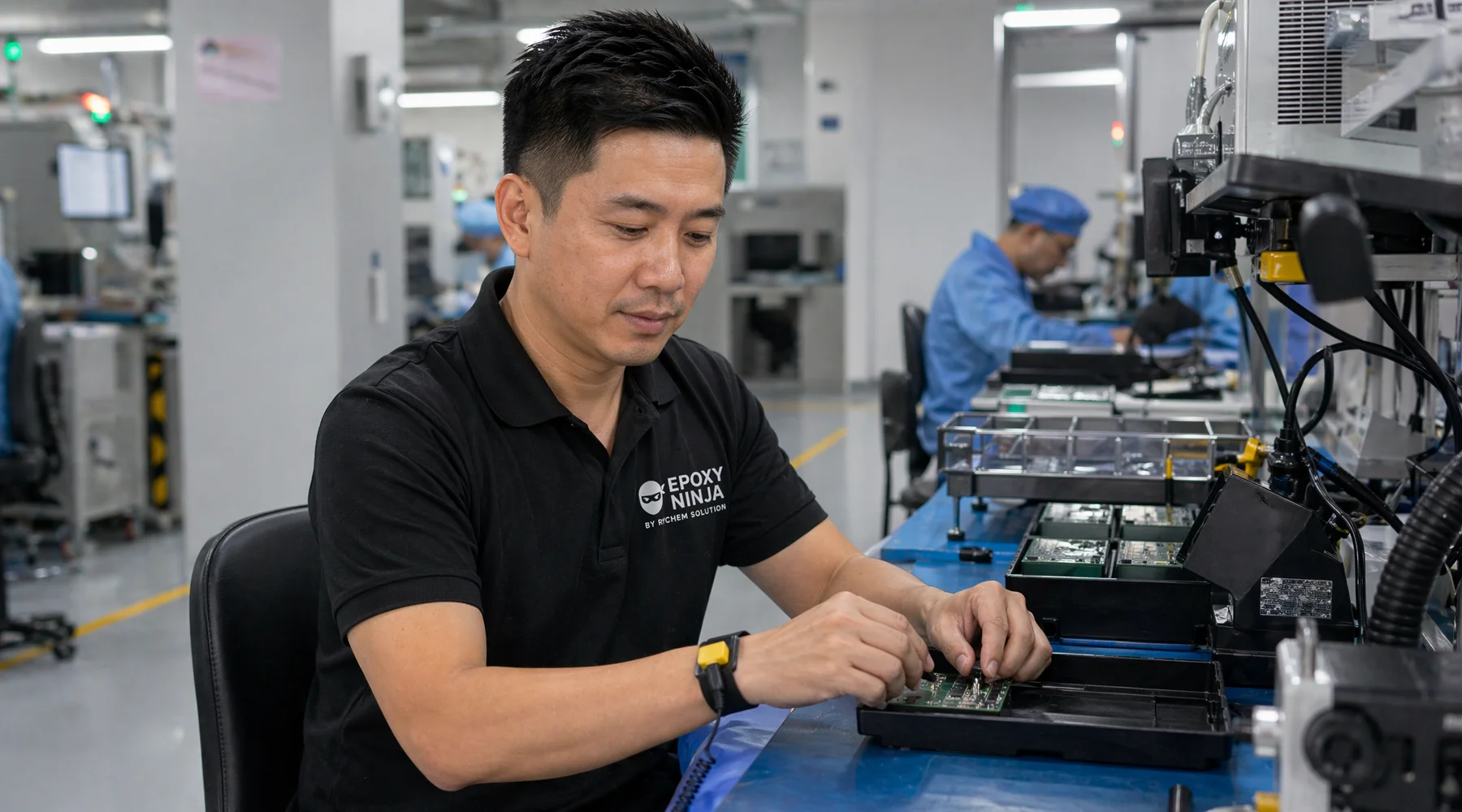
The short answer
Many facility managers in Malaysia assume any floor that prevents shocks is doing its job. That assumption often changes after a costly compliance failure or sudden equipment damage.
We see this confusion regularly on the ground.
A single 100-volt electrostatic discharge event can instantly destroy a semiconductor die worth RM50, highlighting why getting the terminology right matters. As the team at Epoxy Ninja Johor Bahru, our mission is building industrial environments that actively protect your high-value assets.
To skip the theory and jump straight to installation details, you can review our ESD flooring service. Let’s look at the data, clarify the standards, and outline practical ways to meet your facility requirements.
What this guide covers
Understanding the difference between static-dissipative and conductive systems is the foundation of any facility upgrade. The Malaysian standard, MS IEC 61340-5-1, provides the specific technical thresholds your operation must meet to pass multinational audits.
We will cover these specific resistance bands and explain how to apply them. Grounding design, industry requirements, and the difference between true ESD protection and basic anti-static materials round out the key topics.
Static-dissipative vs conductive, resistance bands (10⁶-10⁹ Ω)
For industrial facilities in Johor and across Malaysia, the practical guidance is to start with a moisture scan, walk the process zones, and let the conditions dictate the system instead of a product brochure. We walk through this critical step on every site visit because substrate moisture ruins conductive adhesives. What you decide during this phase dictates 60 to 80 percent of your floor’s actual service life. Setting up the right resistance level prevents both safety hazards and equipment damage.
The MS IEC 61340-5-1 standard clearly separates these two categories based on how fast they move an electrical charge to the ground. Our engineers use these exact bands to determine the appropriate material for your specific production zone. Selecting the wrong category can either cause a dangerous shock hazard or fail to protect sensitive electronics.
| Flooring Category | Resistance Band (Ohms) | Discharge Speed | Best For |
|---|---|---|---|
| Conductive | Under 1×10⁶ Ω | Fast | Explosive handling, volatile fluid areas |
| Static-Dissipative | 1×10⁶ to 1×10⁹ Ω | Controlled, gradual | Electronics manufacturing, cleanrooms |
Grounding design
For industrial facilities in Johor and across Malaysia, the practical guidance is to start with a moisture scan, walk the process zones, and let the conditions dictate the system instead of the brochure. Our installation process guarantees every square meter of your facility connects safely to an earth ground. Proper grounding is the invisible backbone that makes electrostatic discharge protection actually work.
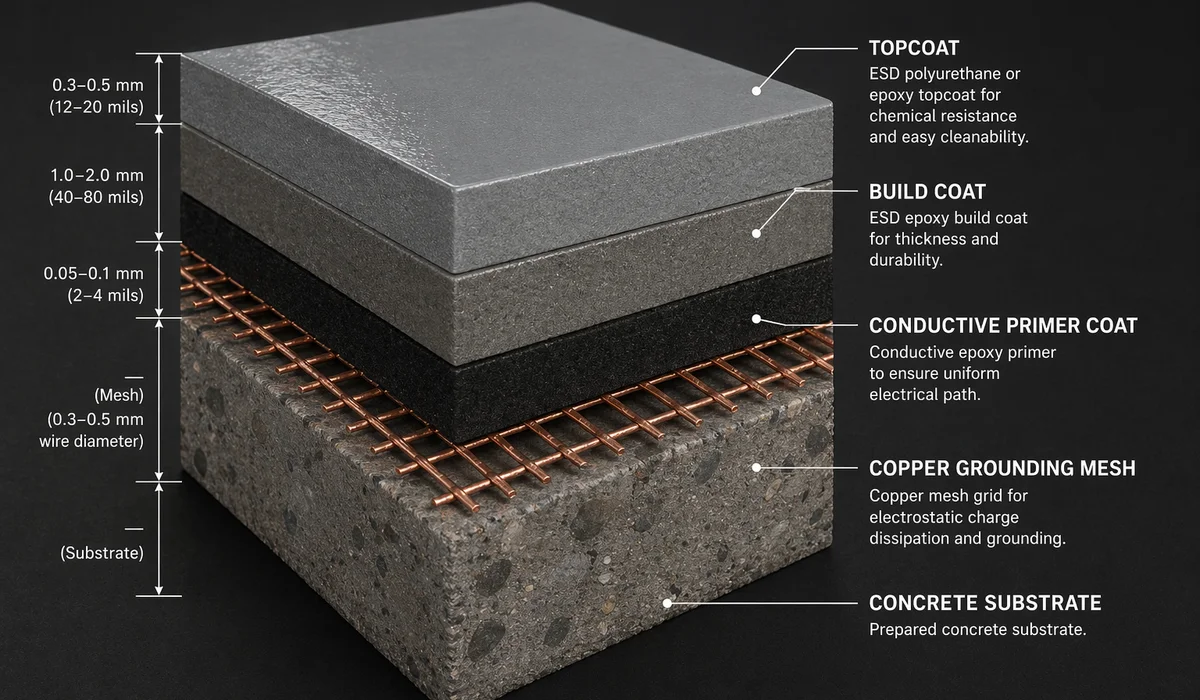
A fully compliant system requires multiple integrated layers to move static electricity safely. We install these specific components to ensure your facility passes IEC 61340-5-1 certification audits. Missing even one of these connection points renders the entire surface useless.
- Conductive adhesive: This specialized glue bonds the floor covering to the subfloor while maintaining an electrical pathway.
- Copper grounding grid: We lay a network of highly conductive copper tape under the buildcoat. This grid collects charges from the entire surface area.
- Earth bonding points: The copper grid connects directly to the facility’s verified earth bonding network. This connection ensures the charge reaches the earth in milliseconds at a safe, controlled rate.
Industries that need it
For industrial facilities in Johor and across Malaysia, the practical guidance is to start with a moisture scan, walk the process zones, and let the conditions dictate the system instead of a product brochure. Our local economy relies heavily on high-value manufacturing, which increases the demand for strict environmental controls. Malaysia’s New Industrial Master Plan 2030 targets a manufacturing GDP contribution of RM587.5 billion. We help facility managers protect that massive investment by installing floors that prevent catastrophic static events.
Specific sectors require strict electrostatic control to maintain yield rates and worker safety. Our clients in these fields cannot afford the downtime caused by a non-compliant environment.
- Semiconductor Fabrication: A tiny static shock can instantly melt microscopic circuitry. Static-dissipative floors (1×10⁶ to 1×10⁹ Ω) are required to prevent ruining expensive wafers.
- EMS (Electronics Manufacturing Services): Contract manufacturers assembling printed circuit boards must prove their static control measures to multinational clients. We provide the certification documentation they need to pass these strict audits.
- Pharma and Medical Labs: Sensitive laboratory weighing equipment and testing devices will produce false readings if exposed to stray static charges.
- Explosive Handling: Chemical plants and munitions factories face severe fire risks from simple static sparks. Highly conductive floors (under 1×10⁶ Ω) instantly bleed away any electrical charge before it arcs.
How ESD flooring differs from anti-static carpet/mats
For industrial facilities in Johor and across Malaysia, the practical guidance is to start with a moisture scan, walk the process zones, and let the conditions dictate the system rather than relying on a brochure. We explain this distinction on every site visit because confusing the two terms often leads to failed compliance audits. What you decide here drives 60 to 80 percent of your floor’s actual service life and protective capability. Many people mistakenly use “anti-static” and “electrostatic discharge” as interchangeable terms. Our goal is to clarify exactly what each system actually does.
An anti-static carpet or mat only prevents the generation of new static electricity when a person walks across it. It does not possess a copper grounding grid to pull an existing charge away from a worker or piece of equipment.
| Feature | Anti-Static Mats/Carpet | True ESD Flooring System |
|---|---|---|
| Primary Function | Reduces static generation from walking | Actively pulls and grounds existing static charges |
| Grounding Network | None | Integrated copper grid connected to earth |
| Standard Test | EN 1815 Walk Test (Must be below 2kV) | MS IEC 61340-5-1 (Resistance-to-ground) |
| Best Application | Basic commercial offices, low-risk areas | Cleanrooms, electronics assembly, volatile areas |
For a closer look at related considerations, read our ESD Flooring Testing and Compliance Ratings guide.
What to do next
If you are weighing this flooring decision for your facility, the fastest next step is scheduling a free site visit. We bring a Tramex CMEX5 moisture meter to test your substrate and document your specific chemical and thermal exposure limits.
Getting accurate baseline data is the only way to ensure your new grounding system will perform reliably for years. Our technicians then hand you a written bill of quantities with honest, transparent cost paths.
There is absolutely no obligation, and we offer same-day response across JB, Pasir Gudang, Skudai, Senai, and Iskandar Puteri. You can find more technical details and exact specifications online.
Our ESD / Anti-Static Flooring service page covers the system spec in detail to help you make an informed choice. Contact us today to secure your facility.
Fast answers.
What's the difference between ESD and anti-static?
Anti-static prevents static build-up; ESD (electrostatic discharge) flooring actively dissipates static to ground via copper mesh. Different resistance bands and standards.
Do I need ESD flooring in my warehouse?
Only if you handle static-sensitive devices (semiconductors, PCBs, explosives). Standard warehouses don't need it.
Can standard epoxy be 'made' ESD?
No — ESD requires conductive/dissipative resins plus a grounding mesh engineered in from substrate up. Retrofitting paint doesn't work.
More in this cluster.
ESD Flooring for Semiconductor and Electronics Factories in Malaysia
ESD-compliant flooring for semiconductor, EMS, and SMT facilities in Senai and Iskandar Puteri. Cleanroom ISO-compatible systems.
ESD Flooring Testing, Compliance Ratings, and Handover Verification
Point-to-point, point-to-ground resistance testing, humidity dependence, periodic re-testing. What to expect at ESD floor handover.
Ready for a real assessment? Free Tramex scan.
Guides are the general case. A site visit gives you the specific answer for your slab, your chemicals, and your operational conditions.