
ESD Testing, Compliance Ratings & Verification
Point-to-point, point-to-ground resistance testing, humidity dependence, periodic re-testing. What to expect at ESD floor handover.
The short answer
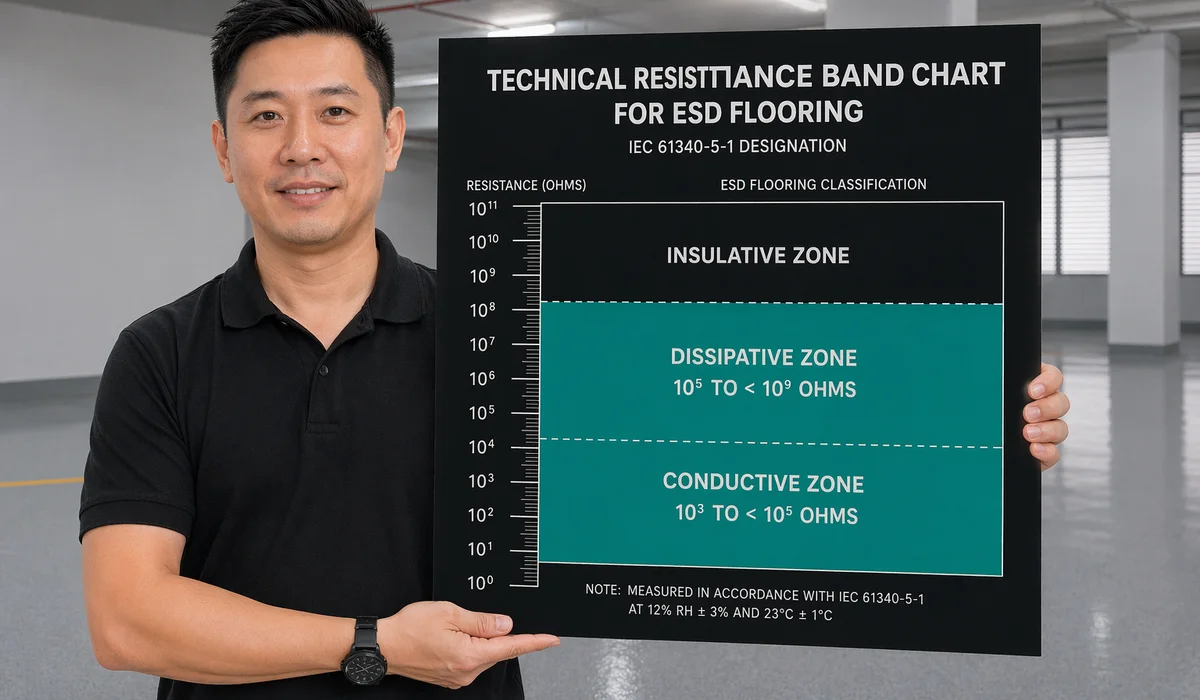
A successful handover requires test reports proving the floor meets ANSI/ESD S20.20 or IEC 61340-5-1 resistance limits. These acceptable ranges usually fall between 1.0 x 10⁶ and 1.0 x 10⁹ ohms.
We set these clear expectations early to surface common sources of test disputes.
Handling these compliance hurdles is a core part of our ESD flooring service. Let’s review the exact data, what it actually tells us, and how you can achieve proper esd flooring testing verification.
What this guide covers
This guide breaks down the specific testing metrics you need for a verified handover. We will walk through the difference between point-to-point and point-to-ground measurements.
You will also see how local weather conditions impact your final readings.
Here is a quick breakdown of the core topics:
- Standard resistance testing methods.
- The impact of relative humidity on test accuracy.
- Official pass and fail thresholds.
- Required re-testing schedules.
Point-to-point and point-to-ground resistance tests
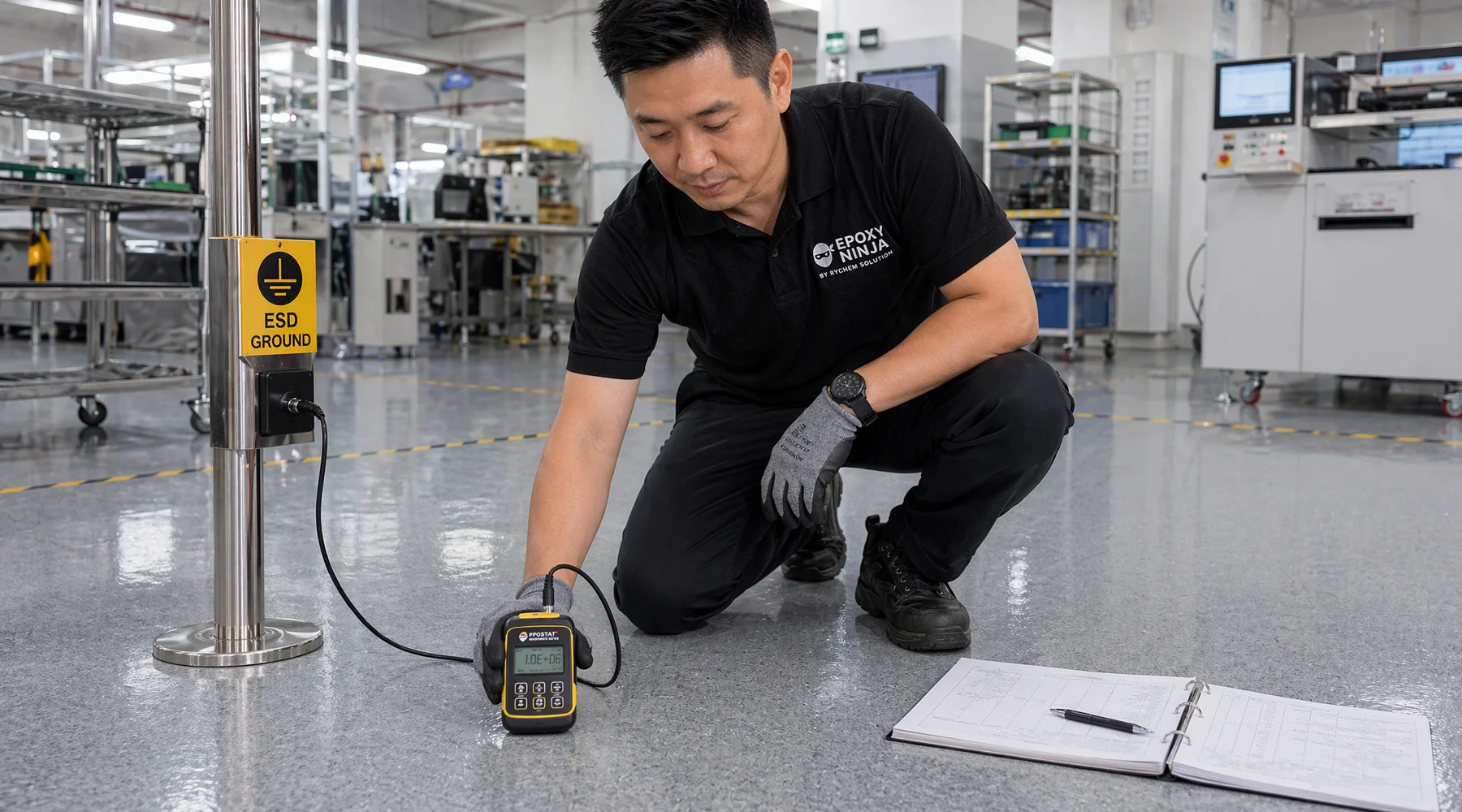
Point-to-ground (Rtg) tests ensure static flows safely into the earth, while point-to-point (Rtt) tests verify the floor has no electrical dead spots. We perform both of these evaluations to guarantee your surface meets international safety standards.
The auditor places two 5-pound weighted electrodes exactly 36 inches apart on the floor to measure the Rtt. This proves the static control works evenly across the entire room.
Two main resistance checks are mandatory:
- Rtt (point to point resistance test): Finds dead spots by measuring the surface between two distinct locations.
- Rtg (Point-to-Ground): Confirms the static safely exits the room by checking the path to the earth ground.
Your facility needs specific testing equipment for accurate esd compliance testing. We rely on professional surface resistance meters, like those from Prostat or Megger, to capture precise data.
The meter automatically switches test voltages from 10V to 100V depending on the resistance level. Getting this right drives the actual service life of your floor.
Using proper testing techniques prevents costly disputes during the esd flooring handover. We typically conduct a minimum of five tests per 5,000 square feet of contiguous flooring.
The slab condition and the discipline of the installation team dictate the success of these measurements.
Humidity dependence: why tests can swing with weather
High humidity creates a false sense of security by artificially lowering electrical resistance on budget flooring materials. We see many facilities fail audits because their aggressive HVAC systems drop the indoor Relative Humidity (RH) to 40% or lower. The dry air quickly turns a naturally safe floor into a dangerous insulator.
Local Malaysian factories often average around 60% to 80% RH outdoors. We know that standard air conditioning strips this moisture away, which alters how your floor behaves. Many basic dissipative mats rely on ambient moisture to function properly.
To prevent sudden failures, certification boards updated their testing protocols. We test all materials at the lowest annual humidity the facility experiences. The ANSI/ESD S20.20 standard strictly requires product qualification at 12% ± 3% RH.
Common humidity-related pitfalls include:
- The AC Paradox: Strong climate control dries out the air and spikes floor resistance.
- Material Drift: Cheaper static control floors stop working when the weather gets dry.
- Testing Errors: Taking measurements on a rainy day hides poor grounding connections.
Pass/fail thresholds per IEC 61340-5-1
To pass official compliance in Malaysia, your floor system must measure under 1.0 x 10⁹ ohms. We use this specific threshold to verify that static electricity dissipates safely before it can damage sensitive micro-electronics.
The decision here directly impacts your daily operational safety. Different work environments require different resistance categories.
We categorise floors into two primary pass zones based on their speed of charge dissipation.
| Flooring Category | Resistance Range | Best Application |
|---|---|---|
| Conductive Flooring | 1.0 x 10⁴ to 1.0 x 10⁶ ohms | Munitions, flammable chemical storage, aerospace |
| Dissipative Flooring | 1.0 x 10⁶ to 1.0 x 10⁹ ohms | Standard electronics assembly, commercial kitchens |
You must also consider the entire grounding system, including employee footwear. We test the person-footwear-flooring combination to ensure the peak body voltage remains below 100 volts.
If workers wear thick rubber-soled boots, the static stays trapped on their bodies regardless of the floor’s quality.
Periodic re-testing cadence (annual typical)
You must re-test your static control flooring at least once every 12 months to maintain certification. We recommend this annual cadence to catch slow deterioration before it causes a catastrophic component failure. Chemical exposure and heavy foot traffic naturally degrade the conductive properties over time.
A passing grade on day one does not guarantee permanent compliance. We find that improper cleaning routines frequently ruin perfectly good floors. Dirt accumulation and harsh detergents act as insulators that block the conductive network.
To keep your floor passing audits year after year, follow these basic maintenance steps:
- Avoid using standard floor waxes that leave an insulating film.
- Clean up chemical spills immediately to protect the epoxy surface.
- Use designated ESD-safe cleaning solutions.
- Schedule a mid-year spot check using a basic surface resistance meter.
For a closer look at related considerations, read our What Is ESD Flooring and When Do You Need It guide.
What to do next
If you are weighing this decision for your facility, the fastest next step is a free site visit. We bring a Tramex CMEX5 moisture meter, walk the substrate, document the chemical and thermal exposure, and hand you a written BQ with the honest cost paths.
There is no obligation, and you get a same-day response across JB, Pasir Gudang, Skudai, Senai, and Iskandar Puteri.
Our ESD / Anti-Static Flooring service page covers the system spec in detail.
Fast answers.
My ESD floor passed at handover — why might it fail re-testing a year later?
Usually humidity or topcoat wear. Conductive paths degrade with abrasion; annual re-test and planned recoating keep you compliant.
What happens if one test point fails?
We investigate: grounding strap, cleaning residue, local moisture. Most localized failures are fixed by cleaning or a recoat.
Is post-install cleaning required before testing?
Yes — cleaning agent residue can skew conductivity readings. Standard practice is neutral pH cleaning and dry before QA tests.
More in this cluster.
ESD Flooring for Semiconductor and Electronics Factories in Malaysia
ESD-compliant flooring for semiconductor, EMS, and SMT facilities in Senai and Iskandar Puteri. Cleanroom ISO-compatible systems.
What Is ESD Flooring and When Do You Need It?
ESD flooring explained — static-dissipative vs conductive, resistance bands, grounding, and which industries actually need it.
Ready for a real assessment? Free Tramex scan.
Guides are the general case. A site visit gives you the specific answer for your slab, your chemicals, and your operational conditions.