
ESD Flooring for Semiconductor & Electronics Factories
ESD-compliant flooring for semiconductor, EMS, and SMT facilities in Senai and Iskandar Puteri. Cleanroom ISO-compatible systems.
The short answer for esd flooring semiconductor factory malaysia
You already know that controlling static in a high-volume manufacturing environment is a constant battle against friction and humidity. When evaluating esd flooring semiconductor factory malaysia, finding the exact right setup demands looking past the marketing materials and focusing purely on resistance data.
We consistently find that electronics manufacturing services in Senai and Iskandar Puteri require static dissipative systems measuring between 1 million and 1 billion ohms. This precise electrical resistance range safely drains static charges away from sensitive components without causing a dangerous electrical spike.
Keeping walking body voltage strictly under the 100-volt limit is the primary goal. Our team at Epoxy Ninja Johor Bahru documents these specific requirements extensively on our ESD flooring service page. Let us look at the exact standards, what the data actually tells us, and how to verify the installation works.
What this guide covers
Protecting delicate microchips requires a clear plan based on verifiable testing data. The primary concept to grasp first is the global semiconductor ESD handling standard, officially known as ANSI/ESD S20.20-2021. We structured the following breakdown to show how this standard translates into daily factory operations across Malaysia.
You will find practical data regarding these core areas:
- Managing surface resistance limits for Surface Mount Technology setups.
- Controlling outgassing and particle shedding in ISO Class 5 to 8 cleanrooms.
- Executing proper point-to-ground testing using heavy 5-pound electrode probes.
This information gives facility managers the exact metrics needed to make an informed, cost-effective decision.
Semiconductor ESD handling standards (ANSI/ESD S20.20)
Our initial process for industrial facilities in Johor always starts with a thorough concrete moisture scan. The actual chemical and thermal conditions on your slab must dictate the final resin system, rather than a flashy sales brochure. The current ANSI/ESD S20.20 standard strictly requires that total electrical resistance falls below 1x10^9 ohms.
We focus heavily on verifying walking body voltage limits during every site assessment. A compliant surface must prevent personnel from generating static charges greater than 100 volts while walking or moving carts. Getting these calculations right during the planning phase dictates the majority of the floor’s actual service life.
Our clients often ask for a clear explanation of the difference between conductive and dissipative ranges. Here is a quick comparison showing how surface resistance levels dictate the industrial application:
| Flooring Type | Resistance Range (Ohms) | Typical Malaysian Application |
|---|---|---|
| Conductive | Less than 1x10^6 | Explosives handling, rapid discharge zones |
| Static Dissipative | 1x10^6 to 1x10^9 | EMS factories, PCB assembly lines |
| Standard Epoxy | Greater than 1x10^10 | General warehousing, non-sensitive areas |
Choosing the dissipative range prevents electricity from energized production equipment from flowing too quickly and shocking an operator.
MRB (manufacturing rework board) and SMT line floor requirements
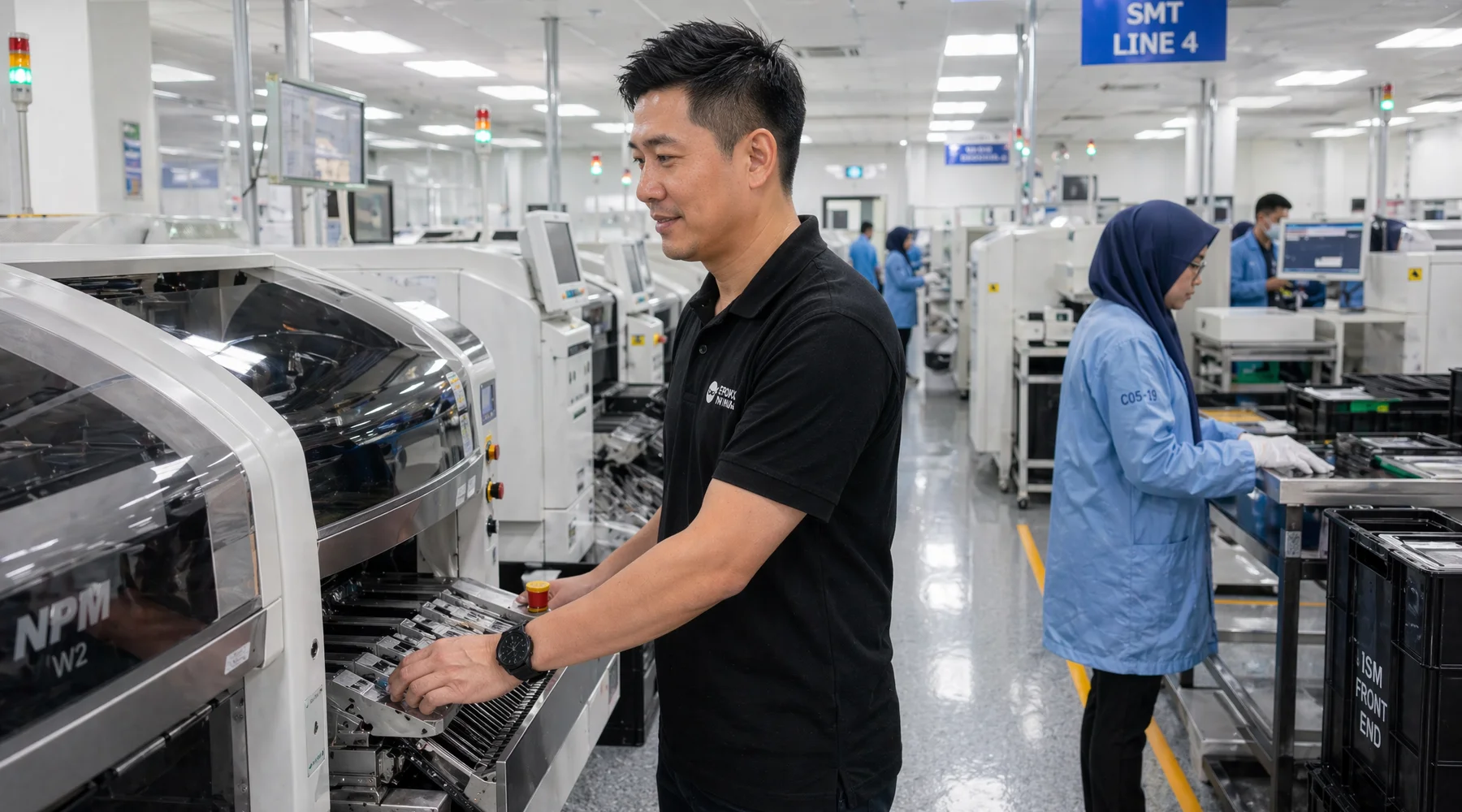
Surface Mount Technology lines and MRB zones require precise static control because automated handlers generate massive tribocharging friction. A proper smt floor esd setup constantly drains this built-up charge safely away from the exposed circuit boards. We highly recommend pairing static dissipative epoxy with continuous grounding monitors in these high-risk areas.
The friction generated by a standard robotic conveyor belt easily produces thousands of volts if left completely ungrounded. Our typical ems factory floor installations utilize specialized carbon-infused underlayments to provide an uninterrupted path to the earth ground.
Modern semiconductor components often suffer permanent damage from an electrostatic discharge as low as 5 to 10 volts.
A common pitfall in Malaysian facilities is relying solely on the grounded surface without enforcing proper footwear protocols. The protective system only functions correctly when personnel wear certified antistatic shoes or heel grounders that make direct physical contact with the floor.
Cleanroom ISO class compatibility (Class 5-8 typical)
Cleanrooms designated as ISO Class 5 through 8 demand flooring that strictly limits both particle shedding and volatile organic compound outgassing. Electronics manufacturers must prioritize materials that meet the ISO 14644-8 standards for airborne molecular contamination. We consistently specify highly cross-linked polyurethane and epoxy resins for these incredibly sensitive environments.
Traditional vinyl tiles contain hundreds of welded joints that can trap microscopic dust and harbor biological contaminants over time. Facilities like the Texas Instruments plant in Malaysia enforce strict outgassing criteria to protect bare silicon wafers from invisible chemical damage. Our application process focuses on creating a monolithic, pore-free finish that easily passes rigorous cleanability testing.
Facility managers should evaluate three specific factors when approving a cleanroom coating:
- Particle Emission: The cured material must resist shedding dust under heavy cart and foot traffic.
- Chemical Resistance: The surface needs to withstand aggressive daily sanitization protocols using harsh disinfectants.
- Static Control: The finish must maintain electrical conductivity internally without relying on topical waxes that degrade indoor air quality.
Avoiding porous materials drastically reduces the time your maintenance crew spends on daily decontamination routines.
Handover point-to-point and point-to-ground testing
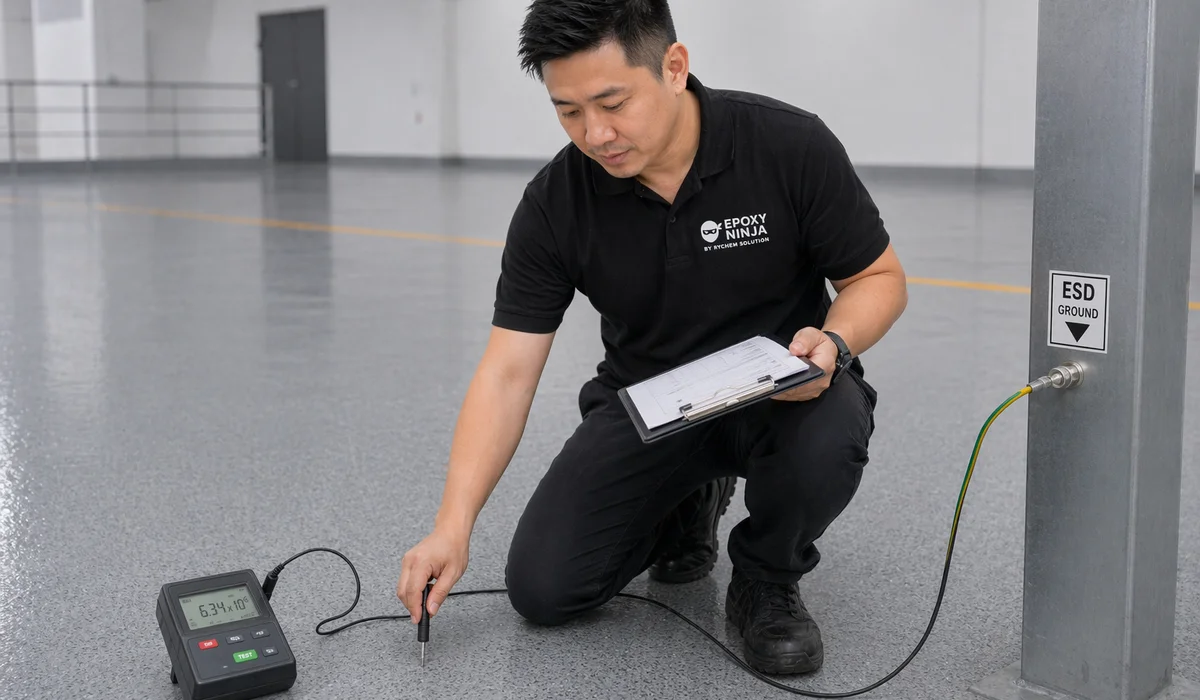
Validating a new installation requires measuring the electrical resistance across the finished surface using standardized testing equipment. The global industry procedure, ANSI/ESD STM 7.1, dictates exactly how these critical measurements happen. We conduct rigorous post-installation testing using calibrated digital meters, such as the Metriso B530, to verify that the semiconductor flooring performs perfectly.
Technicians use heavy, 5-pound electrode probes placed exactly three feet apart to measure point-to-point resistance. They also evaluate point-to-ground resistance by connecting one testing probe directly to the facility’s main grounding grid. Our standard handover documentation always includes a detailed map of these precise test locations across your production zones.
| Test Method | Target Measurement | Primary Purpose |
|---|---|---|
| Point-to-Point (RTT) | 1x10^6 to 1x10^9 ohms | Checks electrical resistance across the floor surface |
| Point-to-Ground (RTG) | Less than 1x10^9 ohms | Verifies the solid connection to the earth ground |
| Walking Body Voltage | Under 100 volts | Measures the actual charge generated by a walking person |
Applying 100 volts of electricity through the probes reveals the true dissipative capacity of the room under load. Manufacturing plants must schedule these detailed audits quarterly to confirm the surface maintains its protective properties. Keeping the surface clean from insulative dirt remains the easiest way to pass these recurring compliance checks.
For a closer look at related considerations, read our ESD Flooring Testing, Compliance Ratings, and Handover Verification guide.
What to do next
Deciding on the proper chemical and thermal exposure limits for a manufacturing plant requires precise, on-site data collection. The fastest next step to resolving your static control issues is scheduling a free site visit to assess your specific concrete substrate. We bring a Tramex CMEX5 moisture meter to document the exact floor conditions and hand you a written BQ with honest cost paths.
There is zero obligation for this initial technical consultation. Same-day response times are currently available across JB, Pasir Gudang, Skudai, Senai, and Iskandar Puteri. Our comprehensive ESD / Anti-Static Flooring service page covers the technical system specifications in complete detail.
This methodical approach guarantees your esd flooring semiconductor factory malaysia project meets every critical international standard.
Fast answers.
Do all semiconductor cleanrooms need ESD flooring?
Yes — ESD is table stakes for wafer, SMT, and rework areas. Back-end packaging and test sometimes relaxes to dissipative only.
What's the downtime for retrofitting ESD flooring?
Depends on phasing — typical 1,000 sqm cleanroom retrofit runs 10-14 days with proper zoning to keep adjacent lines running.
Can ESD coexist with cleanroom ISO class requirements?
Yes — we select resins and aggregates compatible with ISO Class 5-8. Confirm the cleanroom spec before resin selection.
More in this cluster.
ESD Flooring Testing, Compliance Ratings, and Handover Verification
Point-to-point, point-to-ground resistance testing, humidity dependence, periodic re-testing. What to expect at ESD floor handover.
What Is ESD Flooring and When Do You Need It?
ESD flooring explained — static-dissipative vs conductive, resistance bands, grounding, and which industries actually need it.
Ready for a real assessment? Free Tramex scan.
Guides are the general case. A site visit gives you the specific answer for your slab, your chemicals, and your operational conditions.