
Slip Resistance Ratings R9-R13 Explained
DIN 51130 R-ratings demystified — what R9 through R13 actually mean, test method, and which process type needs which rating.
The short answer
The DIN 51130 slip rating classifies flooring slip resistance on a scale from R9 to R13 based on a physical ramp test.
We use this German testing standard to determine the exact surface texture required for industrial environments across Malaysia.
Factory managers need this scale to balance strict workplace safety requirements with daily hygiene standards.
For our anti-slip flooring service, see our anti-slip flooring service.
What this guide covers
This support guide breaks down the exact definitions of the r9 r10 r11 r12 r13 slip rating flooring scale.
Our team at Epoxy Ninja Johor Bahru compiled this resource to help facility managers confidently specify floor textures without guesswork.
Choosing the correct r rating flooring meaning stops workplace accidents and ensures full compliance with occupational safety audits.
You will learn the specific testing methodology, exact industrial use cases for each rating, and the crucial maintenance trade-offs involved.
DIN 51130 ramp-test methodology
Testing facilities determine DIN 51130 slip ratings by placing a human tester on an adjustable ramp covered in motor oil.
We always explain this physical testing process because it highlights how rigorous the standard truly is.
The subject wears specific heavy-duty safety boots while walking back and forth. Technicians slowly increase the angle of the ramp until the tester literally slips and loses traction.
That specific angle of slip dictates the final R rating category.
The official test utilizes three very specific control parameters.
- Testing fluid: 10W-30 engine oil to simulate severe industrial contamination.
- Footwear: Standardised safety boots featuring a distinct cleat pattern.
- Acceptance angle: The specific degree of incline where foot traction completely fails.
Our field engineers rely on these exact slip resistance test measurements when assessing food and beverage plants in Johor.
Proper data prevents costly specification errors on the factory floor.
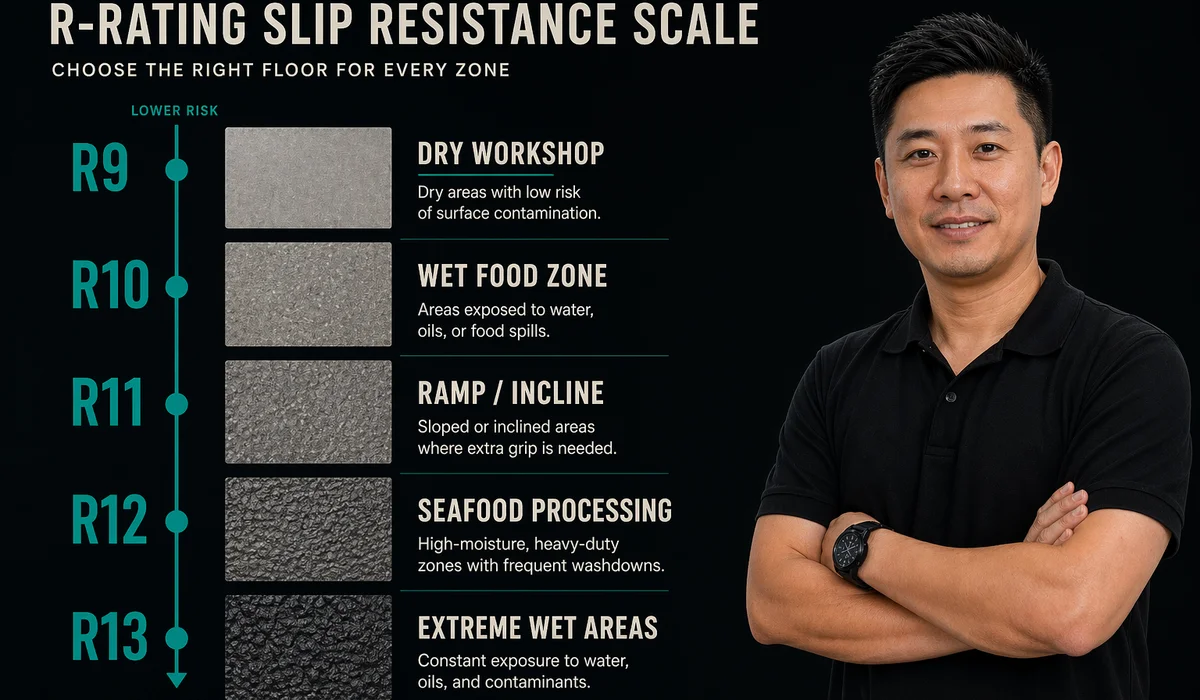
R-rating ranges and what each permits (R9 dry office, R13 heavy wet processing)
Each rating on the R9 to R13 scale corresponds to a specific range of ramp angles and approved industrial uses.
We rely on these classifications to match the correct epoxy texture to your specific process zones.
A simple dry assembly line requires a completely different profile than a wet poultry processing room.
| Slip Rating | Acceptance Angle | Typical Industrial Application |
|---|---|---|
| R9 | 6 to 10 degrees | Lobbies, dry storage, office areas, reception zones |
| R10 | 10 to 19 degrees | Staff washrooms, light assembly, small dry kitchens |
| R11 | 19 to 27 degrees | Commercial kitchens, wet packaging, automotive bays |
| R12 | 27 to 35 degrees | Dairy processing, cold rooms, heavy industrial manufacturing |
| R13 | Over 35 degrees | Slaughterhouses, deep-fat frying zones, heavy oil rendering |
The highest rating is not automatically the best choice for every room in your facility.
Facility owners must carefully match the texture to the specific daily operations happening in that localized space.
Our application teams customize the aggregate broadcast to hit these specific angles accurately.
Getting this correct drives 60-80% of your floor’s actual service life.
Wet vs dry test distinction
The DIN 51130 standard specifically tests slip resistance in oily, contaminated conditions rather than just clean water.
We see many buyers confuse this industrial standard with barefoot wet tests like DIN 51097.
Industrial floors in Malaysia rarely deal with isolated clean water spills. Manufacturing zones constantly face mixtures of grease, harsh chemical washdowns, and heavy forklift traffic.
Our specification process ensures your chosen rating holds up during your worst-case production days.
Relying on a simple dry friction test is highly dangerous for a commercial kitchen or manufacturing plant. The oil-ramp method scientifically proves how a surface performs when things get messy.
We look at three main contamination factors before finalizing a rating.
- Animal fats and oils: Highly common in poultry and meat processing facilities.
- Synthetic lubricants: Frequent in heavy manufacturing and metal stamping plants.
- Chemical washdowns: Daily occurrences in breweries and large dairy facilities.
Tradeoff with cleanability (higher R = more aggressive texture = harder to clean)
Choosing a higher R rating creates a more aggressive surface texture that demands specialized mechanical cleaning methods.
We constantly remind food processing managers about this crucial daily maintenance balance.
An R13 floor provides extreme grip for safety boots, but a standard cotton mop will literally shred to pieces on it within minutes. You have to clean heavily textured surfaces using commercial pressure washers or heavy-duty scrubber dryers.
- R9 to R10: Easily cleaned with standard mops and basic walk-behind floor scrubbers.
- R11: Requires stiffer brush attachments and industrial-strength degreasers.
- R12 to R13: Demands high-pressure hot washing or specialized rotary scrubbers.
Sacrificing hygiene for excessive traction often violates local food safety standards.
Our primary goal is finding the exact sweet spot where your floor is safe to walk on and practical to wash down daily.
This requires balancing the safety officer’s demands with the sanitation crew’s capabilities.
For a closer look at related considerations, read our Anti-Slip Flooring for Wet Processing and Washdown Areas guide.
What to do next
The most effective way to finalise your slip resistance specification is a comprehensive site assessment.
If you are weighing this decision for your facility, the fastest next step is a free site visit.
We bring a Tramex CMEX5 moisture meter, walk the substrate, document the chemical and thermal exposure, and hand you a written BQ with the honest cost paths.
Getting the specification right prevents costly plant shutdowns and safety compliance failures.
No obligation, same-day response across JB, Pasir Gudang, Skudai, Senai, and Iskandar Puteri.
Our Anti-Slip Flooring (Wet Process Areas) service page covers the system spec in detail.
Fast answers.
What R-rating does my kitchen need?
Typically R11 for prep zones, R12 behind cooking lines. Your local EHS or audit scheme may push higher.
Is higher R-rating always better?
No — higher rating = rougher surface = harder to clean. Over-speccing leads to hygiene findings at the other end of the audit.
How is R-rating verified post-install?
By certified ramp test at the manufacturer or third-party lab. We provide the certification document with the system data sheet.
Ready for a real assessment? Free Tramex scan.
Guides are the general case. A site visit gives you the specific answer for your slab, your chemicals, and your operational conditions.