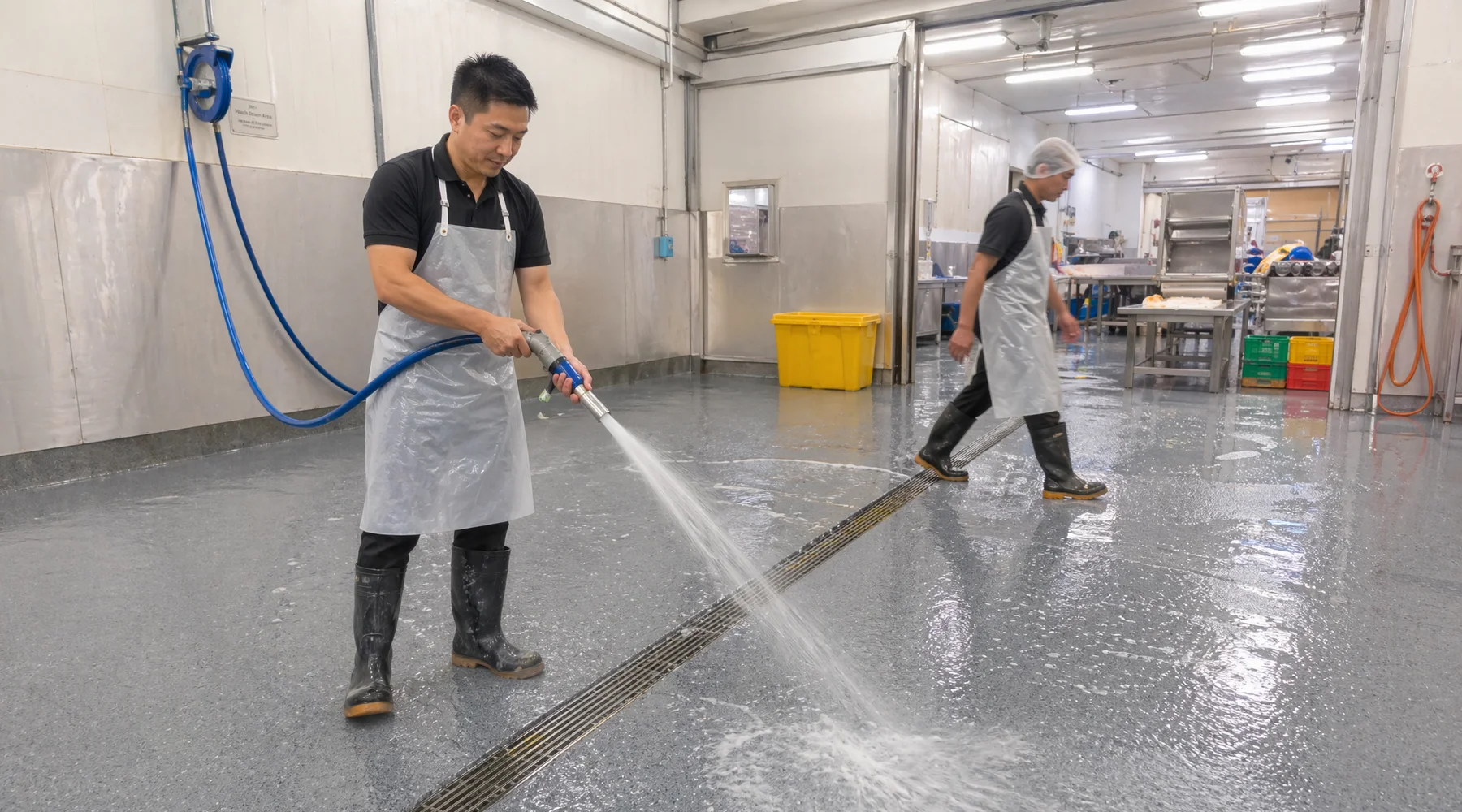
R-Rated Anti-Slip Floors for Washdown, Wet Processing, and Outdoor Ramps
R9-R13 slip-rated anti-slip flooring engineered for wet processing, washdown areas, and safety-compliant outdoor ramps.
Wet-process floors and outdoor ramps need measurable slip resistance, not paint with grit sprinkled on top. We install PU and epoxy anti-slip systems with graded aggregate selection, slip ratings from R9 to R13 (DIN 51130), and cleanability tradeoff balancing so your floor stays compliant AND washdown-friendly.
Have you ever watched an employee slip and nearly fall on a wet production floor?
At Epoxy Ninja Johor Bahru, we know how stressful it is to manage a busy facility while worrying about safety. In Malaysia alone, the Department of Statistics recorded over 38,000 occupational injuries recently, and slips are a major culprit.
A slippery floor is a hidden danger waiting to cause a costly accident.
Grab a cup of coffee, and let’s go through how to fix this the right way. We will show you exactly what works for anti-slip flooring in wet process areas.
Slip resistance is a specification, not a scatter of grit
A common failure pattern we see involves a well-meaning contractor applying a standard epoxy topcoat, broadcasting some builders’ sand into the wet surface, and calling it anti-slip. Three months later, most of the aggregate has come loose under washdown pressure. What is left behind is too smooth to be compliant with Department of Occupational Safety and Health (DOSH) safety guidelines.
Our team approaches this entirely differently, because proper anti-slip is a carefully graded-aggregate system matched to a specific slip rating. Here is what a failing floor usually lacks:
- The Right Grit: Cheap silica sand crushes easily, so we upgrade to Mohs hardness 9 aluminum oxide for durability.
- Chemical Matching: The base and topcoat must bond perfectly to lock the grit in place permanently.
- Post-Install Verification: The traction must be tested and confirmed before production resumes.
We install these elements correctly to ensure the floor stays safe and rated through its entire service life, rather than just looking good on day one.
Picking the right R-rating
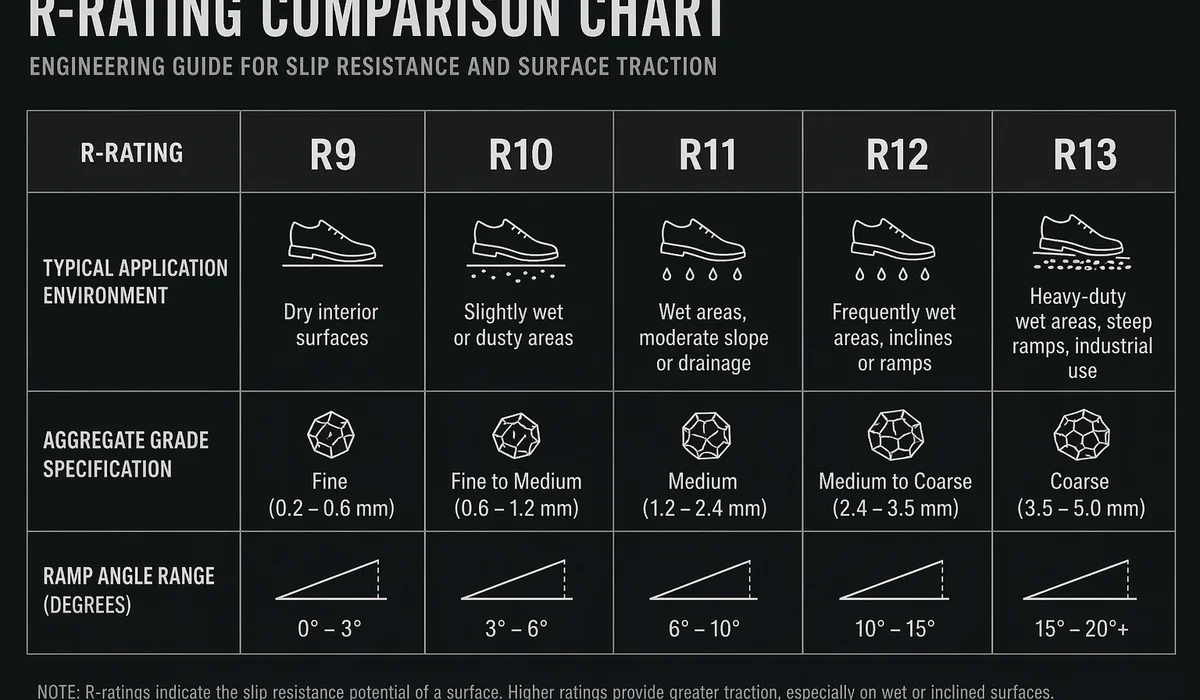
You might have heard of the German DIN 51130 standard, which is the global benchmark for testing slip resistance. During this test, a person wearing cleated work boots walks on a ramp coated with motor oil to determine the exact slipping angle. Each resulting R-band has a fit-for-purpose application.
Here is how each rating fits your specific environment:
- R9: dry admin areas, packaging halls, light commercial.
- R10: general commercial kitchens, dry-to-mixed zones.
- R11: mixed wet-dry processing, most food manufacturing.
- R12: main wet processing like seafood prep, dairy, beverage filling.
- R13: heavy grease environments like poultry processing, rendering, slaughterhouses.
Our clients often think that going straight to the highest rating is the safest bet. Specification is not just “go higher for safety” because too high an R-rating creates a massive problem in zones that cannot sustain deep cleaning.
An R13 floor has deep, aggressive peaks. If you install that in a zone that only gets mopped, the sharp grit will literally shred your mop heads and trap bacteria in the jagged valleys. This creates a hygiene issue that is much worse than the slip risk it was meant to solve.
Aggregate grade selection
Slip rating does not come from a single material. It actually relies on a combination of aggregate particle size, the density of the broadcast, and how well the topcoat seals it all in.
We carefully select the aggregate size based on the specific zone requirements:
- 0.5 to 0.8mm for R10 to R11 mixed zones.
- 0.8 to 1.2mm for R12 wet processing.
- 1.2 to 2.0mm for R13 heavy grease.
The application process calibrates the broadcast density to hit your target rating perfectly. If the broadcast is too thin, the profile quickly disappears under daily hot water washdowns. If it is too thick, your cleaning crew will struggle to sanitize the surface.
A crucial insider trick involves making sure the final lock coat is applied at the exact right thickness. If a contractor applies a polyurethane (PU) or polyaspartic sealer too heavily, it drowns the grit, leaving you with a dangerously slick floor.
Drainage integration
Wet processing floors with poor drainage will collapse any R-rating in practice. Water pooling on a floor completely negates the surface profile and turns your facility into a hazard.
Part of our initial scoping involves physically walking the drainage paths. We look at where water actually flows, check for dead spots where puddles form, and verify if the existing slope matches your process.
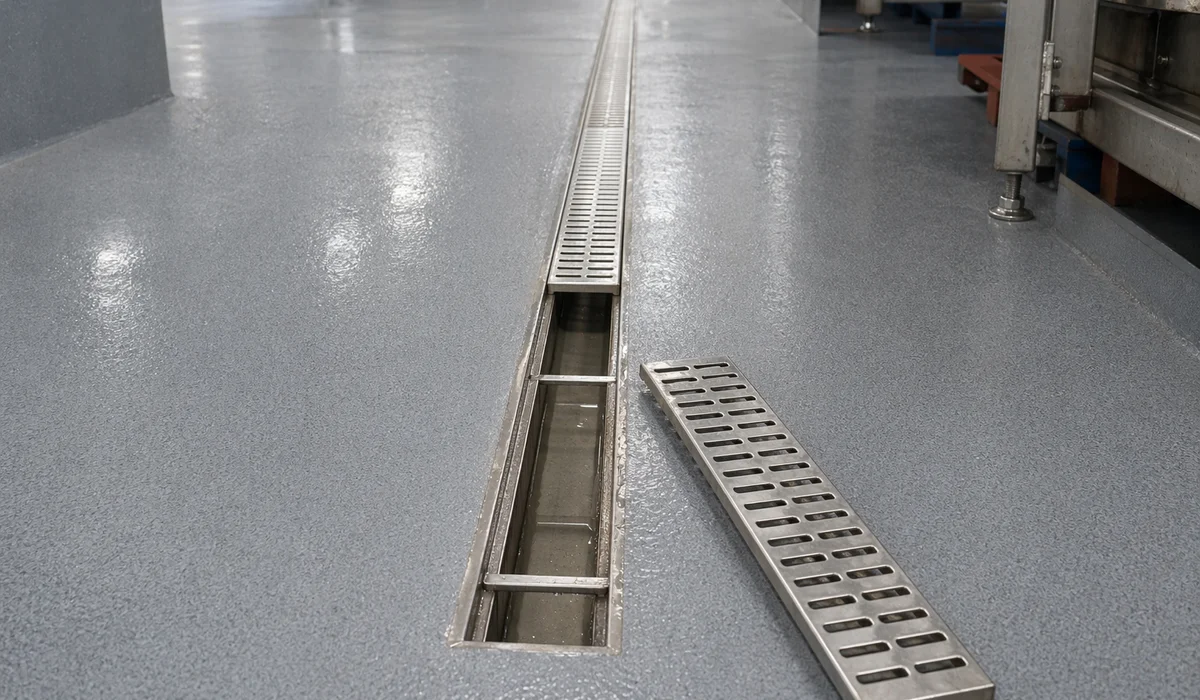
Industry standards dictate that food processing floors need a precise 1% to 2% slope, which is roughly 1/8 to 1/4 inch of drop per foot. If the slope is wrong, we correct it using these essential steps:
- Resloping: We use a high-strength cementitious levelling screed to angle the surface correctly toward the drains.
- Upgrading Systems: Installing additional stainless steel trench drains if the current capacity is too low.
- Keyway Cutting: We create a dedicated anchor trench where the coating meets the metal drain to prevent water from peeling the epoxy up.
This is not optional work if you want a safe, long-lasting environment.
Cost guide
Pricing out a safety upgrade is always a top concern for facility managers. We want to give you a clear, honest look at what these specialized systems cost.
To make things easy to compare, the table below breaks down the typical costs per square foot in Malaysian Ringgit.
| Application Zone | Base Material | R-Rating | Cost (RM/sqft) |
|---|---|---|---|
| Mixed Dry/Wet | Epoxy Base | R10 to R11 | RM 40 to 65 |
| Main Wet Processing | Hygienic PU Base | R12 | RM 70 to 110 |
| Heavy Grease/Blood | Hygienic PU (Washdown Topcoat) | R13 | RM 90 to 130 |
The pricing reflects the premium materials needed to handle aggressive chemical cleaners like sodium hydroxide. You also need to factor in your facility downtime when planning a budget.
While standard epoxy might take 48 to 72 hours to fully cure, a polyurethane concrete system can often handle foot traffic in as little as 12 hours. This speed gets your production lines running again much faster.
If you are ready to fix your slippery floors permanently, contact us today for a free site evaluation. We will help you build a safer, more compliant workspace.
What you're getting.
R9 to R13 DIN 51130 slip ratings
Graded aggregate selection (0.5mm to 2mm) by process zone
PU and epoxy base system options
Washdown-compatible topcoat for F&B and seafood processing
Drainage-slope integration and transition detailing
Real installs. Real factories.
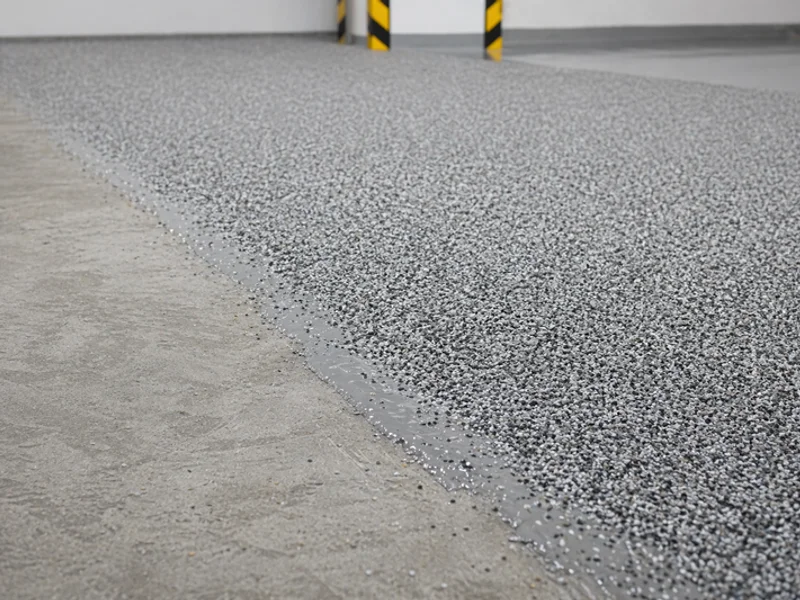
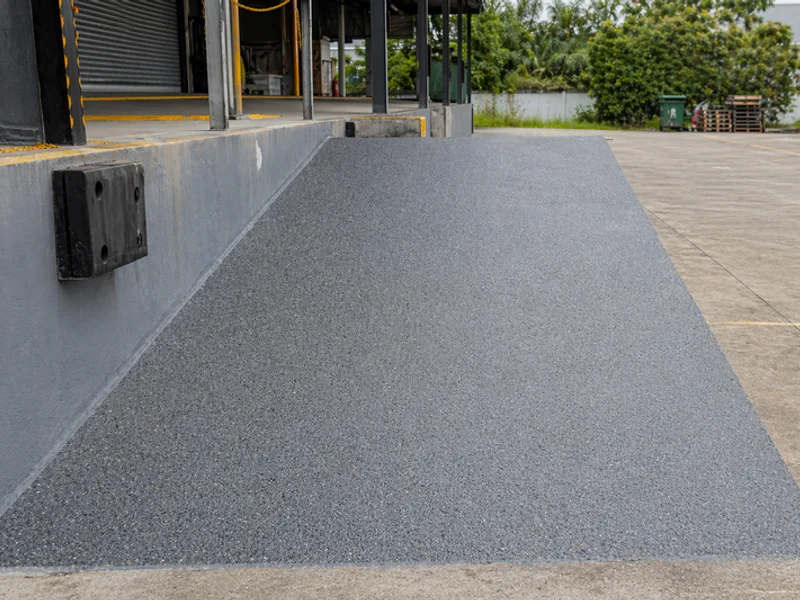


How we install it.
Process-zone mapping
Walk every zone. Document wet/dry, grease level, cleaning chemicals. Each zone gets its own R-rating.
Aggregate grade selection
Select aggregate particle size and density based on R-rating target. Larger for R13, smaller for R10.
Substrate prep
Diamond grinding. Slope correction where drainage integration requires it. Crack routing.
Base system install
PU or epoxy buildcoat poured. Anti-slip aggregate broadcast into wet surface. Excess aggregate swept off.
Washdown-compatible topcoat
Topcoat seals the aggregate in. Cleanable without dislodging the profile. Slip rating verified post-install.
Free site visit. Tramex scan. Written BQ. No obligation.
We walk the slab, run the moisture readings, and give you a written scope before any commitment. Same-day response across Southern Malaysia.
Deeper on the system.
Guides covering the chemistry, cost, and common questions for this system.
Anti-Slip Flooring for Wet Processing and Washdown Areas
R12-R13 anti-slip flooring for F&B, meat, seafood, and chemical washdown facilities. Aggregate retention and drainage integration.
Read guideSlip Resistance Ratings R9 to R13 Explained (DIN 51130)
DIN 51130 R-ratings demystified — what R9 through R13 actually mean, test method, and which process type needs which rating.
Read guideOperators who've worked with us.
5.0★ average from 12 verified Google reviews. No cherry-picking, no edits.
"Superb service by Epoxy Ninja team. Extremely transparent with their work with consistent progress update at all times. It's also worth mentioning that their price point is extremely reasonable for industry standard with quality-finish workmanship. Thank you for the great job well done!"
"We had our flooring done by a company called Epoxy Ninja, and it was an excellent experience. The owner, Michael, who I've known for quite some time, was very attentive to our needs. They listened carefully to what we wanted and worked with great precision. Epoxy Ninja truly delivers high-quality flooring that's durable and impressive. We highly recommend them for any flooring needs!"
"Michael and his team did a great job on my epoxy flooring. They were responsible, professional, and very thorough. The final result looks amazing and high-quality. Highly recommended!"
System questions.
What does the R-rating mean in practice?
R-rating is DIN 51130's measure of slip resistance on an inclined oiled surface. R9 is office-grade. R10 is commercial-grade. R11 is mixed wet/dry. R12 is main food processing and wet manufacturing. R13 is heavy grease (poultry, seafood, rendering). Higher numbers grip harder but are harder to clean.
Do high R-ratings hold grime?
Yes — that's the tradeoff. R13 aggregate has sharper peaks that trap grease and organic matter. You mitigate this with daily high-pressure washdown and periodic deep cleans. We walk through cleaning practicality before recommending rating; sometimes R12 with better drainage beats R13 that never gets properly cleaned.
Can you retrofit anti-slip onto an existing floor?
Yes, with caveats. The existing floor has to be sound and bondable, and the surface profile needs mechanical abrasion (grinding) to accept the new aggregate layer. If the existing coating is failing or delaminating, retrofit just papers over the issue — you'd need proper repair first.
What about outdoor ramps?
Outdoor ramps need UV-stable topcoats in addition to R-rating — standard indoor epoxy chalks and yellows under UV. We spec UV-stable PU topcoats with R11-R12 aggregate for loading-dock ramps, carpark inclines, and exposed exterior areas. Drainage slope integration is critical so water doesn't pool.
Also worth considering.
Food-Grade / HACCP Hygienic Flooring
Seamless hygienic PU systems with integrated coving, built to pass HACCP, GMP, and ISO 22000 audits.
See specPolyurethane (PU) Flooring
Full-depth polyurethane systems engineered for wet, hot, and chemical-heavy industrial environments where epoxy fails.
See specFloor Repair & Moisture Mitigation
Failure diagnosis and remediation for peeling, blistering, and delaminating industrial floors, powered by Tramex moisture mapping.
See specBook a site visit for this system. Tramex included.
Free Tramex moisture scan and a written BQ with no obligation. Same-day response across Southern Malaysia.