
Self-Leveling vs Standard Epoxy Coatings
Thin-film epoxy vs self-leveling — thickness, substrate tolerance, durability, appearance, cost. Which is right for your floor?
The short answer
We regularly see facility managers comparing self leveling vs standard epoxy options for their industrial floors. A standard epoxy coating provides a basic 0.5mm surface shield for light operations.
A true self-leveling system creates a heavy-duty, 3mm gap-free slab.
Our technicians know this thicker application resists constant forklift impact and meets strict Malaysian Department of Occupational Safety and Health guidelines. You can review the exact specifications we use on our self-leveling epoxy service page.
Making the correct choice directly impacts your operational downtime and long-term maintenance costs.
What this guide covers
Our goal is to break down the exact thin film vs self leveling performance differences. You will learn how material volume dictates structural strength.
The following sections compare surface preparation, abrasion resistance, and hygiene standards for food processing plants. We will help you determine which system actually makes financial sense for your specific warehouse or commercial kitchen.
Data from recent 2026 industrial projects in Johor Bahru highlights why making the wrong initial choice leads to expensive floor failures.
Thickness: Self Leveling vs Standard Epoxy
Our team categorises floor protection into two distinct volume classes based on operational needs. Thin-film epoxy acts as a surface paint that sits between 0.3mm and 0.5mm thick. When evaluating self leveling epoxy thickness, the material is applied as a dense liquid that cures into a 2mm to 4mm protective slab.
We apply thin-film layers using basic rollers, creating a non-homogeneous barrier. This thin barrier consists of one primer coat and two topcoats, leaving the concrete vulnerable once scratched. A self-leveling system utilises a thick mortar foundation mixed with quartz sand, achieving a highly homogeneous structure.
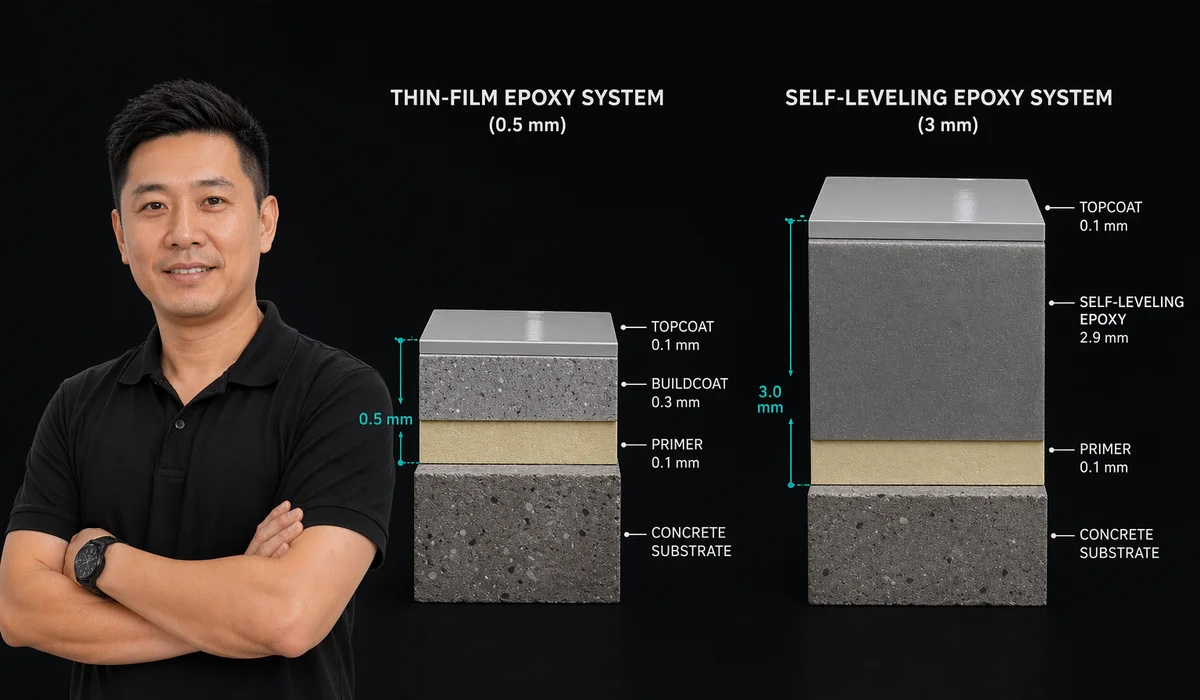
Our 2026 project data shows that homogeneity defines long-term durability. The thicker 3mm layer distributes heavy pallet jack loads evenly across the floor. This prevents the weak spots and micro-voids that often cause thinner films to peel under pressure.
| Feature | Thin-Film Epoxy | Self-Leveling Epoxy |
|---|---|---|
| Typical Thickness | 0.3mm to 0.5mm | 2.0mm to 4.0mm |
| Application Method | Paint roller or brush | Squeegee and flow application |
| Structure Type | Non-homogeneous layers | Homogeneous mortar foundation |
| Best For | Light foot traffic areas | Forklifts and heavy machinery |
Substrate flatness tolerance required for each
We enforce strict Concrete Surface Profile (CSP) standards because the application thickness dictates the necessary floor preparation. A thin-film 0.5mm coating requires a moderate CSP 2 to 3 rating. This means a light diamond grind is usually sufficient to open the concrete pores.
Our heavy-duty self-leveling systems demand a much rougher CSP 3 to 5 profile. Achieving this deeper texture requires aggressive shot blasting to ensure the thick 3mm liquid bonds securely. If the substrate has major undulations, a thin coating simply highlights every flaw and crack.
We always conduct a site visit to check the substrate flatness before recommending a system. Self-leveling epoxy naturally corrects minor dips and uneven sections as the liquid spreads. The thicker liquid settles into depressions, creating a perfectly flat surface for sensitive warehouse robotics.
- Moisture Testing: Both systems require concrete moisture levels below 4% to prevent blistering.
- Contaminant Removal: Heavy oils must be purged before applying any resin.
- Crack Repair: Thicker systems can span small hairline fractures, but large joints need specialised epoxy putty.
- Mechanical Profiling: Shot blasting is non-negotiable for commercial self-leveling durability.
Durability and abrasion rating delta
Our compressive strength tests prove that self-leveling systems dramatically outperform standard coatings under mechanical stress. A standard thin-film coating is prone to scratching and chipping when subjected to steel-wheeled carts. A quartz-filled 3mm self-leveling floor can reach a compressive strength of 80 to 120 MPa.
We install these high-build systems specifically to handle constant 24/7 forklift traffic. Traditional tiles crack under pallet jacks, and vinyl peels when exposed to hot water washdowns. A complete epoxy coating comparison reveals that the homogeneous volume of a thicker layer absorbs heavy impact energy.
Our installations in food and beverage plants must comply with strict Malaysian Hazard Analysis Critical Control Point (HACCP) standards. Thin coatings often degrade rapidly when exposed to the lactic acids in dairy processing or aggressive alkaline cleaners. A dense self-leveling mortar layer provides superior chemical resistance and prevents hazardous bacterial growth.
| Stress Factor | Thin-Film Epoxy (0.5mm) | Self-Leveling Epoxy (3mm) |
|---|---|---|
| Compressive Strength | Low to Moderate | High (80 to 120 MPa) |
| Forklift Traffic | Not recommended | Highly resistant |
| Chemical Spills | Basic protection | Withstands industrial acids |
| Thermal Shock | Max resistance around 65°C | Better thermal mass absorption |
Finish appearance
We offer different aesthetic finishes, but self-leveling epoxy naturally cures to a flawless, glass-smooth surface. Thin-film coatings tend to replicate the exact texture of the concrete below them. If the underlying slab is rough, a 0.5mm paint layer will look bumpy and uneven.
Our clients in the pharmaceutical and electronics sectors prefer the high-gloss, mirror-like finish of a 3mm pour. This glass-smooth finish reflects ambient light, which brightens large factory spaces and reduces energy costs. You can easily clean this flat surface using standard industrial floor scrubbers.
We can also broadcast anti-slip aggregates into the topcoat if you need a matte texture for safety. Commercial kitchens require this added grip to meet local municipal safety codes. A textured finish prevents slips during wet operations while remaining completely gap-free to satisfy JAKIM halal certification audits.
- High-Gloss Smooth: Ideal for electronics manufacturing and cleanrooms requiring maximum dust control.
- Slight Orange Peel: A rolled topcoat over a thick base to hide minor surface scuffs.
- Anti-Slip Matte: Essential for wet processing zones, wash-down areas, and loading docks.
- Satin Finish: A balanced option that reduces glare while remaining easy to mop.
For a closer look at related considerations, read our Self-Leveling Epoxy for Warehouses and Production Floors guide.
What to do next
We strongly advise scheduling a professional site evaluation before committing to a specific flooring thickness.
The fastest way to resolve the self leveling vs standard epoxy debate for your facility is a free, on-site inspection. A technician will bring a Tramex CMEX5 moisture meter to accurately test your substrate.
Our team documents your chemical exposure and thermal shock risks to generate a precise Bill of Quantities (BQ). You will receive an honest comparison of the different cost paths based on actual data.
This service includes a same-day response across Johor Bahru, Pasir Gudang, Skudai, Senai, and Iskandar Puteri. We want you to make an informed choice that protects your concrete investment for years.
You can find the full technical breakdown on our Self-Leveling Epoxy Flooring service page. Book your assessment today to eliminate guesswork and secure a durable factory floor.
Fast answers.
Is self-leveling always better?
No — thin-film is enough for light-duty offices, retail, and low-traffic zones. Self-leveling is warranted where flatness, durability, or appearance matter.
Can self-leveling fix a wavy concrete floor?
Up to a point — 2-4mm SL can absorb minor waviness but won't correct slope. Severe unevenness needs grinding or patching first.
How much more does self-leveling cost?
Typically 2-3x thin-film per sqft, driven by material thickness and substrate prep requirements.
More in this cluster.
Fixing Uneven Concrete Before Self-Leveling Epoxy
Grinding, patching, screeding — how uneven concrete is corrected before self-leveling. When SL alone won't fix slope.
Self-Leveling Epoxy for Warehouses and Production Floors
Forklift-rated self-leveling epoxy for warehouses, 3PL operations, and production floors. Thickness, dust control, line marking.
Ready for a real assessment? Free Tramex scan.
Guides are the general case. A site visit gives you the specific answer for your slab, your chemicals, and your operational conditions.