
Mortar Thickness, Cure Time & Traffic Ratings
Thickness bands, cure schedules, and traffic return-to-service for epoxy, PU, and urethane concrete mortars.
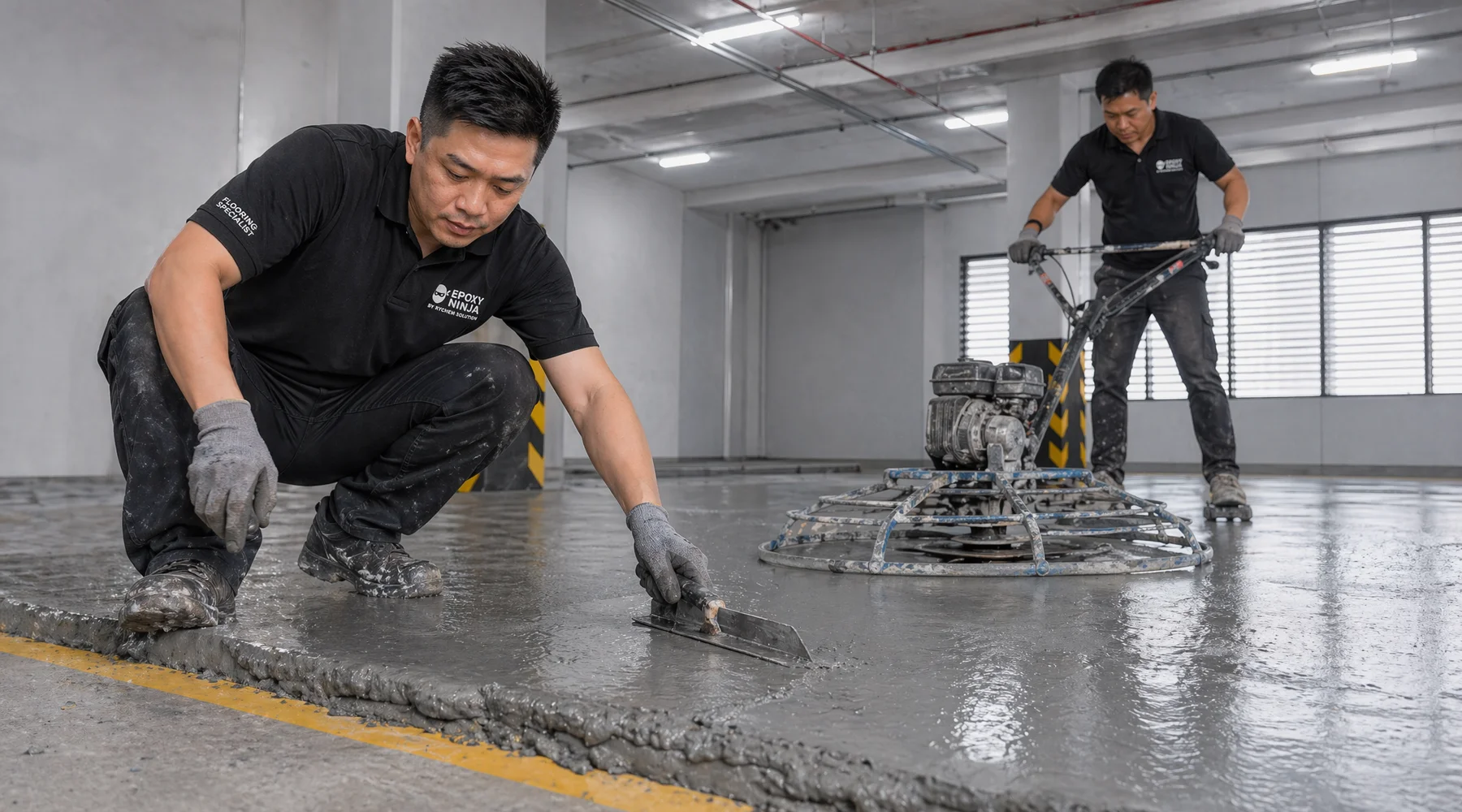
The short answer
We know that facility shutdown planning requires exact data, not guesses.
The difference between a 12-hour and 48-hour epoxy mortar thickness cure time dictates your production schedule. Our team sees facility managers miscalculate these critical return windows constantly, leading to costly substrate failures.
For accurate baseline data and system specs, see our mortar flooring service. Let’s review the actual numbers you need to plan a successful installation without risking your investment.
What this guide covers
This guide breaks down pu mortar thickness bands, precise curing windows, and traffic return schedules. We will show you how to match your operational loads to the correct system depth to maximize service life.
Choosing the wrong specification guarantees premature floor failure in heavy manufacturing environments. Our installation data from across Johor Bahru highlights four main areas of focus for facility owners.
- Thickness requirements: 6mm, 9mm, and 12mm application standards.
- Cure milestones: The critical gap between foot traffic and chemical resistance.
- Traffic ratings: Exact hours needed before forklift operations resume.
- Temperature factors: How Malaysia’s ambient heat accelerates setting times.
Thickness bands by application (6mm light / 9mm medium / 12mm heavy)
System thickness directly dictates how much thermal shock and impact your floor can survive. We categorize mortar floors into three strict thickness bands to match different industrial demands.
6mm: Light to Medium Duty
A 6mm troweled mortar base handles standard pedestrian traffic and light pallet jacks. Our crews install this specification primarily in dry processing zones and packaging lines where point loads remain low.
At this depth, the floor resists moderate impacts but cannot handle constant thermal cycling from boiling water spills.
9mm: Medium to Heavy Duty
Moving up to a 9mm application provides the baseline defense for commercial kitchens and wet processing areas. We recommend this thickness when your facility uses 80°C hot water washdowns regularly.
Products like Sika PurCem perform optimally at 9mm for food and beverage plants operating in Malaysia.
12mm: Extreme Heavy Duty
A 12mm system is mandatory for heavy engineering spaces and extreme thermal shock environments. Our heavy-duty specification absorbs the impact of dropped metal components and 120°C steam cleaning.
This maximum thickness prevents the mortar from delaminating under the severe stress of constant, loaded forklift turning.
Cure-to-service (foot) vs cure-to-full-chemical-resistance
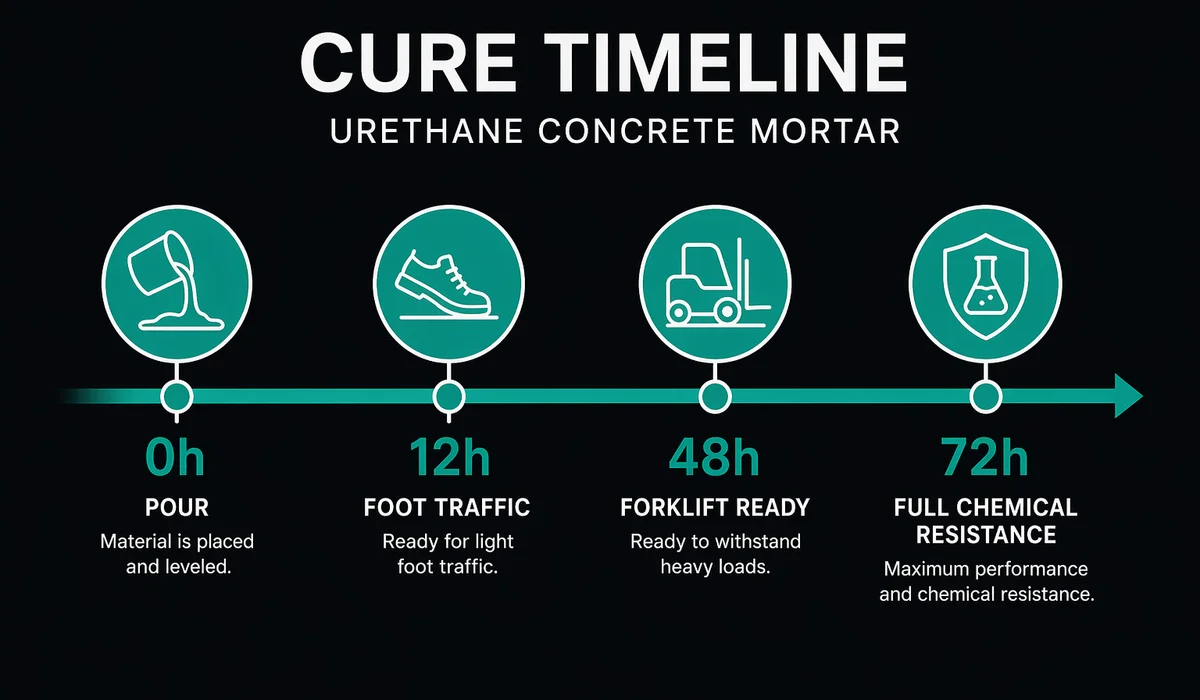
Foot traffic readiness occurs at 12 hours, but full chemical resistance requires a strict 72-hour curing window. We see production managers mistakenly assume a hard floor is a fully cured floor.
The initial urethane concrete cure creates a mechanical bond strong enough for personnel to walk on safely. Our testing shows the chemical cross-linking process is only about 40% complete at this 12-hour mark.
Exposing the floor to organic acids or industrial degreasers too early permanently damages the polymer matrix. Industry-standard systems like Flowcrete Flowfresh require the full three days to reach their maximum chemical defense ratings.
Here is a breakdown of the chemical curing timeline:
| Curing Stage | Time Elapsed | Permitted Exposure |
|---|---|---|
| Initial Set | 12 Hours | Dry ambient air, no liquids or washdowns |
| Partial Cure | 48 Hours | Water contact, neutral pH routine cleaners |
| Full Cure | 72 Hours | Aggressive chemicals, CIP acids, hot fats |
Traffic return times
You must wait 12 hours for foot traffic, 24 hours for rubber wheels, and 48 hours for heavy forklifts. We enforce these mortar return to service timelines strictly on every site to guarantee structural integrity.
Returning heavy machinery to the area prematurely causes micro-cracking in the uncured base layer. Our field data confirms that rolling loads exert massive point pressure that fresh mortar cannot yet distribute effectively.
Facility owners must plan their downtime around these specific physical milestones:
- Foot Traffic (12 Hours): Personnel can walk on the surface for light inspections. No ladders or heavy toolboxes allowed.
- Wheel Traffic (24 Hours): Hand-pushed pallet jacks with rubber wheels can operate safely. Avoid tight, pivoting turns.
- Forklift Traffic (48 Hours): Hard polyurethane forklift wheels and fully loaded reach trucks can resume normal operations.
These timelines assume a standard Malaysian ambient temperature of 30°C. We always verify the floor hardness with a Schmidt hammer before officially handing over the production area.
Temperature dependencies on cure
Higher ambient temperatures accelerate curing, while cold nights or high humidity delay the process significantly. We monitor site conditions closely because Malaysia’s climate directly impacts the chemical reaction speed.
At a standard daytime temperature of 30°C, polyurethane mortar systems cure rapidly and hit their 12-hour foot traffic milestone reliably. Our installation teams must work faster during application because the pot life shrinks to roughly 15 minutes under these warm conditions.
If your facility operates a cold storage room at 10°C, that same curing process takes twice as long. You cannot force a fast cure in a refrigerated zone without using specific cold-temperature chemical accelerators.
Site Tip: Never assume uniform temperatures across a large factory floor. We always place temperature loggers in the coldest corners to ensure the entire system cures at the expected rate before opening it to traffic.
For a closer look at related considerations, read our Heavy-Duty Flooring for Loading Docks and Impact Zones guide.
What to do next
Getting your epoxy mortar thickness cure time right prevents expensive operational delays.
If you are weighing this decision for your facility, the fastest next step is a free site visit.
We bring a Tramex CMEX5 moisture meter, walk the substrate, and document your specific chemical and thermal exposure.
This data allows us to build a written BQ with honest cost paths. Our team provides a same-day response across JB, Pasir Gudang, Skudai, Senai, and Iskandar Puteri with zero obligation.
The Heavy-Duty Mortar Flooring service page covers the system specification in detail. Contact us today to schedule your assessment and secure an accurate project timeline.
Fast answers.
Can I walk on mortar the same day?
Usually after 12-24 hours. Full chemical resistance needs 5-7 days. Plan the shutdown window around the latter, not the former.
Does thicker mortar cure slower?
Yes — exotherm builds in thick sections and cure proceeds in phases. 12mm mortar often needs an extra 24h vs 6mm.
What temperature is ideal for mortar cure?
20-25°C. Below 15°C cure slows dramatically; above 30°C exotherm risks bubbles and uneven set.
More in this cluster.
Epoxy Mortar vs PU Mortar vs Urethane Concrete: Which Heavy-Duty System?
Three heavy-duty mortar systems compared — bond, thermal, chemical, cost. Which wins for loading docks, F&B, or foundries?
Heavy-Duty Flooring for Loading Docks and Impact Zones
Heavy-duty mortar for loading docks, intake bays, and impact zones. Forklift point load, dock edge, transition ramp detailing.
Ready for a real assessment? Free Tramex scan.
Guides are the general case. A site visit gives you the specific answer for your slab, your chemicals, and your operational conditions.