
Heavy-Duty Flooring for Loading Docks & Impact Zones
Heavy-duty mortar for loading docks, intake bays, and impact zones. Forklift point load, dock edge, transition ramp detailing.
The short answer
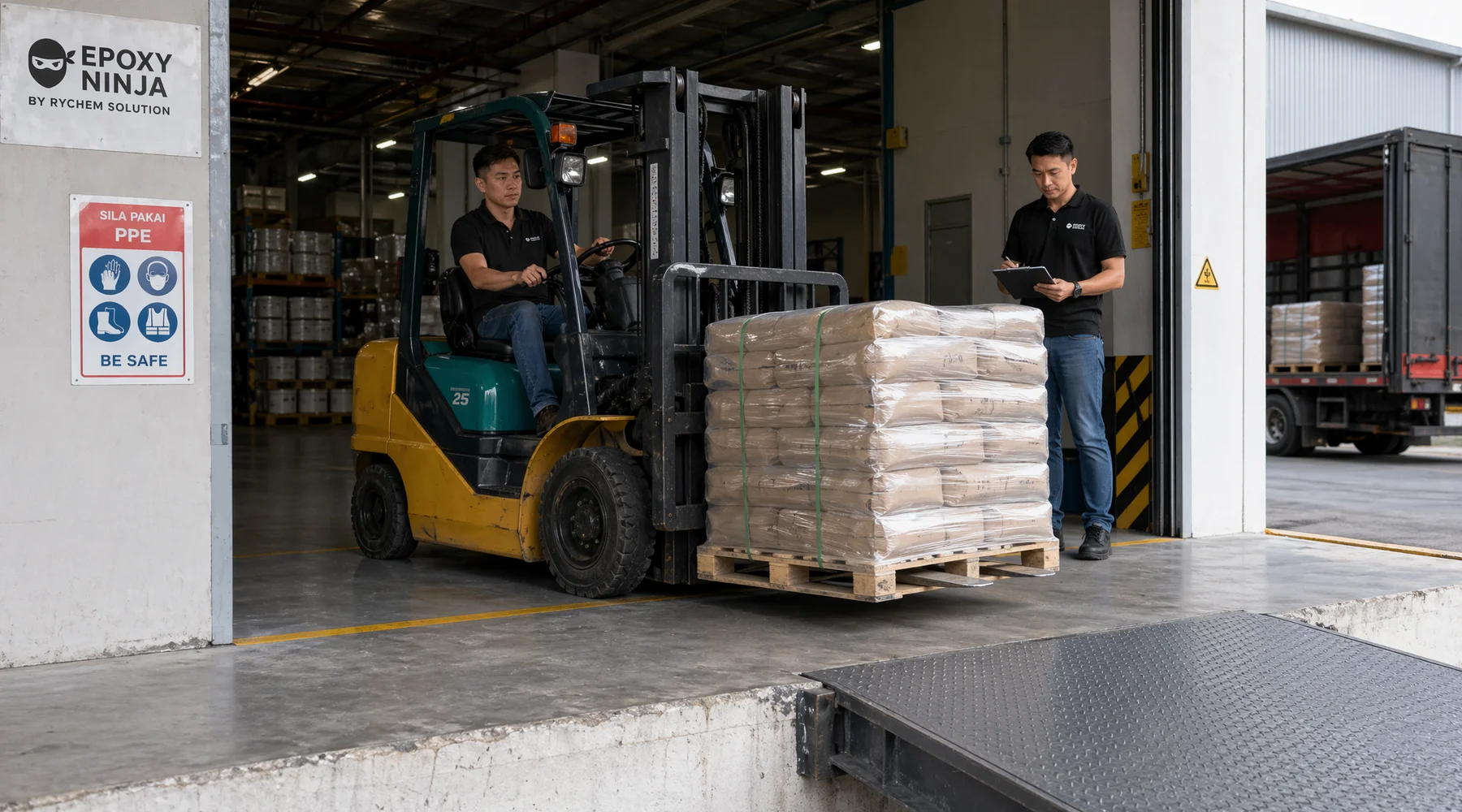
For the loading dock flooring industrial malaysia factories require, we recommend matching your heavy-duty mortar specification directly to the realities of your impact zones. The team at Epoxy Ninja Johor Bahru knows that standard coatings simply cannot handle the extreme pressure of loaded commercial vehicles.
For a system built to survive these severe conditions, see our mortar flooring service.
What this guide covers
We focus specifically on the mechanical forces that actually break industrial floors. Warehouse traffic destroys standard concrete rapidly without the right protection.
This guide details forklift weight distribution, pallet drop zones, edge detailing, and safe ramp slopes.
The technical data provided here aligns with current 2026 DOSH Malaysia workplace guidelines.
Forklift point-load stress calculations
Our site inspections across Johor regularly reveal concrete crushed by unexpected vehicle weight. Many factory owners underestimate the true mass their loading zones endure daily.
A standard three-ton forklift actually weighs around 4,500 kilograms before you even load it. We calculate that adding a full 3,000-kilogram load brings the total mass to 7,500 kilograms.
All of this immense weight transfers directly to the floor through four small polyurethane tires. These hard wheels concentrate the load into tiny contact points, creating extreme pressure.
| Equipment Type | Empty Weight | Maximum Loaded Weight |
|---|---|---|
| Manual Pallet Jack | 80 kg | 1,500 kg |
| Electric Stacker | 500 kg | 2,000 kg |
| 3-Ton Forklift | 4,500 kg | 7,500 kg |
Our application teams frequently replace standard epoxy floors that shattered under this stress. The rigid nature of basic epoxy makes it highly vulnerable to point-load fractures.
Waterborne polyurethane mortar provides a much better forklift impact flooring solution for these heavy manufacturing lines. We typically specify a 6mm to 9mm thickness for genuine heavy-duty industrial applications.
This thicker urethane layer acts as a shock absorber for the concrete slab underneath. Your material selection dictates exactly how long the dock will survive.
- Standard Epoxy (2mm to 3mm): Fails quickly under hard polyurethane wheels.
- Light PU Mortar (3mm to 4mm): Handles manual pallet jacks safely.
- Heavy PU Mortar (6mm to 9mm): Survives 7,500kg rolling loads easily.
Pallet-drop impact resistance
Our flooring assessments show that loading docks suffer constant abuse from dropped goods. Food and beverage processing plants regularly move heavy 1,000-kilogram IBC totes.
Standard 1.2-ton timber pallets also slam onto the floor during rapid unloading cycles. We consistently notice that rigid floor coatings fail quickly in these high-impact zones.
Consider these common impact hazards and how different materials react to the stress.
- IBC Totes: Dropping a full tote causes rigid epoxy to delaminate instantly.
- Timber Pallets: Hard corner impacts chip thin coatings, exposing bare concrete to bacteria.
- Metal Tools: Dropped wrenches leave dents in polyurethane, but shatter traditional epoxy completely.
- Steel Kegs: Breweries require 9mm urethane mortar to survive repeated keg drops.
Epoxy provides excellent compressive strength for slow, static loads. However, it becomes highly brittle over time and chips when heavy metal tools or pallets drop suddenly.
Our chosen solution for food factories involves highly elastic polyurethane mortar systems. This material has a lower modulus of elasticity compared to standard commercial resins.
The floor actually flexes slightly upon impact, dissipating the shock rather than shattering. Choosing a dedicated pallet drop floor keeps your production lines running without unscheduled maintenance breaks.
Dock-edge detailing (nosing, angle iron integration)
We pay special attention to the dock edge because it takes the hardest hits from reversing trucks. The lip of your loading bay requires mechanical reinforcement to survive this daily punishment.
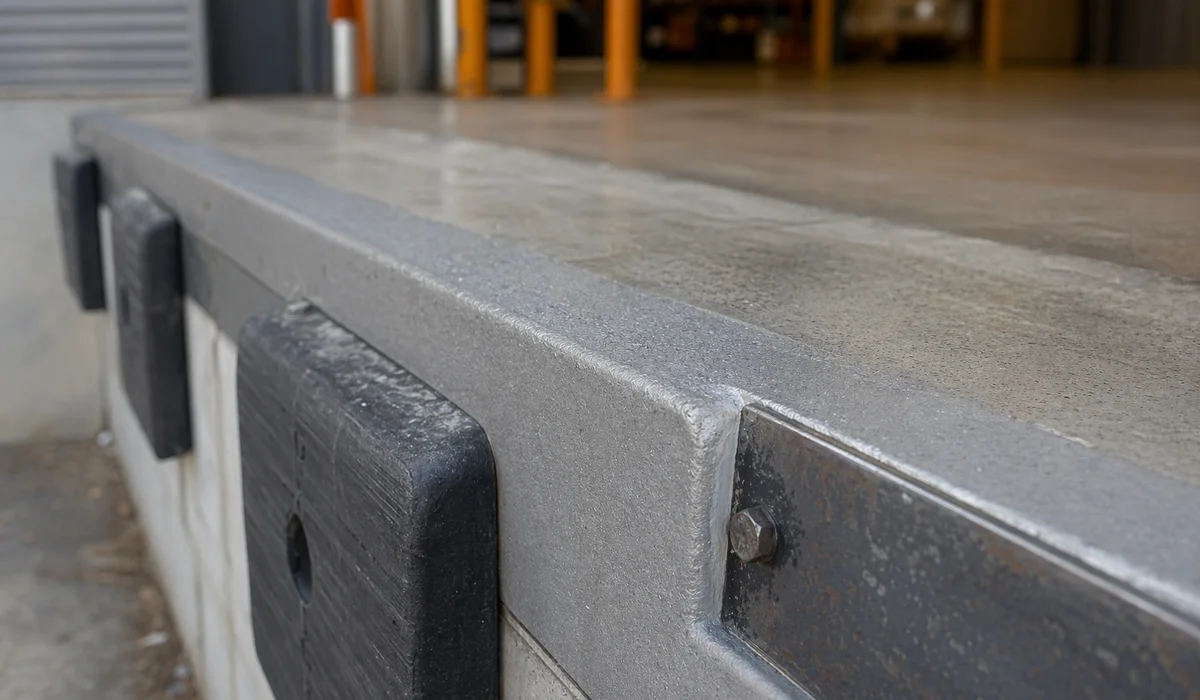
Bare concrete edges will crumble within months if left completely unprotected. Our standard practice involves installing heavy-duty steel angle iron nosing.
A 50x50x6mm mild steel angle iron provides excellent structural defence against trailer impacts. You must properly anchor this steel directly into the concrete substrate before pouring the floor.
- Impact Defence: Weld and anchor mild steel angle irons to the concrete edge.
- Flexible Bonding: Apply polyurethane mortar tightly against the steel nosing.
- Waterproofing: Seal the joint completely to prevent water ingress during washdowns.
We then create a chamfered mortar edge to integrate the steel smoothly with the flooring system. Metals and concrete expand at completely different rates when the temperature changes.
This difference in thermal expansion tears standard dock edge coating materials away from the steel joints. Our installation teams use polyurethane to absorb this specific movement and prevent joint failure.
Transition ramp specification
We design transition ramps to keep your operators safe and your equipment fully functional. According to the latest 2026 guidelines from the Department of Occupational Safety and Health (DOSH) Malaysia, ramp gradients require careful planning.
The recommended maximum slope ratio for a standard forklift ramp is 1:12. Our safety audits frequently find older ramps built much too steeply for modern warehouse equipment.
A 1:12 ratio means that for every one inch of vertical rise, you need twelve inches of horizontal length. Pushing a forklift up a steeper slope drastically increases the risk of tipping over.
- DOSH Compliance: Maintain a maximum 1:12 gradient for safe forklift operations.
- Textured Finish: Broadcast heavy quartz aggregate to prevent wheel spin in wet conditions.
- Visual Safety: Use contrasting colours to clearly mark the ramp edges for drivers.
- Transition Zones: Create flat landing areas at the top and bottom to stabilize loads.
We also strictly enforce high slip resistance on all inclined industrial surfaces. Loading docks get wet from rain, condensation, or daily washdown procedures.
A smooth floor on a wet 1:12 incline creates a massive hazard for heavy machinery. Our team applies specialized aggregates into the wet mortar to achieve the necessary traction.
Contractors must target a high Pendulum Test Value (PTV) rating to ensure tires grip the surface securely. Proper traction prevents catastrophic accidents on your loading dock.
For a closer look at related considerations, read our Epoxy Mortar vs PU Mortar vs Urethane Concrete guide.
What to do next
We know that selecting the right industrial floor requires evaluating real physical data. If you are weighing this decision for your facility, the fastest next step is a free site visit.
Our experts bring a Tramex CMEX5 moisture meter to accurately assess your current concrete substrate. You can expect us to walk the process zones and document the specific chemical and thermal exposure.
We will then hand you a written BQ outlining the honest cost paths for your specific environment. This evaluation comes with no obligation and features a same-day response across JB, Pasir Gudang, Skudai, Senai, and Iskandar Puteri.
We strongly encourage you to review the technical details before making your final investment decision.
The Heavy-Duty Mortar Flooring service page covers our system spec in detail. Protect your operations by scheduling a professional site assessment today.
Fast answers.
What thickness for a loading dock floor?
Typically 9-12mm mortar for unrestricted forklift and pallet impact. Light-duty docks can go 6mm.
Do I need dock-edge steel angle integrated into the mortar?
For heavy-duty docks with trailer impact, yes — steel nosing protects the mortar edge from chipping.
How often do loading dock floors need repair?
A properly spec'd mortar can run 10-15 years before repair. Under-spec'd coatings fail in 2-3.
More in this cluster.
Epoxy Mortar vs PU Mortar vs Urethane Concrete: Which Heavy-Duty System?
Three heavy-duty mortar systems compared — bond, thermal, chemical, cost. Which wins for loading docks, F&B, or foundries?
Mortar System Thickness, Cure Time, and Traffic Ratings
Thickness bands, cure schedules, and traffic return-to-service for epoxy, PU, and urethane concrete mortars.
Ready for a real assessment? Free Tramex scan.
Guides are the general case. A site visit gives you the specific answer for your slab, your chemicals, and your operational conditions.