
Industrial Epoxy Flooring Cost in Malaysia (RM per sqft)
Real RM per sqft for industrial epoxy and PU flooring in Malaysia. Ranges by system, factors that drive cost, and how to read a quote.
The short answer
We know that finding an accurate epoxy flooring cost in Malaysia is a constant struggle for facility managers.
Industrial epoxy flooring currently costs between RM 2.50 per square foot for basic thin-film coats and up to RM 40.00 per square foot for heavy-duty systems. This price gap shows exactly why matching the right chemical resistance and thickness to your specific operational needs is so critical.
Our team publishes these honest industrial flooring RM per sqft ranges by system type so you can budget accurately.
The following breakdown covers the five main factors that move a quote up or down, outlines the specific costs for different floor types, and explains what a trustworthy proposal should look like. For the PU-specific cost guide, see PU-specific cost guide.
What this guide covers
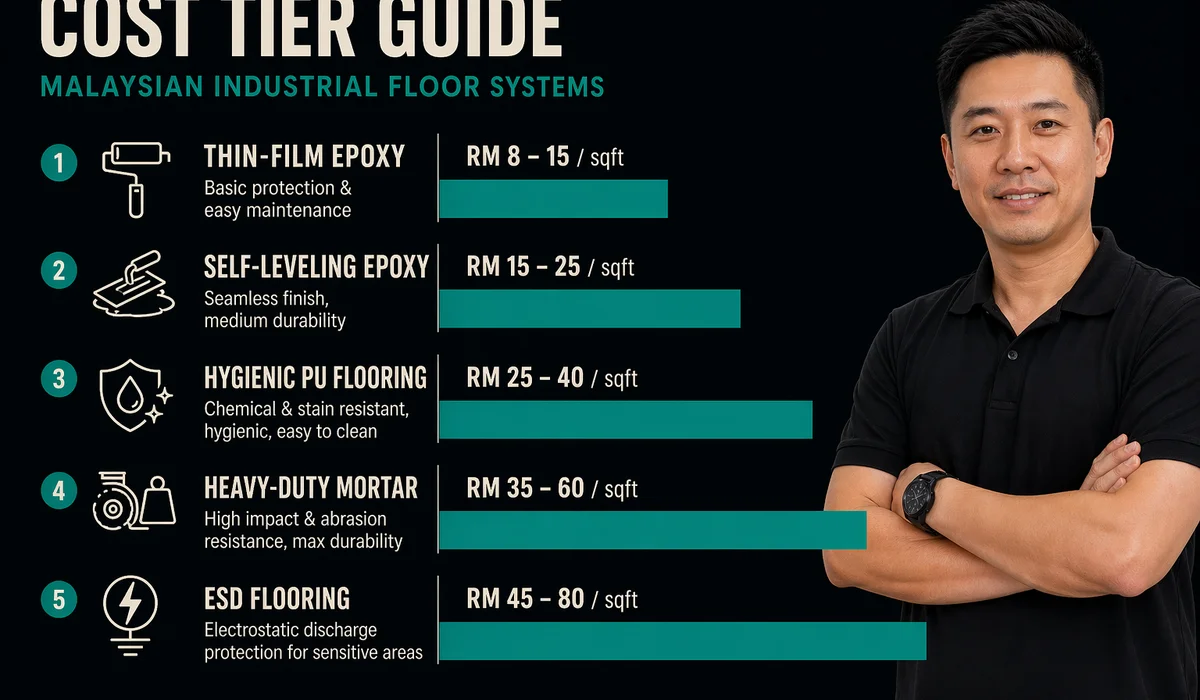
This guide directly breaks down the realistic costs for five major industrial flooring systems used across Malaysia. We detail the specific pricing for thin-film epoxy, self-leveling systems, hygienic PU, heavy-duty mortar, and ESD floors.
Understanding the difference between a simple RM 3.00 thin-film application and a highly specialized RM 35.00 ESD system prevents costly budgeting mistakes. Our estimators also cover the hidden cost drivers like moisture mitigation and surface preparation that often surprise warehouse owners. Getting these details right the first time ensures your concrete slab is protected for the long haul.
RM/sqft ranges by system
The epoxy flooring price per sqft in Malaysia ranges from RM 2.50 for basic epoxy up to RM 40.00 for premium polyurethane systems. We have seen these numbers play out consistently across Malaysian industrial sites, presenting real trade-offs for facility managers.
The cost difference between systems is never generic, because it heavily depends on your slab condition, chemical exposure levels, and the installer’s discipline. Our experts rely on proven products from brands like Mapei and Sika to ensure these installations meet strict industrial standards. Selecting the wrong system can lead to premature failure in Malaysia’s hot, humid climate.
Here is a breakdown of the specific pricing and ideal use cases for each system.
| Flooring System | Average Cost (RM/sqft) | Best Suited For |
|---|---|---|
| Thin-film epoxy | RM 2.50 - RM 4.00 | Light manufacturing, pedestrian walkways |
| Self-leveling epoxy | RM 12.00 - RM 25.00 | Uneven floors, commercial showrooms |
| Hygienic PU (Polyurethane) | RM 25.00 - RM 40.00 | Food and beverage processing, cold storage |
| Heavy-duty mortar | RM 15.00 - RM 30.00 | Heavy machinery zones, forklift traffic |
| ESD (Anti-static) | RM 15.00 - RM 35.00 | Electronics manufacturing, cleanrooms |
We strongly recommend evaluating your facility’s daily traffic before choosing a specific system.
- Thin-film epoxy: This entry-level option usually requires a simple roller application and cures relatively quickly. You can expect to pay around RM 2.50 to RM 4.00 per square foot. Our team often suggests this for light assembly areas or clean walkways where heavy forklift traffic is not a concern.
- Self-leveling epoxy: Applying a 2mm to 10mm layer creates a perfectly smooth, continuous surface over rough concrete. Expect costs between RM 12.00 and RM 25.00 per square foot. We find this system incredibly valuable for facilities that need to correct significant unevenness without replacing the entire slab.
- Hygienic PU: Polyurethane systems handle extreme temperature fluctuations and aggressive chemical spills far better than standard epoxy. Budget between RM 25.00 and RM 40.00 per square foot for these high-performance floors. Our food and beverage clients rely on PU to maintain strict health and safety compliance in wet processing areas.
- Heavy-duty mortar: Trowel-applied epoxy or PU mortar provides massive impact resistance for extreme industrial environments. Pricing typically falls between RM 15.00 and RM 30.00 per square foot depending on the required thickness. We install this heavy-duty solution in engineering workshops where dropped tools and heavy machinery would instantly shatter a thinner coating.
- ESD: Electrostatic discharge flooring safely grounds static electricity to protect sensitive electronic components. Costs range from RM 15.00 to RM 35.00 per square foot, heavily dependent on the required copper grounding grid and specialized conductive primers. Our technicians must strictly adhere to ANSI/ESD S20.20 standards during these highly technical installations.
Five cost drivers
The five main factors that dictate your final flooring quote are slab condition, moisture mitigation, coating thickness, chemical formulation, and required certification paperwork. We evaluate these variables during every site visit because they can easily double the base price of a seemingly simple installation.
Ignoring these variables often leads to unexpected change orders mid-project. Our estimators rely on these exact five elements to build accurate, transparent quotes for Malaysian industrial sites. The cost threshold here is never generic, as it depends entirely on your specific facility constraints and the installer’s technical discipline.
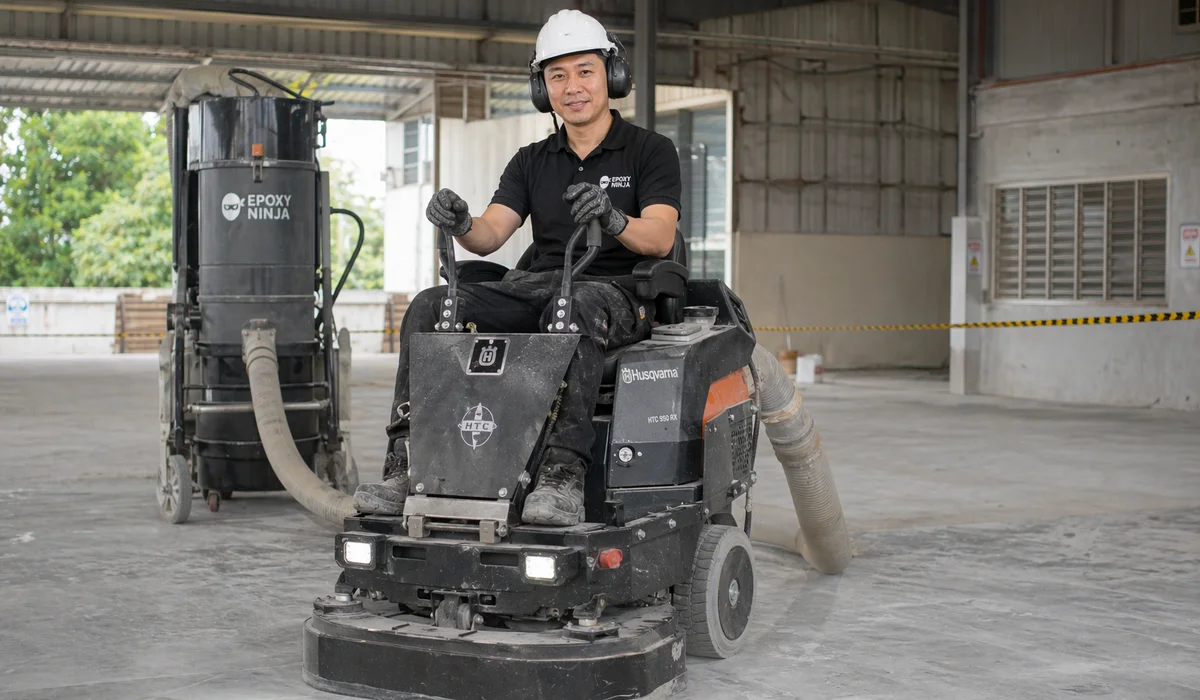
- Slab condition: Extensive diamond grinding to remove old coatings or level out deep divots requires expensive planetary grinders and extra labor hours. We use aggressive diamond tooling to achieve the correct Concrete Surface Profile (CSP) before any resin touches the floor. A badly damaged slab can add RM 3.00 to RM 5.00 per square foot in preparation costs alone.
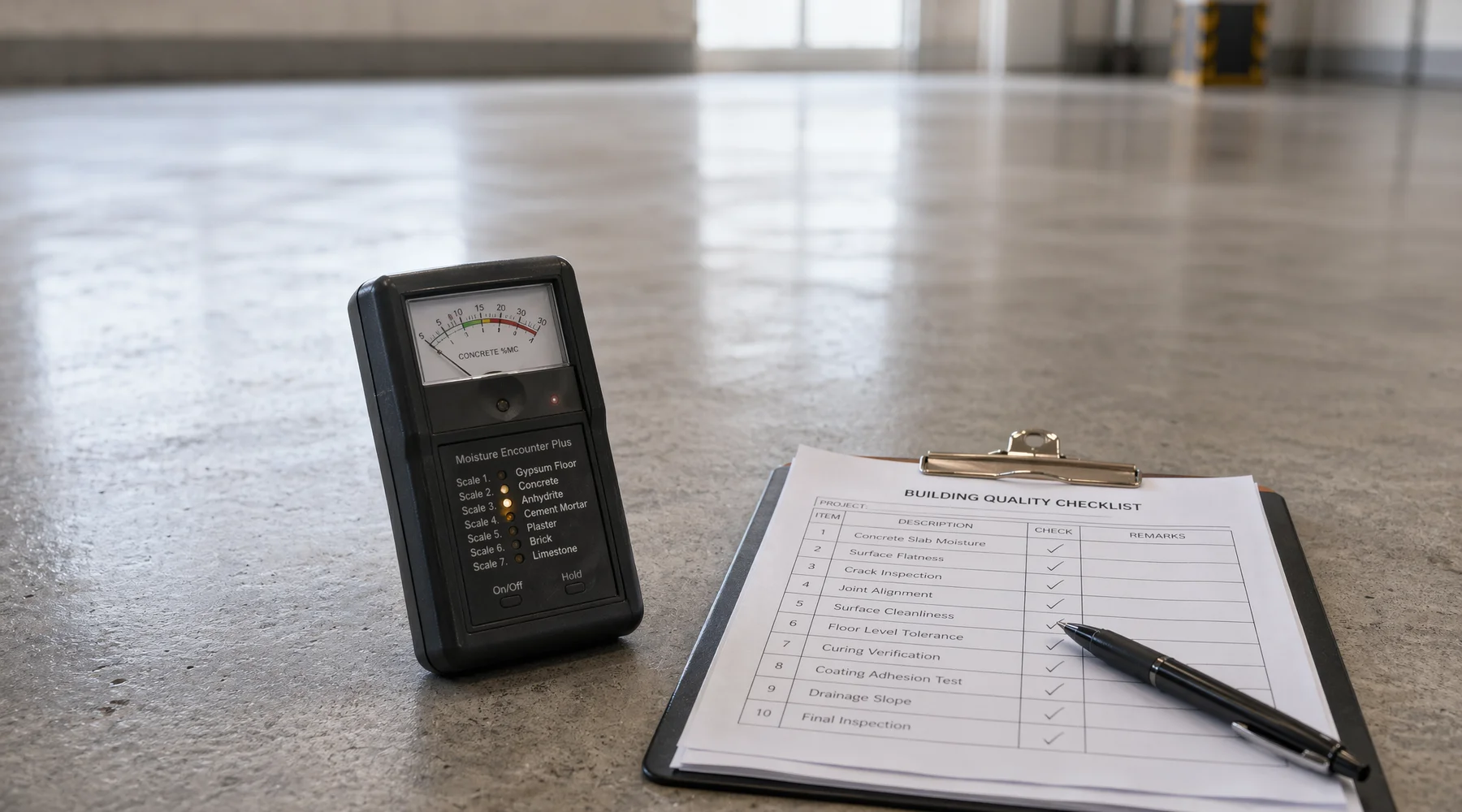
- Moisture mitigation: Malaysia’s humid climate often causes moisture vapor to rise through the concrete slab, which destroys coating adhesion. Our standard practice includes testing with a Tramex CMEX5 meter to measure internal humidity. Installing a specialized liquid moisture barrier adds immediate upfront cost but prevents catastrophic peeling within the first year.
- Thickness: Applying a 4mm heavy-duty self-leveling system uses significantly more raw resin than a 0.5mm thin-film coat. We always match the physical thickness to your specific operational load to prevent premature wear. Thicker applications simply require more material, driving up the total price per square foot.
- Chemistry: Standard bisphenol-A epoxy resins are highly affordable, while specialized novolac or aliphatic urethanes cost a premium. Our technical team specifies these advanced chemistries only when you need extreme resistance to strong acids or UV degradation. Upgrading the chemical formulation directly impacts the raw material costs on your invoice.
- Certification paperwork: Securing proper CIDB registration (minimum G3 for flooring) and carrying comprehensive liability insurance adds overhead for professional contractors. We maintain strict compliance and safety standards, which provides peace of mind but slightly increases operational costs. Hiring an uncertified team might save money initially, but it exposes your facility to massive legal and financial risks if an accident occurs.
Food-grade and ESD premium over baseline epoxy
Upgrading from a baseline epoxy to a food-grade PU or an ESD system typically adds RM 10.00 to RM 25.00 per square foot to your total cost. We see this premium directly tied to the highly specialized conductive materials and antimicrobial additives required for these environments.
Facilities processing food or electronics simply cannot compromise on these regulatory requirements. Our team walks through these specific compliance needs on every single site visit. What you decide here drives 60 to 80 percent of your floor’s actual service life, making it critical to get the call right the first time.
Food-grade polyurethane systems command a higher price because they must resist aggressive organic acids and withstand daily high-pressure hot water washdowns. We often use specialized PU screeds in commercial kitchens because standard epoxy will crack and fail under thermal shock. This thermal resilience and joint-free, hygienic finish justifies the higher RM 25.00 to RM 40.00 per square foot investment.
Similarly, an ESD (Electrostatic Discharge) floor requires a complex installation process that baseline epoxy does not need. Our installers must carefully lay a conductive copper tape grid and apply specific carbon-loaded primers before the final topcoat. Failing to meet strict ANSI/ESD standards in an electronics manufacturing plant could result in millions of Ringgit in damaged microchips, making the upfront premium a necessary insurance policy.
These specific upgrades require detailed planning and verification.
- Verify HACCP compliance for any food processing environment.
- Confirm exact thermal shock parameters for hot water washdown zones.
- Require documented electrical resistance testing post-installation for ESD floors.
- Ensure the contractor has specific experience with conductive copper grid layouts.
What’s included in an honest quote (prep, primer, buildcoat, topcoat, cleanup)
An honest flooring quote must clearly itemize costs for mechanical surface preparation, the specific primer system, the structural buildcoat, the protective topcoat, and final waste cleanup. We refuse to hide these crucial steps, as cutting corners on any single phase guarantees early coating failure.
Reviewing a proposal carefully protects you from contractors who intentionally leave out necessary steps to appear cheaper. Our detailed Bill of Quantities (BQ) breaks down every phase so you know exactly what materials and labor you are paying for. The cost threshold here is heavily influenced by the required slab repair and the installer’s commitment to quality.
| Quote Component | What to Look For | Why It Matters |
|---|---|---|
| Preparation | Diamond grinding or shot blasting | Creates the necessary profile for strong adhesion. |
| Primer | Moisture-tolerant or conductive base | Seals the concrete and prevents bubbling. |
| Buildcoat | Specified thickness in millimeters | Provides the actual load-bearing strength. |
| Topcoat | UV-stable or chemical-resistant layer | Protects against scratches and fading. |
| Cleanup | HEPA vacuuming and debris removal | Ensures your facility is ready for immediate use. |
Surface preparation should account for a significant portion of a professional quote. We use large planetary grinders to remove old paint and open the concrete pores, a process that is labor-intensive and requires specialized equipment. If a contractor suggests simply acid washing an industrial slab, that is a massive red flag.
The primer and buildcoat specifications must clearly state the exact products and total dry film thickness (DFT). Our technicians ensure that a multi-layer system is applied according to the manufacturer’s strict guidelines. Omitting the primer or thinning out the buildcoat reduces the contractor’s material costs but drastically shortens the lifespan of your floor.
What to do next
The fastest and most accurate way to determine your exact epoxy floor cost is to schedule a professional site inspection. We offer a free, no-obligation site visit to assess your specific facility requirements and provide a firm, itemized quotation.
Evaluating the concrete substrate in person is the only way to eliminate pricing guesswork. Our estimators bring a Tramex CMEX5 moisture meter, walk the substrate, document the chemical and thermal exposure, and hand you a written BQ with the honest cost paths. Having this detailed assessment allows you to make a confident, data-driven decision for your business.
The rapid response team at Epoxy Ninja handles inquiries across JB, Pasir Gudang, Skudai, Senai, and Iskandar Puteri, often providing same-day service. We prioritize transparent communication and will quickly help you compare the different material options available.
Reach out today to secure a durable surface that protects your operation for years to come.
Fast answers.
What's the cheapest industrial epoxy option?
Thin-film epoxy at ~RM15-25/sqft — but it peels fast under thermal or chemical load. Usually false economy outside light-duty offices.
Why do quotes vary so much for the same area?
Moisture mitigation, substrate prep depth, and chosen chemistry can each move the total 20-40%.
Is moisture testing usually included in the price?
We include it. Quotes without a moisture line item are usually skipping the test — that's the #1 cause of peeling floors.
More in this cluster.
Common Causes of Industrial Epoxy Floor Failure (And How to Prevent Them)
The 5 reasons epoxy floors fail — moisture vapor, poor prep, wrong chemistry, thermal shock, chemical attack. Fixable with proper diagnostics.
Epoxy vs Polyurethane Flooring: How to Choose the Right System
Epoxy vs PU flooring compared — bond, thermal shock, chemical resistance, cost. Which wins for your factory? Honest answer inside.
How to Choose an Industrial Flooring Contractor in Malaysia
Vet your flooring contractor with 10 questions covering moisture testing, chemistry expertise, BQ transparency, and warranty. Red flags flagged.
Professional Site Preparation for Resinous Industrial Flooring
How professional contractors prep a concrete slab for epoxy or PU — grinding, shot blasting, moisture scan, crack repair. What to expect.
Ready for a real assessment? Free Tramex scan.
Guides are the general case. A site visit gives you the specific answer for your slab, your chemicals, and your operational conditions.