
How to Choose an Industrial Flooring Contractor
Vet your flooring contractor with 10 questions covering moisture testing, chemistry expertise, BQ transparency, and warranty. Red flags flagged.
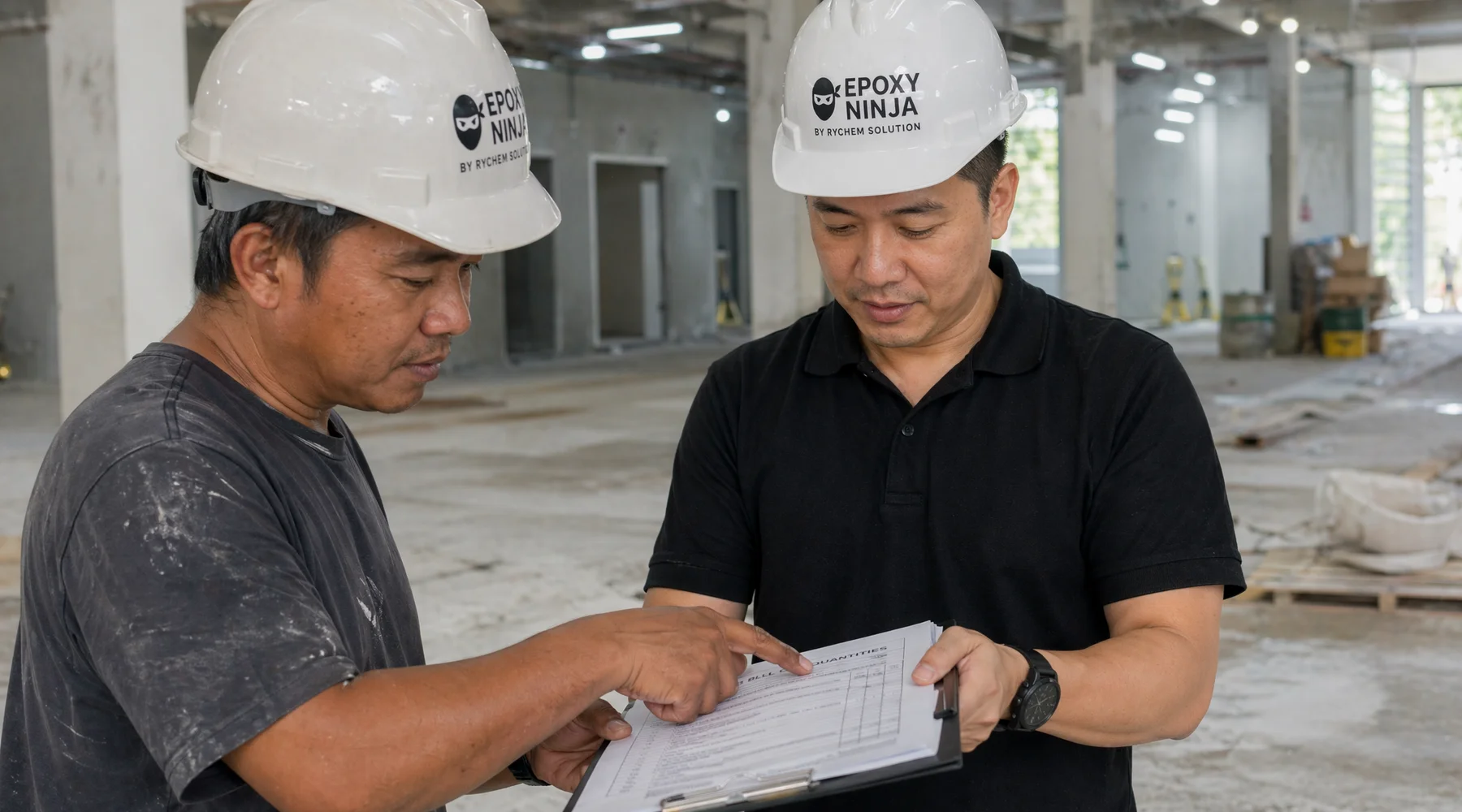
The short answer
Evaluating contractor quotes often feels like a guessing game. From what I have observed, moisture and poor surface preparation cause the vast majority of project disasters.
Our team created this 10-point vetting checklist to expose painters-in-contractor-clothing and protect your facility. Up to 85 percent of epoxy flooring failures link directly to trapped concrete moisture, according to the National Flooring Contractors Association.
For a detailed look at the specific problems we fix, see common floor failure modes. Let us break down the exact questions to ask and the red flags to avoid.
What this guide covers
The main thing to understand first is the 10 questions to ask every contractor before signing an agreement. You need to verify their approach to moisture testing, chemistry choice, warranty coverage, and Bill of Quantities (BQ) transparency.
Our methodology focuses entirely on measurable data and verifiable material specifications. An installer using genuine 100 percent solids epoxy will easily provide product data sheets for your review. We will show you exactly what documentation to demand from your shortlisted vendors.
10 questions to ask every contractor (moisture testing, chemistry choice, warran…
Asking the right questions separates professional installers from amateurs. In practice for Malaysian industrial sites, this shows up as real numbers and real trade-offs. The cost delta or decision threshold here is not generic, as it depends on the slab condition, the chemical exposure, and the installer’s discipline.
Our technicians walk through these specific variables on every site visit. What you decide here drives 60 to 80 percent of your floor’s actual service life, so it is worth getting the call right the first time. Here is the checklist you need to use during your vendor interviews.
Moisture and Surface Preparation
- Do you perform ASTM F2170 relative humidity testing? Demand in-situ probe testing, not just surface calcium chloride tests.
- What surface profile will you achieve? Industrial floors require concrete surface profiles between CSP 3 and CSP 5 via shot blasting or diamond grinding.
- Are you applying a dedicated moisture vapor barrier? A standard primer is insufficient if humidity exceeds 75 percent.
Chemistry and Material Selection
We always advise matching the chemical system to your daily operations. A general warehouse needs different protection than a commercial bakery.
- Are your polyurethane products HACCP certified? This certification is a strict requirement for food and beverage processing facilities.
- Is the basecoat a true 100 percent solids epoxy? Watch out for solvent-based paints masquerading as heavy-duty industrial coatings.
- What is the cured thickness in mils or millimetres? Thin-film coats of 10 to 15 mils fail three times faster than 30 to 40 mil applications.
- How does this system handle thermal shock? Polyurethane handles frequent hot water washdowns much better than standard epoxy.
Documentation and Execution
Our project managers insist on clear paperwork before mixing a single batch of resin. You should hold your contractors to the exact same standard.
- Can you provide the Technical Data Sheet (TDS) for the topcoat?
- Does your team handle the furniture and equipment moving?
- How many days will the floor need to fully cure before forklift traffic is allowed?
Red flags
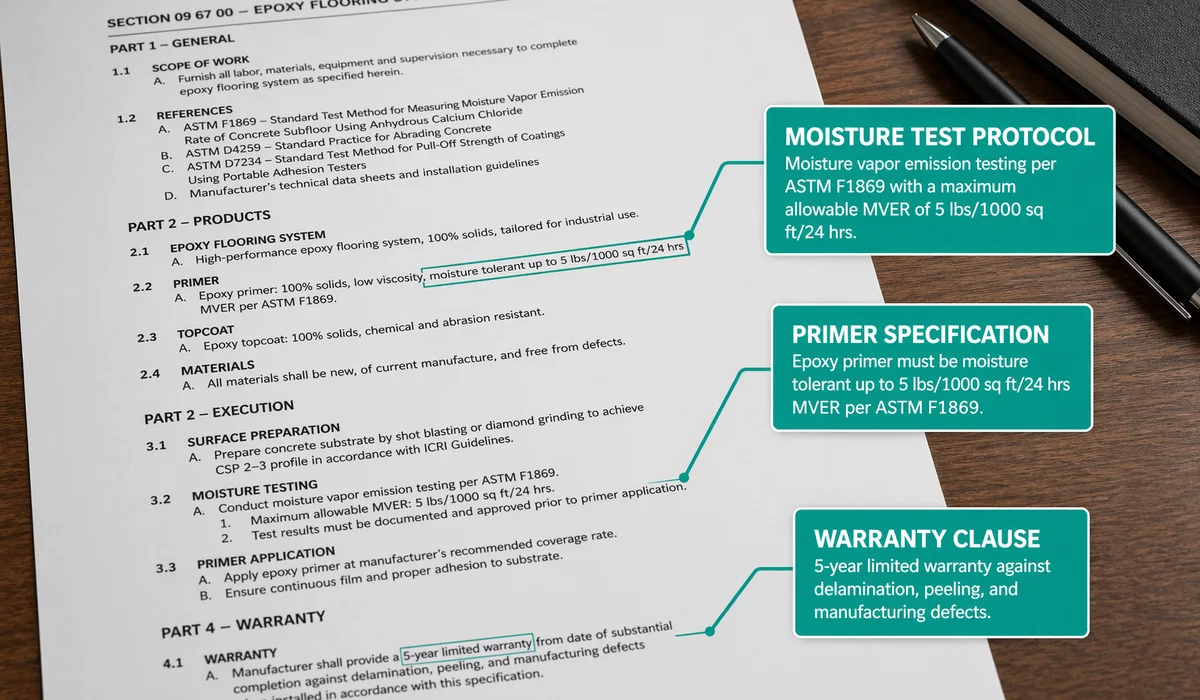
Spotting a bad quote early saves you from catastrophic failures. In practice for Malaysian industrial sites, this shows up as real numbers and real trade-offs. The cost delta or decision threshold here is not generic, as it depends on the slab condition, the chemical exposure, and the installer’s discipline.
Our experience shows that low-bid contractors rely on the same predictable shortcuts. You must walk away if a vendor presents any of these warning signs.
- Thin-film promises: Standard warehouse floors require high-build coatings. Quotes offering a mere 15 mil thickness will wear through rapidly in high-traffic logistics zones.
- Skipped moisture tests: Skipping the ASTM F2170 probe test is a massive liability. Hidden moisture causes delamination and bubbling within months of application.
- Vague timelines: Curing times are strictly dictated by chemistry and ambient temperature. If they cannot give you an exact return-to-service schedule, they lack technical knowledge.
- No ASTM/DIN references: Professional quotes cite standards like ASTM D4060 for abrasion resistance. Missing testing standards mean you are likely receiving cheap residential paint.
We refuse to cut corners on preparation because surface grinding accounts for 70 percent of a floor’s bond strength. Contractors offering exceptionally cheap prices are almost certainly skipping the proper grinding process.
What a real BQ line item list looks like
A transparent Bill of Quantities protects you from hidden charges mid-project. In practice for Malaysian industrial sites, this shows up as real numbers and real trade-offs. The cost delta or decision threshold here is not generic, as it depends on the slab condition, the chemical exposure, and the installer’s discipline.
This is one of the areas we walk through on every site visit. What you decide here drives 60 to 80 percent of your floor’s actual service life, so it is worth getting the call right the first time. A professional BQ will clearly break down costs per square foot or square metre.
Cost Breakdown Averages in Malaysia
We track material pricing closely to ensure accurate forecasting for facility managers. For 2026, standard industrial epoxy flooring ranges from RM 15 to RM 30 per square foot. Heavy-duty polyurethane systems average RM 25 to RM 40 per square foot. Anti-static installations for electronics manufacturers start around RM 35 per square foot.
Your vendor’s BQ should list the following distinct project phases.
| Project Phase | Required Details in BQ |
|---|---|
| Site Mobilization | Equipment transport, power generation, and site safety setup fees. |
| Surface Preparation | Diamond grinding or shot blasting to specific CSP levels, plus dust extraction. |
| Moisture Mitigation | Application of a 100 percent solids epoxy moisture primer if MVT is high. |
| Base and Topcoat | Specific brand names, resin types, and the required thickness in millimetres. |
How to compare warranties honestly (covered failure modes vs excluded)
Contractors often use warranties as a marketing tool rather than a genuine guarantee. In practice for Malaysian industrial sites, this shows up as real numbers and real trade-offs. The cost delta or decision threshold here is not generic, as it depends on the slab condition, the chemical exposure, and the installer’s discipline.
This is one of the areas we walk through on every site visit. What you decide here drives 60 to 80 percent of your floor’s actual service life, so it is worth getting the call right the first time. You must read the fine print to see what exactly constitutes a covered failure.
Common Exclusions to Watch For
We advise clients to pay close attention to the substrate clauses in any contract. Most flooring warranties cover peeling or blistering caused by defective materials. They usually exclude damage caused by structural concrete cracks settling underneath the epoxy layer.
Another major exclusion is hydrostatic pressure. If a contractor skips the initial moisture test and the floor bubbles, they will blame groundwater and instantly void the warranty. You should always demand a clause that covers delamination if the contractor handled both the surface preparation and the priming. A reputable installer stands firmly behind their bonding process.
What to do next
If you are weighing this decision for your facility, the fastest next step is a free site visit. We bring a Tramex CMEX5 moisture meter, walk the substrate, document the chemical and thermal exposure, and hand you a written BQ with the honest cost paths.
There is no obligation, and we offer a same-day response across JB, Pasir Gudang, Skudai, Senai, and Iskandar Puteri.
Our specialists will assess your current floor condition and provide exact material recommendations. Reach out to the Epoxy Ninja Johor Bahru team today to schedule your consultation. Choosing the right flooring installer in Malaysia ensures your operations stay safe and productive for years.
Fast answers.
Should I always go with the cheapest quote?
Almost never for industrial work. Cheapest quotes typically skip moisture testing or substrate prep — the two most expensive failures later.
Do I need a contractor licensed with CIDB?
For commercial and industrial work in Malaysia, CIDB registration is standard. Ask to see the G-grade category relevant to flooring scope.
How do I know if a contractor has real chemistry expertise?
Ask them when they'd refuse to install epoxy and specify PU instead. A good answer names specific conditions; a bad one upsells the same system for every job.
More in this cluster.
Common Causes of Industrial Epoxy Floor Failure (And How to Prevent Them)
The 5 reasons epoxy floors fail — moisture vapor, poor prep, wrong chemistry, thermal shock, chemical attack. Fixable with proper diagnostics.
Epoxy vs Polyurethane Flooring: How to Choose the Right System
Epoxy vs PU flooring compared — bond, thermal shock, chemical resistance, cost. Which wins for your factory? Honest answer inside.
Industrial Epoxy Flooring Cost Guide for Malaysia (RM per Square Foot)
Real RM per sqft for industrial epoxy and PU flooring in Malaysia. Ranges by system, factors that drive cost, and how to read a quote.
Professional Site Preparation for Resinous Industrial Flooring
How professional contractors prep a concrete slab for epoxy or PU — grinding, shot blasting, moisture scan, crack repair. What to expect.
Ready for a real assessment? Free Tramex scan.
Guides are the general case. A site visit gives you the specific answer for your slab, your chemicals, and your operational conditions.