
What Is HACCP-Certified Flooring?
HACCP is a food-safety framework, not a flooring cert. Here's what flooring must actually enable to pass — cleanability, coving, slip, chemistry.
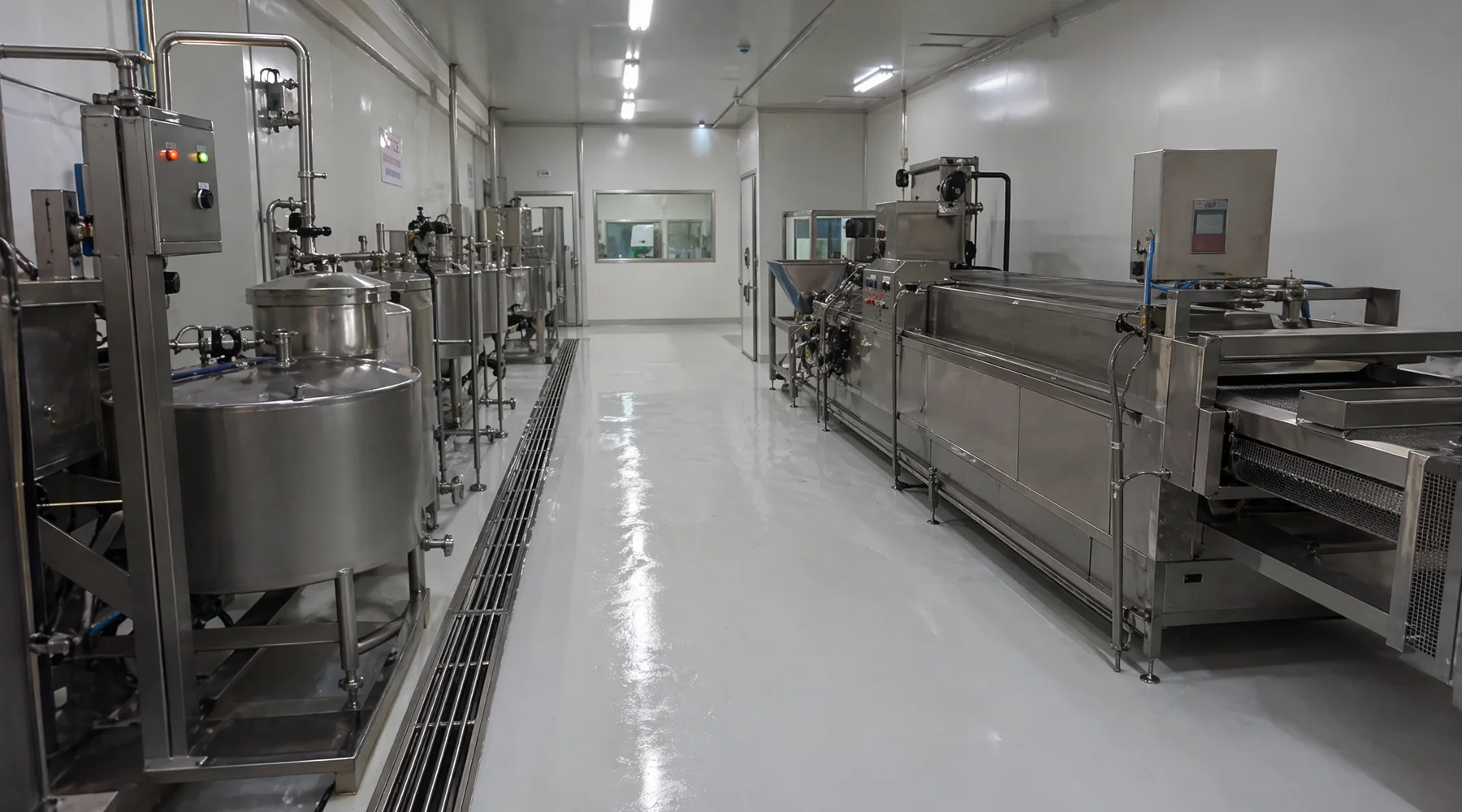
The short answer
If you are wondering exactly what is haccp certified flooring, the answer surprises many facility managers here in Malaysia. The most important distinction most people miss is that the certification applies to your facility’s safety system, not the bucket of resin itself.
We created this guide to clarify the official requirements for passing a Ministry of Health audit.
Your floor must physically support the hygiene standards set by MS 1480:2025. For the practical installation details, see our HACCP flooring service.
What this guide covers
We are going to break down the specific MS 1480:2025 standards and provide a clear haccp flooring definition for practical application. This section covers the required physical properties of an approved surface.
A clear understanding of these rules helps you avoid expensive rework later.
Let’s review the common gap between brochure claims and actual audit compliance, followed by a look at related facility frameworks.
HACCP = Hazard Analysis Critical Control Point, a facility framework, not a product cert
Many business owners mistakenly search for a magic product that guarantees an instant pass from the Ministry of Health. The reality is that the Hazard Analysis Critical Control Point framework dictates how your entire production environment manages food safety risks.
Our approach always starts with understanding that the floor is just one functional component of this larger system. In Malaysia, the current governing standard is MS 1480:2025.
The MS 1480:2025 Update
The 2025 revision places a massive emphasis on your prerequisite programs, which include the physical building conditions governed by MS 1514:2022 Good Manufacturing Practices. This means auditors actively inspect your floor for joint-free finishes and proper drainage gradients.
We always advise clients that a poorly laid premium material will still fail an inspection. Pooling water creates a biological hazard regardless of the brand name on the coating tin.
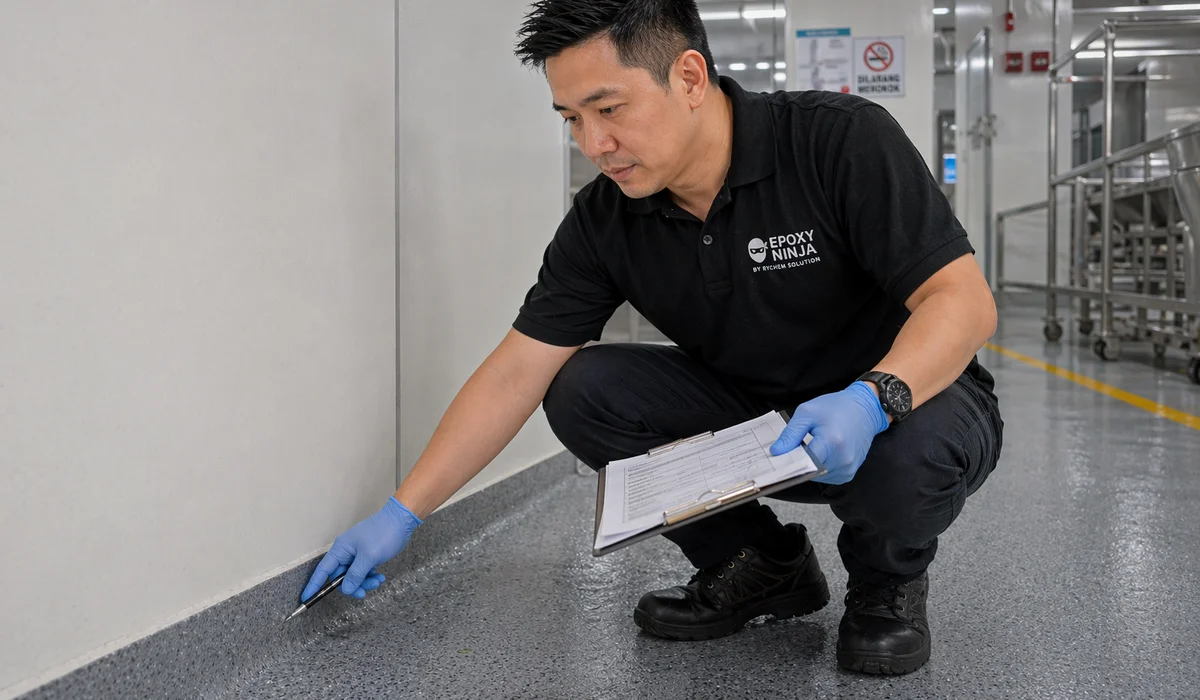
Practical Site Evaluation
For industrial facilities in Johor and across Malaysia, the practical guidance here is to start with a moisture scan, walk the process zones, and let the conditions dictate the system. You should never let a glossy brochure dictate your technical specifications.
We walk through these exact conditions on every site visit. What you decide here drives 60-80% of your floor’s actual service life. Getting the call right the first time prevents massive operational headaches.
What flooring must enable
Auditors require your facility surfaces to actively prevent biological, chemical, and physical hazards. We focus on installing systems that deliver five mandatory functional properties. Missing even one of these criteria will trigger a non-conformity report during your MS 1480:2025 evaluation.
Core Functional Properties
Here are the specific details inspectors verify when they walk your process zones:
- Cleanability: Food and beverage floors must withstand aggressive sanitation routines. Our specified polyurethane concrete systems can handle hot steam cleaning up to 120°C without degrading.
- Non-porous surface: The finish must be completely impervious to stop bacterial growth. Micro-cracks in standard concrete provide perfect breeding grounds for pathogens like Salmonella.
- Integral coving: Inspectors check the wall-to-floor junctions very closely. We build a curved 50mm or 100mm radius cove to eliminate 90-degree corners where dirt typically accumulates.
- Slip rating: Safety for your staff is a primary concern. Wet commercial kitchens typically require a Pendulum Test Value (PTV) of 36 or higher to prevent fall injuries.
- Chemical resistance: Organic acids and harsh cleaning agents destroy weak coatings. Lactic acid in dairy plants or citric acid in beverage factories require highly resistant industrial resins.
Common claim-vs-reality gap (‘claims HACCP’ vs actually audit-compliant)
A major issue in the industry is the misunderstanding of material labels. We frequently hear clients ask, is there a haccp floor cert that guarantees an automatic pass?
The reality is that an approved food grade floor cert applies to the final, installed environment, not just the liquid product. A bucket of resin might hold a safety certification, but that approval is entirely dependent on the final application.
The Application Matters Most
The installation quality determines whether you pass or fail. Our application teams know that a perfectly mixed resin is useless if the subfloor has incorrect falls to the drain.
A 2015 study by the World Health Organization found that uncleared water or foodstuffs cause a massive percentage of major slip-and-fall injuries in manufacturing.
Brochure Claims vs. Audit Reality
Comparing marketing promises with actual inspection criteria reveals why professional application is essential. We use this table to show clients exactly what matters to an auditor.
| Marketing Claim | The Reality on Site | Ministry of Health Auditor Focus |
|---|---|---|
| ”Certified Food Safe” | Only applies to the liquid material in the tin. | Is the final cured surface completely unbroken and non-toxic? |
| ”Anti-Microbial Additives” | A helpful bonus, like silver-ion technology. | Is the floor actually free of pooling water and easy to sanitize? |
| ”Easy to Wash” | Tested in a laboratory environment. | Does the installed floor slope correctly to the stainless steel drains? |
System Dictation
For industrial facilities in Johor and across Malaysia, the practical guidance here is to start with a moisture scan, walk the process zones, and let the conditions dictate the system. We always insist that the physical environment must drive the specifications.
What you decide here drives 60-80% of your floor’s actual service life.
Related frameworks
The requirements for a compliant floor overlap with several other major safety standards used in Malaysia. Our installations ensure your facility is prepared for multiple types of regulatory inspections simultaneously.
You will find that meeting the physical property rules for one standard usually satisfies the others. Here are the other critical certifications that heavily scrutinize your factory layout:
- GMP (Good Manufacturing Practices): Malaysia uses MS 1514:2022 to govern basic facility hygiene. This framework is the mandatory foundation you must establish before applying for advanced food safety programs.
- ISO 22000: This international standard focuses heavily on comprehensive food safety management systems. The structural integrity of your processing environment is a core component of this global benchmark.
- Halal compliance: The Department of Islamic Development Malaysia (JAKIM) conducts rigorous audits to ensure zero cross-contamination. Their inspectors pay intense attention to drainage layouts and surface cleanability.
For a closer look at related considerations, read our Commercial Kitchen vs Cold Storage Flooring guide.
What to do next
If you are weighing this decision for your facility, the fastest next step is a free site visit.
We bring a Tramex CMEX5 moisture meter to accurately assess your current concrete slab. Documenting the specific chemical and thermal exposure of your space is a mandatory part of our process.
We then hand you a written Bill of Quantities (BQ) with honest, transparent cost paths. There is absolutely no obligation to proceed after our consultation.
Our team provides same-day responses across Johor Bahru, Pasir Gudang, Skudai, Senai, and Iskandar Puteri. The detailed system specifications are available on our Food-Grade / HACCP Hygienic Flooring service page.
Now that you understand what is haccp certified flooring, reach out to schedule your assessment today.
Fast answers.
Is there an official HACCP certificate for flooring products?
No. HACCP certifies facilities, not floor products. Resin manufacturers can claim compliance with specific HACCP-relevant requirements, but no product carries a 'HACCP certified' stamp.
What documentation should my contractor provide for HACCP audits?
System product data sheets, cleanability test reports, slip resistance certificates, and install records — all kept in your facility HACCP file.
Does halal compliance affect flooring choice?
Indirectly — halal-certified facilities still need HACCP-grade floors, and JAKIM auditors look at cleanability and cross-contamination control at the floor level.
More in this cluster.
Commercial Kitchen vs Cold Storage Flooring: Different Needs, Different Systems
Kitchen floors face grease and heat; cold storage faces thermal shock and condensation. Different systems for different conditions.
Food-Grade Flooring Requirements for F&B Facilities in Malaysia
What F&B facility floors actually need — wet/dry zoning, thermal shock, chemical, slip rating. Self-qualify your system spec.
HACCP-Compliant Flooring Cost Guide for Malaysia
HACCP-compliant hygienic PU flooring prices in Malaysia — base system, coving, slip aggregate, documentation. Realistic RM/sqft.
Hygienic Coving: Floor-to-Wall Transitions for F&B and Pharma
Hygienic coving done right — radius, integral vs applied, wall-seal detail. The corner auditors always flag.
Ready for a real assessment? Free Tramex scan.
Guides are the general case. A site visit gives you the specific answer for your slab, your chemicals, and your operational conditions.