
Industrial Floor Repair Cost in Malaysia
Spot repair and full remediation RM/sqft ranges for industrial floors in Malaysia. Diagnostic fee structure and scope variance.
The short answer
We at Epoxy Ninja Johor Bahru often see facility managers hesitate when facing a failing floor, unsure if they need a quick patch or a total overhaul.
The reality is that an accurate industrial floor repair price in Malaysia falls into two distinct buckets. Spot repairs typically cost between RM35 and RM70 per square foot, while full remediation ranges from RM60 to RM140 per square foot.
Our team analyzes the epoxy floor repair cost Malaysia market daily to help you determine the most cost-effective path for your facility. To explore what goes into that pricing, see our floor repair service. Getting the diagnosis right the first time prevents a minor blister from becoming a major structural issue.
What this guide covers
Our assessment process breaks down the specific variables that drive your final repair bill. A quick visual inspection rarely tells the whole story. Rising damp and heavy forklift traffic often hide deeper substrate damage.
We will outline the exact costs associated with different repair methods. The data clearly shows why some floors fail within months while others last decades. Let’s examine the pricing models, the diagnostic process, and the specific materials needed to keep your operations running safely.
Spot repair RM/sqft (typical RM35-70)
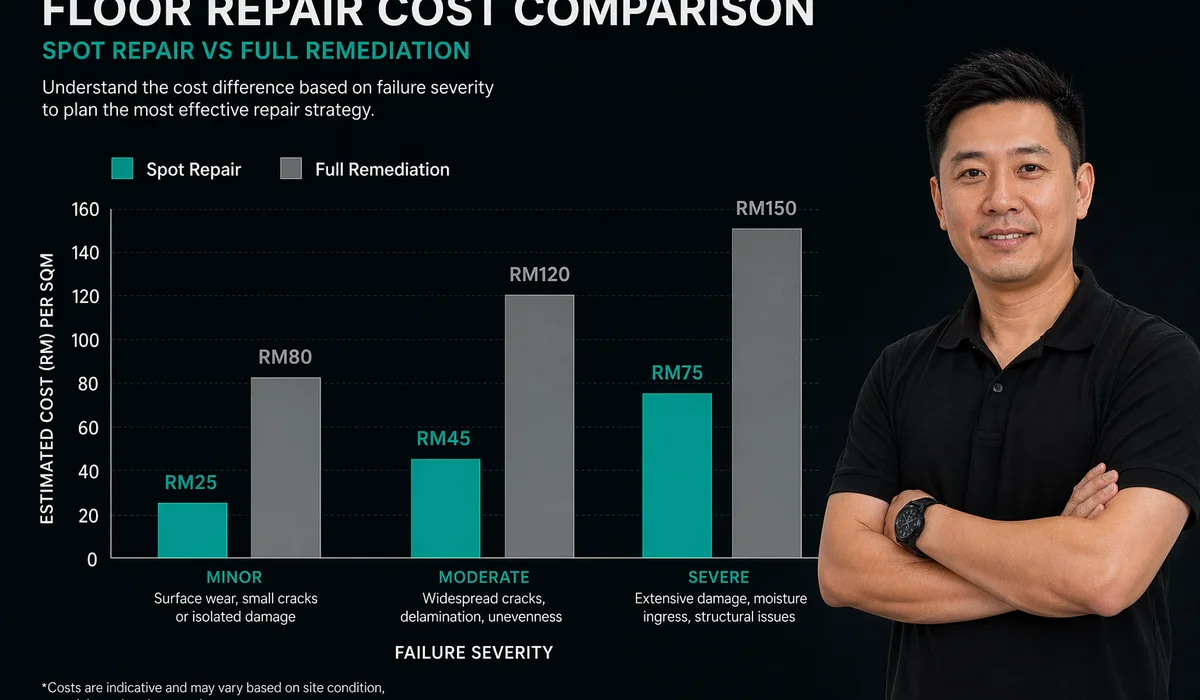
We regularly handle localized damage where full floor replacement is unnecessary. The typical epoxy patch cost per sqft sits between RM35 and RM70. This price range reflects the intensive preparation required to ensure the new material bonds perfectly with the existing substrate.
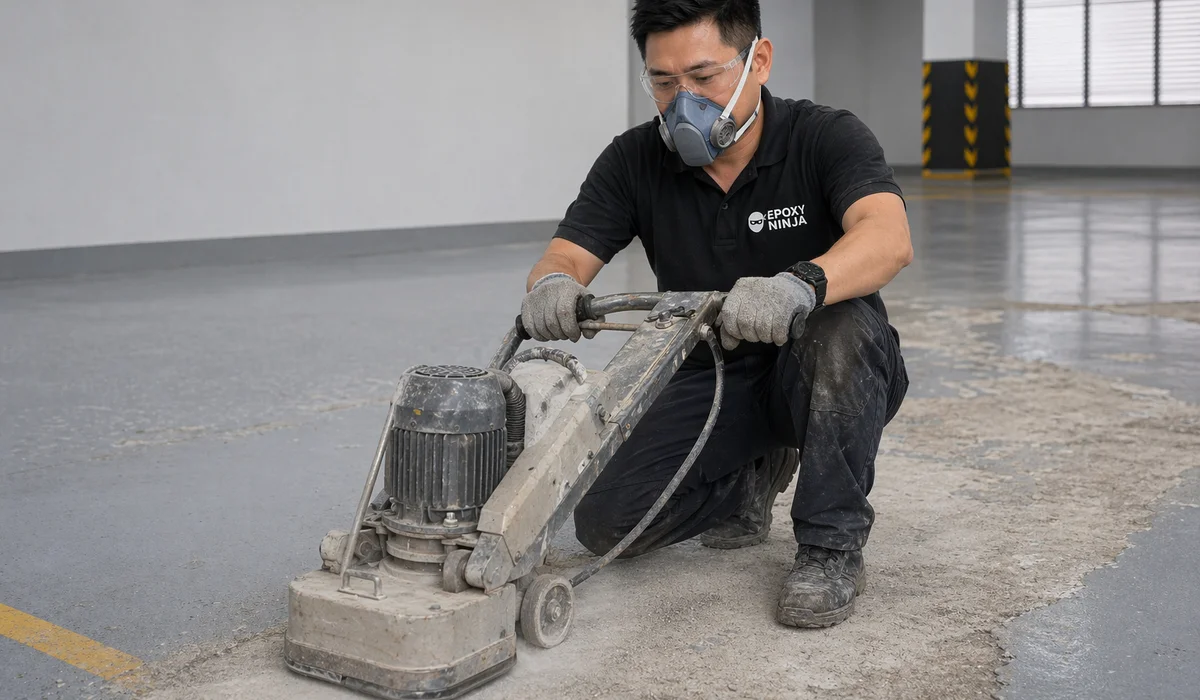
Our standard spot repair protocol involves grinding down the damaged area and applying a high-strength epoxy mortar. Simply painting over a cracked section is a common mistake that leads to immediate peeling. The RM35 starting point generally covers basic surface cracking in low-traffic warehouse zones.
We see costs push toward the RM70 mark when heavy machinery is involved. Forklift aisles and loading docks experience immense dynamic stress. In these high-impact areas, contractors must cut deeper into the concrete and use premium chemical-resistant resins.
- Surface Preparation: Mechanical grinding removes loose debris and creates a rough profile for better adhesion.
- Crack Chasing: Technicians widen existing cracks using a V-blade grinder before filling them with a rigid epoxy binder.
- Moisture Checking: Localized tests ensure no rising damp is causing the specific failure.
- Material Selection: Standard epoxies handle foot traffic, while polyurethane blends manage thermal shocks.
Full remediation RM/sqft (typical RM60-140)
We advise full remediation when an industrial floor suffers from widespread delamination or severe chemical attack. The floor remediation cost spans from RM60 to RM140 per square foot. This substantial investment is mandatory for facilities that must meet strict hygiene regulations.
Our teams use heavy-duty scarifiers to strip away the entirely failed coating down to the bare concrete. Food and beverage processing plants often require HACCP-certified polyurethane screeds like NovaCrete PU MF or Sika Ucrete. These specialized materials drive the price toward the higher end of the spectrum.
| Remediation Level | Price Estimate (RM/sqft) | Best Use Case |
|---|---|---|
| Standard Epoxy Removal | RM60 to RM80 | Dry warehouses, light manufacturing, general storage. |
| Heavy-Duty PU Screed | RM90 to RM115 | Commercial kitchens, automotive workshops, wet zones. |
| HACCP Grade with Moisture Barrier | RM120 to RM140 | Food processing, chemical plants, cold storage facilities. |
We find that Malaysian weather plays a huge role in these major overhauls. The constant 80 to 90 percent relative humidity traps moisture inside aging concrete slabs. Ignoring this trapped moisture guarantees that your expensive new coating will fail.
Our installation process accounts for these environmental challenges. Applying a proper damp-proof membrane adds to the initial cost but prevents future disaster. A properly installed system provides decades of reliable operation under extreme industrial conditions.
Diagnostic site visit structure (included vs paid)
We conduct a rigorous site assessment before writing any quotation. An accurate industrial floor repair price requires data, not guesswork. Many recurring flooring problems in Malaysia stem from poor initial diagnostics.
Our diagnostic visits evaluate the exact condition of your concrete slab. A visual check might spot surface dusting, but it cannot detect the moisture hidden beneath. High moisture content is the number one cause of blistering in epoxy coatings.
We bring specialized equipment to every site visit to gather this crucial data. The standard protocol involves several distinct testing phases. Accurate measurement tools eliminate the risk of premature coating failure.
Core Testing Procedures
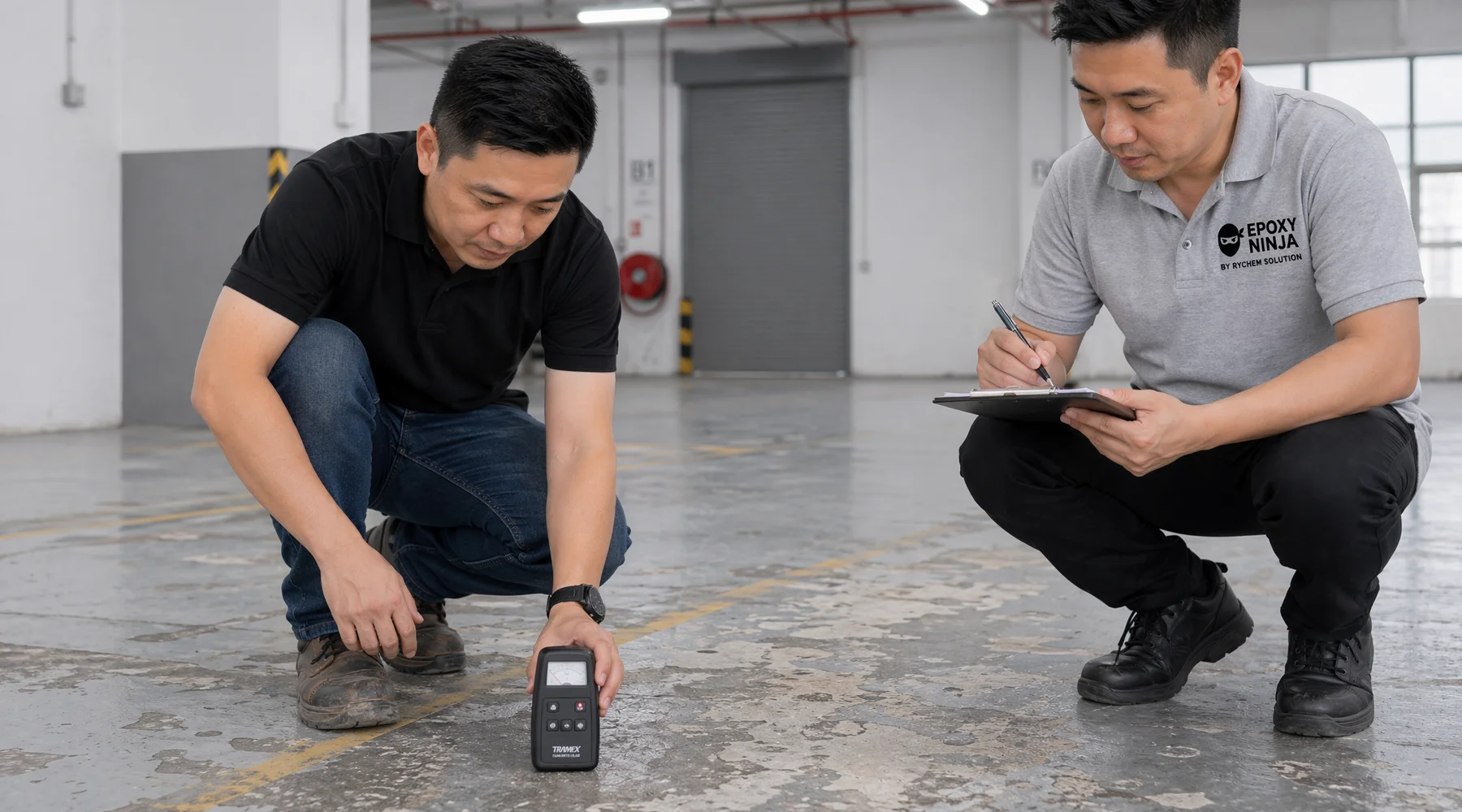
Our technicians rely on the Tramex CMEX5 digital moisture meter for immediate, non-destructive readings. This device uses electrical impedance to measure moisture content up to 20mm deep into the concrete. Epoxy systems generally require a moisture content below 5 percent to bond correctly.
We also evaluate the ambient conditions inside the facility. Sudden temperature swings can cause condensation on the slab surface during application. Documenting these variables helps create a precise, honest bill of quantities.
- Non-Destructive Moisture Testing: Using the Tramex CMEX5 to scan large areas quickly.
- Deep Probe Analysis: Inserting sensors into drilled holes to measure relative humidity inside the slab.
- Chemical Exposure Review: Identifying the specific acids, alkalis, or oils that touch the floor daily.
- Thermal Shock Assessment: Checking if the floor experiences rapid heating and cooling from ovens or freezers.
Scope-variance factors
We see project costs fluctuate based on three critical variables discovered during the site visit. Understanding these factors helps facility managers budget effectively. Every Malaysian industrial site presents a unique combination of these challenges.
Moisture mitigation depth
Our first major variable is the amount of moisture trapped in the concrete. If the Tramex meter shows readings above 5 percent, standard primers will fail. The contractor must apply a specialized damp-proof membrane to block the rising damp.
We adjust the project scope based on how deep this moisture penetrates. A surface-level issue might need a thin moisture barrier system. Deep, structural moisture requires intensive waterproofing treatments that significantly increase the epoxy floor repair cost in Malaysia.
Chemistry change
Our material selection changes drastically depending on your daily operations. A standard warehouse storing dry goods does perfectly fine with basic epoxy resins. A meat processing plant washing down floors with boiling water needs something much tougher.
We upgrade the system to a thermal-shock polyurethane mortar for extreme environments. Polyurethane screeds can withstand temperatures ranging from minus 40 to 150 degrees Celsius. This chemical upgrade directly impacts the final price per square foot.
Prep phasing
Our scheduling flexibility is the final factor that alters the project cost. Halting factory production for a week is rarely an option for busy manufacturers. Splitting the repair work into weekend shifts or overnight phases keeps your business running.
We must factor in the additional labor costs associated with phased preparation. Mobilizing equipment and crews multiple times naturally increases the total bill. Proper planning minimizes these disruptions while ensuring a high-quality finish.
For a closer look at related considerations, read our Epoxy Floor Repair vs Full Replacement guide.
What to do next
We know that finalizing your epoxy floor repair cost Malaysia budget is a tough decision.
The fastest way to get clarity is to arrange a free, comprehensive site visit. A professional assessment removes the guesswork from your facility maintenance budget.
Our team brings a Tramex CMEX5 moisture meter, walks the substrate, and documents all chemical and thermal exposures. You will receive a written bill of quantities outlining the honest cost paths for your specific situation.
Accurate site data guarantees a transparent approach for every facility assessment.
We guarantee a same-day response across JB, Pasir Gudang, Skudai, Senai, and Iskandar Puteri. Review those specifications to see exactly how these durable systems are built. Taking action today prevents costly operational downtime tomorrow.
Our Floor Repair & Moisture Mitigation service page covers the system specification in detail. Professional support makes this entire process straightforward. It is a smart investment for your facility’s future.
Fast answers.
Is the moisture scan part of the repair quote?
For our clients, yes — a free site visit with Tramex scan is standard. Out-of-state jobs may have a travel charge credited to the project.
Why is full remediation only slightly more expensive than spot repair?
Mobilization and setup costs are fixed. On a 500+ sqm job, the spread between large spot repair and full remediation narrows.
Can I claim repair cost on insurance?
Sometimes — if the failure was caused by a covered event (flood, sprinkler burst). Routine wear-out or install defects usually aren't covered.
More in this cluster.
Concrete Moisture Testing Explained: MVER, RH, and Tramex Mapping
MVER, RH, calcium chloride, and Tramex mapping — what each method measures, what the thresholds mean, and why it matters.
Epoxy Floor Repair vs Full Replacement: How to Decide
When to repair, when to fully replace. Decision matrix by failure area %, substrate integrity, system age, and downtime budget.
Fixing Blistering, Delamination, and Pinholes in Industrial Floors
Root causes and fixes for blisters, delamination, and pinholes. When spot repair works, when full removal is the only answer.
Signs Your Industrial Floor Needs Repair (Before It Fails Completely)
Blisters, edge lift, pinholes, powdering — catch floor failure early before it costs you a shutdown and full replacement.
Ready for a real assessment? Free Tramex scan.
Guides are the general case. A site visit gives you the specific answer for your slab, your chemicals, and your operational conditions.