
Concrete Moisture Testing for Epoxy Flooring
MVER, RH, calcium chloride, and Tramex mapping — what each method measures, what the thresholds mean, and why it matters.
The short answer
Skipping proper concrete moisture testing before an epoxy installation is a direct path to failure.
We check your floors in Malaysia using three main methods: MVER, relative humidity, and Tramex scanning to find exact moisture levels. Understanding these readings helps facility managers choose the correct mitigation system.
For full system details, review our floor repair service.
What this guide covers
This guide explains the precise moisture limits your concrete must meet before an industrial coating is applied. Our specialists break down the three industry-standard tests used across manufacturing plants today.
You will learn the acceptable thresholds for each method and understand why relying on just one test creates unnecessary risk. A multi-test approach provides the complete picture needed for a lasting floor.
Moisture Vapor Emission Rate (MVER): what it measures
Moisture Vapor Emission Rate tells you exactly how much water weight is leaving your concrete slab over a 24-hour period. We use this data to see if escaping moisture vapour will ruin your new epoxy coating.
Most standard epoxy systems fail if the mver moisture vapor emission exceeds 3 pounds per 1,000 square feet. Our team often encounters much higher readings in areas like Pasir Gudang due to high local water tables.
Installing a floor over a highly active slab without proper mitigation guarantees blistering. We always match the test results to the specific chemical tolerance of your chosen flooring system.
| Test Result (MVER) | Slab Condition | Recommended Action |
|---|---|---|
| Under 3 lbs | Standard | Proceed with normal epoxy |
| 3 to 10 lbs | High Moisture | Requires moisture barrier primer |
| Over 10 lbs | Severe Issue | Needs heavy-duty mitigation system |
Relative Humidity (ASTM F2170): in-situ probe method
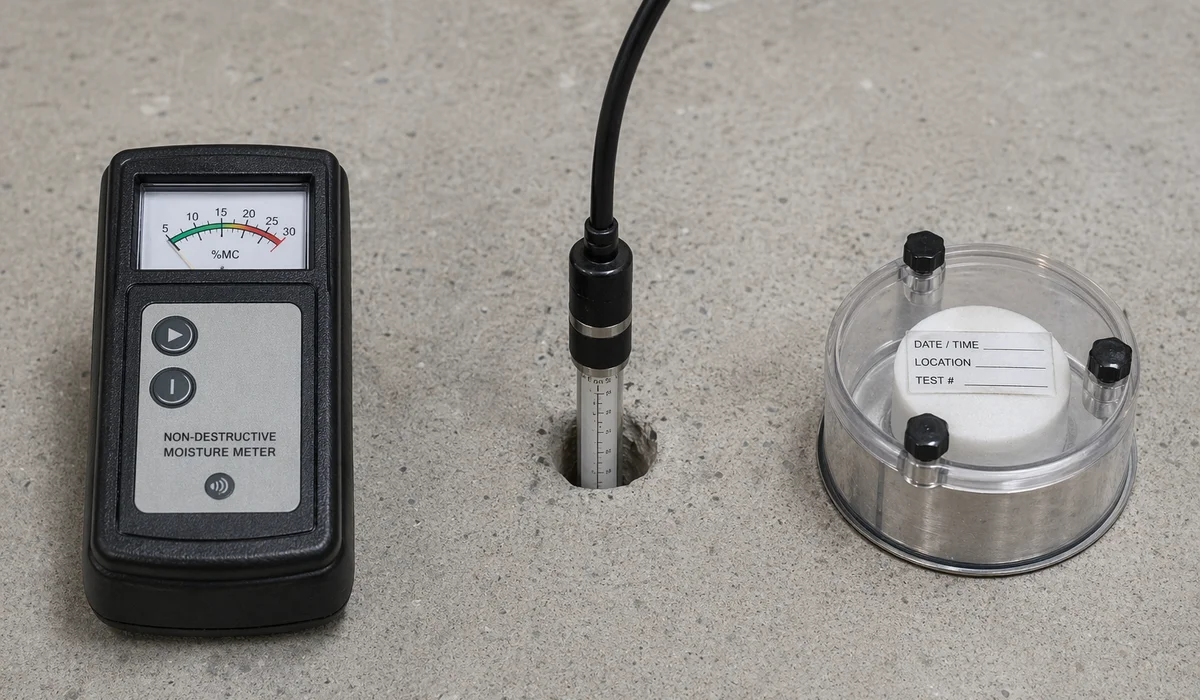
The astm f2170 rh test gives a true picture of the moisture trapped deep inside the concrete core. Our crews drill small test holes to 40% of the slab depth to place precision digital sensors.
A standard industrial epoxy typically needs an internal relative humidity below 80% to bond correctly. We leave these probes in place for 24 hours to let the internal environment stabilise.
This waiting period ensures the digital reading reflects the true equilibrium moisture. Here is the exact process for placing an in-situ probe:
- Map out testing locations based on the total square footage.
- Drill a precise hole to the required slab depth.
- Clean the hole thoroughly with a wire brush and vacuum.
- Insert the sensor sleeve and cap it for the acclimation period.
Calcium Chloride Test: gravimetric MVER method
The calcium chloride test calculates surface-level moisture evaporation by weighing a salt dish before and after exposure. We place a sealed plastic dome over a pre-weighed dish of calcium chloride for about 72 hours.
The salt actively absorbs escaping water vapour directly from the concrete surface. Our technicians weigh the dish afterward to calculate the exact emission rate in pounds.
Ambient humidity in Malaysian factories heavily skews these surface readings. We recommend pairing this gravimetric method with internal probes for better accuracy.
Surface tests only show a snapshot of top-level evaporation. High warehouse humidity easily contaminates the calcium chloride dish, which is why internal slab testing remains essential for a successful installation.
Tramex non-destructive mapping: why we use CMEX5 over destructive tests
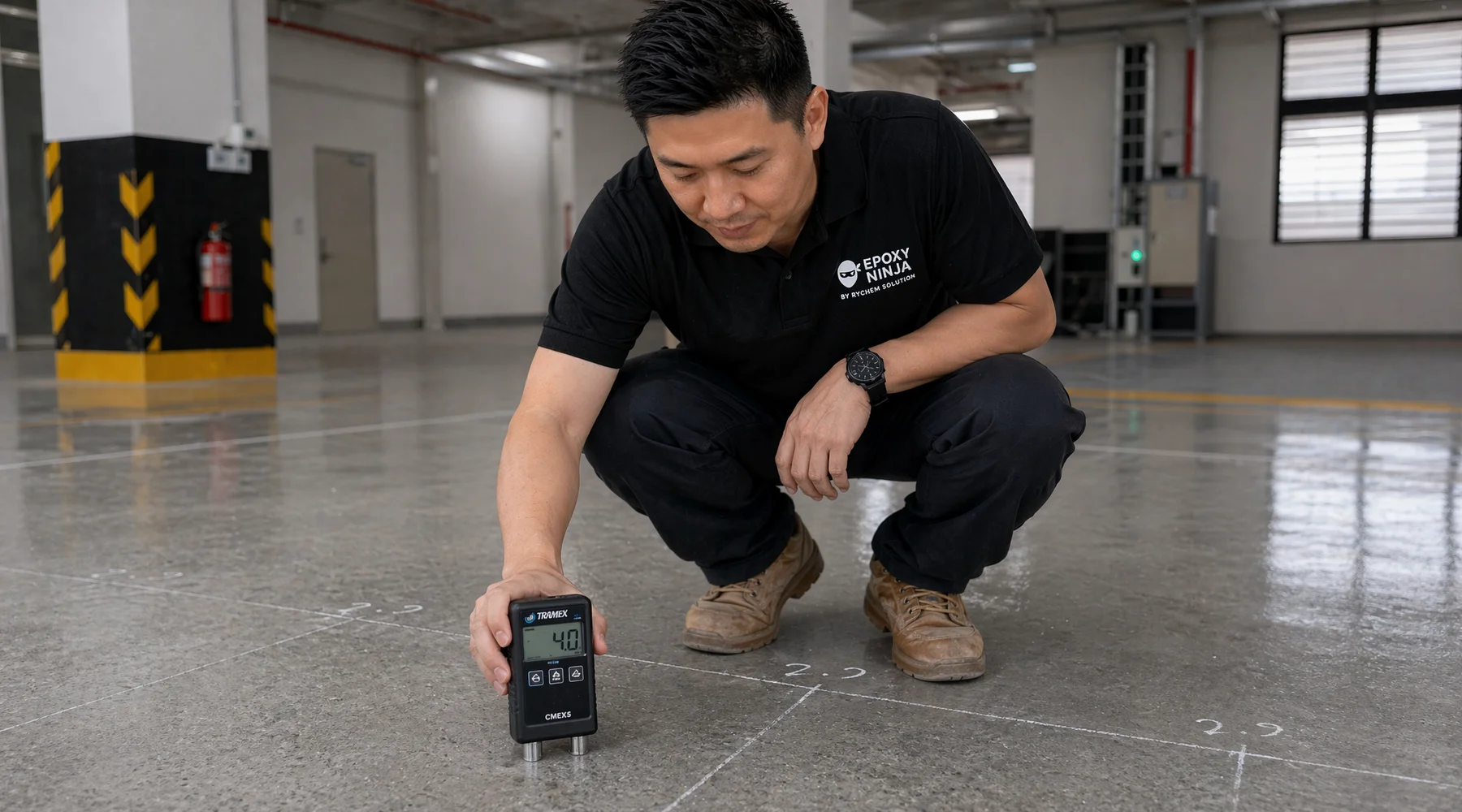
A tramex moisture meter provides instant, non-destructive moisture readings across large factory floors. Our technicians use the Tramex CMEX5 to scan hundreds of square feet in minutes without drilling holes.
The device sends electrical signals into the top 3/4 inch of the slab to measure the concrete moisture equivalent. We use this rapid mapping technique to locate hidden wet spots before planning the mitigation strategy.
Finding these problem areas early prevents costly rework down the line. Here are the main advantages of using CMEX5 mapping:
- Scans massive areas quickly without damaging the existing slab.
- Delivers instant percentage readings for immediate decision-making.
- Connects via Bluetooth to map the entire floor visually.
- Identifies specific problem zones that require deeper probe testing.
For a closer look at related considerations, read our Fixing Blistering, Delamination, and Pinholes guide.
What to do next
Making the correct decision on moisture testing prevents catastrophic flooring failures. We bring a Tramex CMEX5 directly to your facility to map your substrate and document the thermal exposure.
You receive a written BQ outlining the honest cost paths based on exact local conditions. We provide no-obligation, same-day responses across JB, Pasir Gudang, Skudai, Senai, and Iskandar Puteri.
Full system specifications are available on the Floor Repair & Moisture Mitigation service page.
Fast answers.
What MVER threshold is safe for epoxy?
Typical standard: below 3 lbs/1000 sqft/24hr (or ~85% RH in ASTM F2170). Higher means moisture mitigation primer or system change.
Why use Tramex if calcium chloride and RH probes exist?
Tramex is non-destructive — we map the whole slab in an afternoon. Calcium chloride and RH probes are slow, destructive, and spot-based. We use Tramex for mapping, RH for confirmation.
Does a dry slab today stay dry?
Not always — slabs can absorb moisture from below during monsoon. That's why we re-check readings the morning of the pour.
More in this cluster.
Epoxy Floor Repair vs Full Replacement: How to Decide
When to repair, when to fully replace. Decision matrix by failure area %, substrate integrity, system age, and downtime budget.
Fixing Blistering, Delamination, and Pinholes in Industrial Floors
Root causes and fixes for blisters, delamination, and pinholes. When spot repair works, when full removal is the only answer.
Industrial Floor Repair Cost Guide for Malaysia
Spot repair and full remediation RM/sqft ranges for industrial floors in Malaysia. Diagnostic fee structure and scope variance.
Signs Your Industrial Floor Needs Repair (Before It Fails Completely)
Blisters, edge lift, pinholes, powdering — catch floor failure early before it costs you a shutdown and full replacement.
Ready for a real assessment? Free Tramex scan.
Guides are the general case. A site visit gives you the specific answer for your slab, your chemicals, and your operational conditions.