
Epoxy Floor Repair vs Full Replacement
When to repair, when to fully replace. Decision matrix by failure area %, substrate integrity, system age, and downtime budget.
The short answer
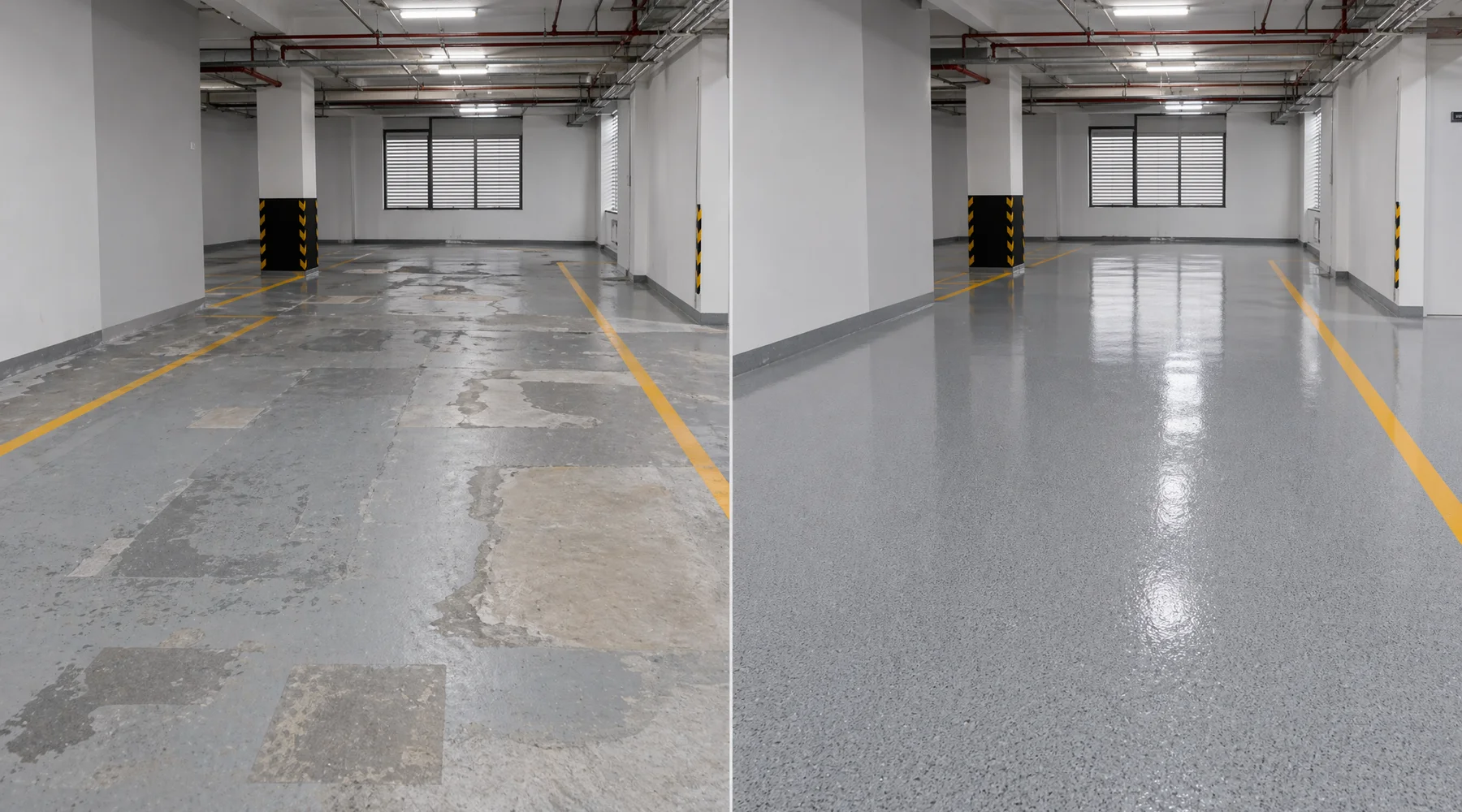
Our team at Epoxy Ninja Johor Bahru constantly fields questions about whether a damaged facility floor needs a quick patch or a complete overhaul. If you are asking yourself, “should I repair or replace epoxy,” the dividing line usually comes down to three things: the total percentage of the failing area, the age of the system, and the current moisture levels in the concrete slab.
We generally recommend a full replacement if more than 25% of the floor is peeling or if moisture vapor exceeds 4.5%. This specific data helps you avoid throwing good money at a dying substrate.
For a detailed breakdown of how we handle localized fixes, see our floor repair service.
What this guide covers
This guide breaks down the four core metrics you need to evaluate before making a final floor remediation decision. We will look closely at the failure percentages, substrate moisture limits, system age, and chemistry fit.
Understanding these factors will save your facility from costly, repeated downtime. Here is exactly what you need to evaluate:
- Failure area %
- Substrate moisture
- System age
- Chemistry fit
Decision matrix
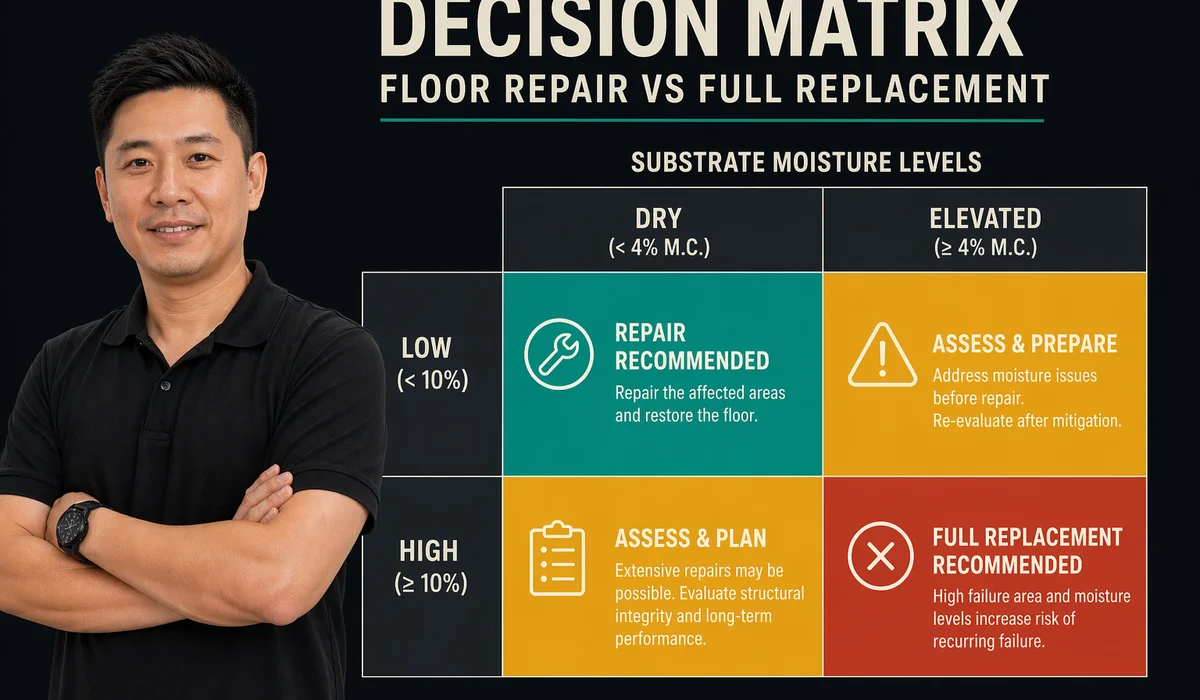
Our decision matrix removes the guesswork from facility maintenance. You should consider a full replacement if the damage covers more than 25% of your total square footage. A partial vs full floor repair debate often ends quickly when you realize widespread failures look like a patchwork quilt and fail again within months.
Moisture is the silent killer of industrial coatings in Malaysia. We rely on the Tramex CMEX5 digital meter to get an accurate reading of the concrete slab before making any recommendations. Any reading above 4.5% moisture content requires a dedicated moisture vapor barrier, making simple spot repairs risky.
System age and chemistry fit also play a massive role. An epoxy floor older than seven years usually has degraded adhesion across the entire surface, not just in the visible problem spots. You must also match the repair chemistry to the original coating, like using urethane cement for high-heat food processing zones, to prevent delamination.
Cost delta
The financial difference between patching a floor and pouring a new one depends entirely on your specific industrial environment. Our recent 2026 projects in Johor Bahru show that full industrial-grade epoxy replacements typically run between RM15 and RM30 per square foot. Spot repairs cost less upfront but require high minimum mobilization fees that make small patches relatively expensive per square foot.
| Factor | Localized Spot Repair | Full Floor Replacement |
|---|---|---|
| Average Cost (Industrial) | RM 800 - RM 1,500 (Minimum trip fee) | RM 15 - RM 30 per sq ft |
| Best For | Forklift gouges, dropped tool impact | Widespread peeling, chemical attack |
| Warranty Coverage | Limited to repaired area only | 1 to 3 years for the entire facility |
| Expected Lifespan | 1 to 3 years | 7 to 10+ years |
A common mistake factory managers make is chasing cheap fixes for systemic problems. You might pay RM1,000 to fix a few gouges today, only to have the adjacent sections peel off next month.
We advise clients to calculate the total cost of ownership over a five-year period rather than just looking at the initial invoice. This simple math usually reveals that a full remediation is a much smarter investment.
Expected lifespan after repair vs after replacement
A properly executed spot repair will usually last 1 to 3 years, while a brand-new industrial epoxy system should easily perform for 7 to 10 years. This is one of the areas we walk through on every site visit. What you decide here drives 60-80% of your floor’s actual service life, so it is worth getting the call right the first time.
Our clients need to know that a patch is only a temporary bridge, not a permanent cure. The longevity of any fix depends heavily on the preparation methods used.
We always mechanically grind the damaged section to ensure the new resin bites into the raw concrete. If your contractor just paints over the chipped area, that patch will likely flake off within six months.
Age plays a critical factor in how the surrounding floor will behave. Pushing a failing 8-year-old floor to last another year might make sense if you are planning a facility relocation soon. You should invest in a full replacement if you intend to stay in the building for the next decade.
Downtime implications of each path
Spot repairs usually keep a specific zone offline for 12 to 24 hours, whereas a full factory replacement requires shutting down the area for 3 to 7 days. In practice for Malaysian industrial sites, this shows up as real numbers and real trade-offs.
We can often use fast-curing polyaspartic resins for small patches, allowing forklift traffic to resume the very next morning. This rapid turnaround is highly valuable for 24/7 food and beverage processing lines.
Full replacements require multiple coats, primer curing times, and extensive surface grinding that simply cannot be rushed. The decision threshold here is not generic, as it heavily depends on these timeline factors:
- Surface Preparation: Grinding the entire slab takes 1 to 2 days.
- Primer Curing: Industrial primers require 12 to 24 hours to set properly.
- Topcoat Application: Multi-layer systems need adequate drying time between coats.
- Final Cure: Heavy forklift traffic must wait at least 48 to 72 hours after the final pour.
Our team highly recommends mapping out your production calendar before calling a flooring contractor. Planning ahead prevents emergency rush charges and ensures the resin gets the proper time to cure.
For a closer look at related considerations, read our Industrial Floor Repair Cost Guide for Malaysia guide.
What to do next
If you are weighing this epoxy floor repair vs replacement decision for your facility, the fastest next step is a free site visit.
We bring a Tramex CMEX5 moisture meter, walk the substrate, document the chemical and thermal exposure, and hand you a written BQ with the honest cost paths. You get a no-obligation, same-day response across JB, Pasir Gudang, Skudai, Senai, and Iskandar Puteri.
Our Floor Repair & Moisture Mitigation service page covers the system spec in detail. Taking action now prevents a small safety hazard from turning into a major operational delay.
Fast answers.
At what failure % should I just replace the floor?
Rule of thumb: above 25-30% failure area, or if the substrate is wet across most of the slab, full replacement is cheaper long-term.
Does a repaired floor last as long as a new one?
Spot repair typically extends life by 3-5 years in a working zone. Full replacement resets the clock to full system lifespan.
How fast can we do a full replacement?
For 500-1,000 sqm: 7-10 days including demolition, moisture remediation, and full re-install. Larger jobs scale by zone phasing.
More in this cluster.
Concrete Moisture Testing Explained: MVER, RH, and Tramex Mapping
MVER, RH, calcium chloride, and Tramex mapping — what each method measures, what the thresholds mean, and why it matters.
Fixing Blistering, Delamination, and Pinholes in Industrial Floors
Root causes and fixes for blisters, delamination, and pinholes. When spot repair works, when full removal is the only answer.
Industrial Floor Repair Cost Guide for Malaysia
Spot repair and full remediation RM/sqft ranges for industrial floors in Malaysia. Diagnostic fee structure and scope variance.
Signs Your Industrial Floor Needs Repair (Before It Fails Completely)
Blisters, edge lift, pinholes, powdering — catch floor failure early before it costs you a shutdown and full replacement.
Ready for a real assessment? Free Tramex scan.
Guides are the general case. A site visit gives you the specific answer for your slab, your chemicals, and your operational conditions.