
Carpark Floor Maintenance & Recoating Schedule
Annual inspection checklist, recoat intervals, trigger-based repair signs, and the cost of deferred maintenance.

The short answer
We at Epoxy Ninja Johor Bahru see this scenario constantly across industrial and commercial facilities. You know how quickly a minor hairline crack in a loading bay can turn into a massive structural headache under constant forklift traffic.
Standard epoxy installations in Malaysia typically start around RM2.50 to RM4.00 per square foot.
Let’s look at the actual data, what the wear patterns are telling us, and explore practical ways to map out your carpark floor maintenance schedule. For a detailed breakdown of the exact specifications, see our carpark flooring service.
What this guide covers
This guide breaks down the critical carpark floor maintenance schedule milestones required to keep your facility’s flooring safe and compliant. Understanding your specific carpark recoat cycle prevents sudden closures and keeps operations running smoothly.
Our team has structured this resource to walk you through the exact signs of wear you need to monitor. The following sections will detail everything from annual checks to the true cost of delayed repairs.
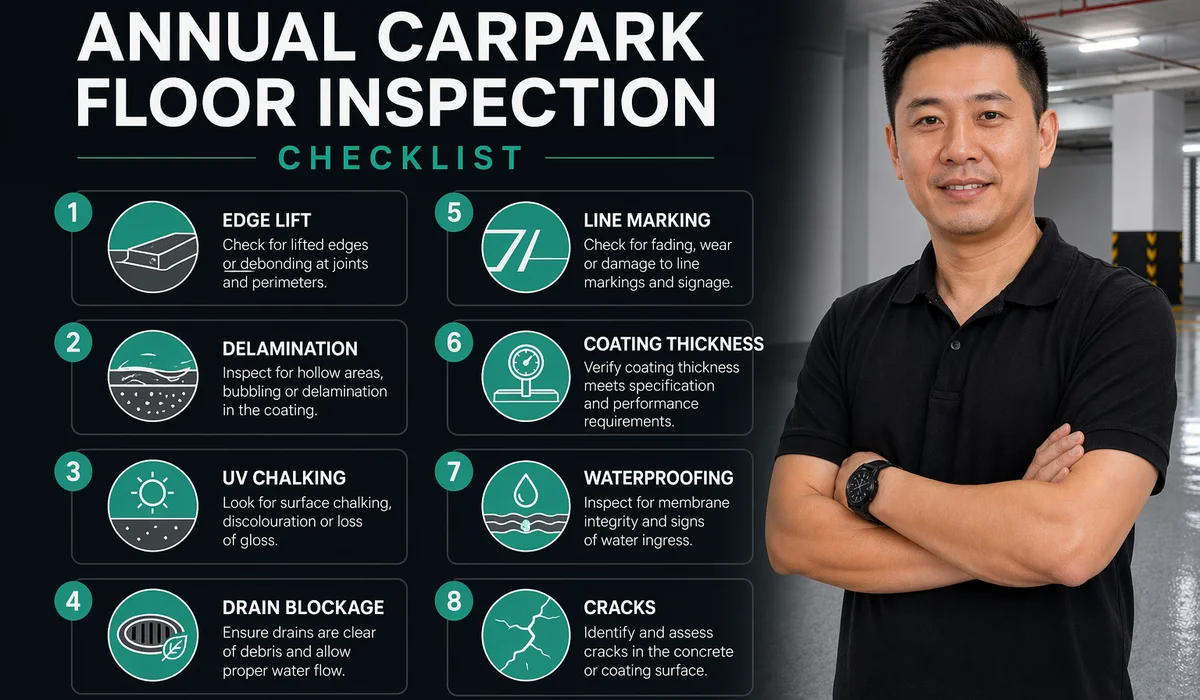
Annual inspection checklist (cracks, water pooling, line wear, edge delamination…
An effective annual carpark inspection must catch early signs of moisture damage, structural stress, and surface wear before they escalate. Facility managers need a systematic approach to identifying these vulnerabilities early.
We highly recommend using a “chain-dragging” test during your yearly review. This simple method involves dragging a heavy metal chain across the deck surface. A hollow sound clearly indicates that the concrete is delaminating beneath the surface, even if no visible cracks are present yet.
Moisture damage is another critical factor in Malaysia’s humid climate. Inspectors must look for damp spots and efflorescence on the underside of suspended decks. These white, chalky mineral deposits prove that water is actively migrating through the concrete slab.
Your team should evaluate these four specific areas during every walkthrough:
- Expansion Joints: Check for total sealant failure or tears that allow water infiltration.
- Drainage Systems: Ensure gullies and gutters are completely free of debris to prevent standing water.
- Surface Scaling: Look for rough, flaking patches where the top layer of concrete has broken away.
- Line Demarcation: Measure the fading of safety yellow walkways to maintain occupational safety compliance.
Typical recoat intervals by deck type
Standard epoxy and polyurethane systems generally require recoating every 5 to 10 years, depending heavily on daily traffic volume and chemical exposure. High-traffic warehouse loading zones often need attention much sooner than standard employee parking areas.
Our experience shows that a well-maintained epoxy coating can easily last 15 years in moderate conditions. A complete failure forces you to strip the entire floor down to the bare concrete, which drastically increases project costs.
Environmental factors heavily influence these timelines. Exposed top decks face intense ultraviolet radiation and require specific UV-resistant polyurethane topcoats to prevent yellowing and chalking. Sheltered indoor levels deal primarily with mechanical wear from vehicle tires and turning friction.
The impact of facility usage
Food and beverage processing plants face entirely different challenges than dry storage warehouses. Spills involving lactic acids or harsh industrial cleaning chemicals will rapidly degrade standard coatings. These environments require chemical-resistant urethane cement, which boasts a different lifecycle altogether.
Managers should plan their budgets around these baseline intervals:
- High-Traffic Ramps: 3 to 5 years
- Heavy Manufacturing Zones: 5 to 7 years
- Standard Commercial Parking: 7 to 10 years
- Pedestrian Walkways: 10 to 12 years
Trigger-based repair signs to act on immediately
Immediate intervention is required the moment you spot exposed steel reinforcement, significant pooling water, or deep structural cracks. Ignoring these specific warning signs allows water and chemicals to compromise the building’s structural integrity.
We always warn clients about the dangers of spalling concrete. This occurs when the concrete surface breaks away entirely, leaving the internal steel rebar exposed to the elements. Once that steel begins to rust, it expands significantly and literally pushes the surrounding concrete apart from the inside out.
Water stains on lower-level ceilings are another massive red flag. This symptom points directly to a failure in the waterproofing membrane or the expansion joint sealants on the floor above. Catching this early prevents the water from damaging electrical conduits and lighting fixtures below.
Chemical and thermal damage
Industrial kitchens and processing facilities must watch for specific chemical breakdown signs. Pitted areas or soft spots in the floor indicate that acids or aggressive sanitizers have eaten through the protective layer.
Action is mandatory when you observe these critical issues:
- Visible rust stains bleeding through the concrete.
- Cracks wider than 2 millimeters in high-traffic zones.
- Soft, gummy patches in areas exposed to high heat or chemicals.
- Loss of anti-slip aggregate on sloped ramps.
Cost of deferred maintenance: how small failures become big
Delaying a basic recoat can easily multiply your repair bills by ten times or more. A minor crack allows moisture to penetrate the slab, turning a simple surface fix into a major structural restoration project.
Our data indicates that proactive deck coating maintenance is always the most economical choice. Patching a localized area or applying a fresh topcoat requires minimal downtime and materials. Waiting for a catastrophic failure means closing the entire facility for days to perform deep concrete repairs.
The financial difference is stark. In Malaysia, a standard professional epoxy maintenance coat might range from RM2.50 to RM4.00 per square foot. Full concrete rehabilitation, including rebar treatment and new screed laying, can easily exceed RM25.00 per square foot.
The hidden operational costs
The price tag for repairs is only one part of the equation. Damaged floors create severe trip hazards for employees and slow down forklift operations. Slower material handling directly impacts your daily productivity and bottom line.
Consider these compounding expenses of delayed action:
- Extended Downtime: Full restorations require weeks of curing time.
- Equipment Wear: Rough surfaces destroy forklift tires prematurely.
- Compliance Fines: Failed floors violate strict food safety and hygiene regulations.
- Liability Claims: Uneven surfaces drastically increase the risk of workplace accidents.
For a closer look at related considerations, read our Carpark Line Marking and Traffic Safety Zoning guide.
What to do next
Setting up a proper carpark floor maintenance schedule is the most effective next step for any facility manager. This evaluation will give you a clear, data-driven understanding of your current floor condition.
We bring specialized equipment, like the Tramex CMEX5 moisture meter, to accurately diagnose hidden issues beneath the surface. The assessment process includes documenting your specific chemical exposures and measuring potential thermal shock risks.
You will receive a detailed written bill of quantities outlining honest, transparent cost paths. This ensures you only pay for the exact level of protection your facility truly needs.
Our Epoxy Carpark Flooring service page covers the system specifications and installation processes in detail.
Fast answers.
How often do carparks need recoating?
Exposed top deck: 5-7 years for topcoat refresh. Sheltered intermediate deck: 8-12 years. Driven by UV, water, and traffic intensity.
What's the cost of skipping annual inspection?
A RM5K-10K repair becomes RM50K+ when water penetrates the slab and causes structural corrosion. Maintenance pays for itself.
Can I recoat just part of a deck?
Yes — zone-based recoating is common. We match the topcoat system and feather the transition for visual continuity.
More in this cluster.
Carpark Deck Coating System Types Compared
Thin-film vs full-build PU, exposed vs sheltered deck, waterproofing-integrated. Which carpark coating system fits your building?
Carpark Line Marking and Traffic Safety Zoning
Bay layout, directional arrows, EV and disabled bay marking, speed graphics. Paint types for durability in Malaysian carparks.
Ready for a real assessment? Free Tramex scan.
Guides are the general case. A site visit gives you the specific answer for your slab, your chemicals, and your operational conditions.