
Carpark Deck Coating System Types Compared
Thin-film vs full-build PU, exposed vs sheltered deck, waterproofing-integrated. Which carpark coating system fits your building?

The short answer
We understand perfectly that managing a commercial facility means dealing with constant maintenance requests. Concrete slabs rarely fail overnight. They slowly degrade because a generic coating was applied to an area that demanded specialized protection.
Our team sees this exact scenario play out constantly across industrial sites.
For our local clients, comparing carpark deck coating types is the primary focus of our carpark flooring service. This guide outlines exactly how to evaluate your options and choose a system that actually lasts.
What this guide covers
You need to understand the distinct categories of materials available before signing off on a quotation. This breakdown focuses on the specific conditions found in Malaysian facilities.
We will compare material thicknesses, weather exposure ratings, and integrated moisture barriers. The goal is to provide a clear framework for making a cost-effective decision regarding your multi storey carpark floor.
Thin-film vs full-build PU carpark deck coating types
The biggest point of confusion in the local market is the difference between surface paints and true structural layers. Many contractors quote a generic epoxy coating without specifying the dry film thickness. We always clarify this distinction during our initial consultations. A thin-film system typically measures under 0.5 millimetres thick. These light applications are essentially just protective paints applied in a primer and topcoat sequence.
Our technicians recommend thin films solely for light-duty zones like basic pedestrian walkways or small office parking bays. They lack homogeneity entirely. Once a vehicle tyre scratches the surface, the bare concrete underneath is completely exposed. We see these systems lose their gloss and require touch-ups within just two years in busy environments.
Full-build polyurethane systems provide an entirely different level of performance. These heavy-duty installations range from 1.0 to 5.0 millimetres in thickness. Our application process involves multiple integrated layers that chemically bond into a dense block. This homogeneous structure means that even deep scratches will not expose the concrete substrate.
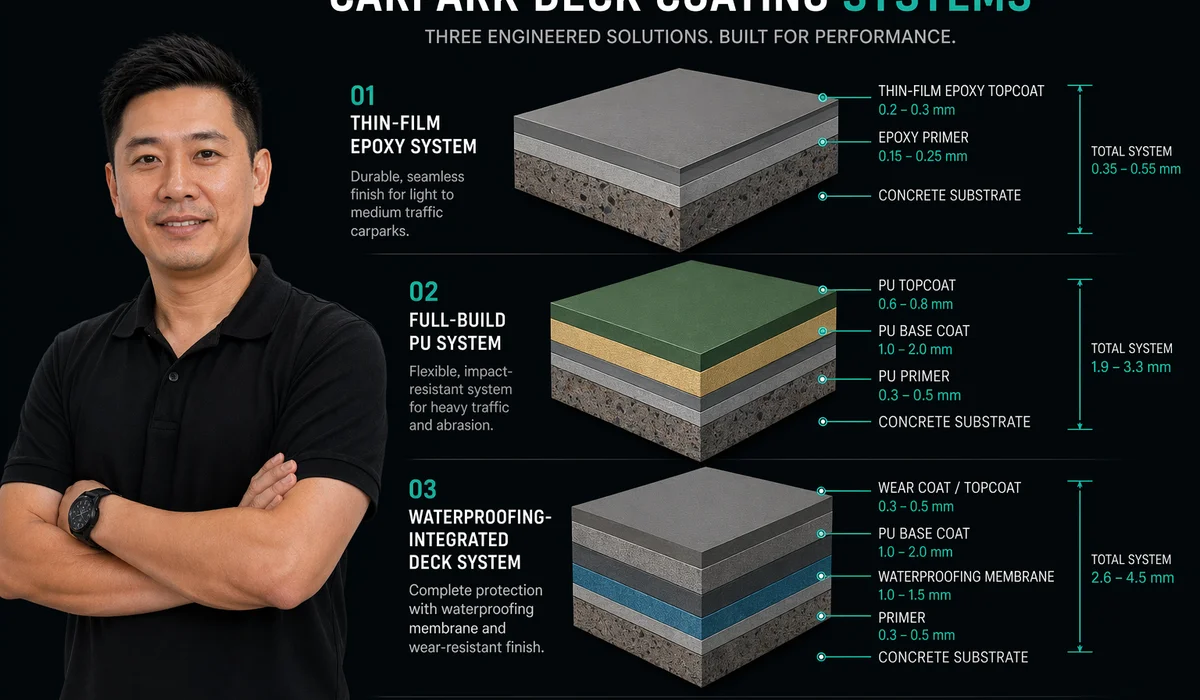
Carpark flooring systems comparison
| System Characteristic | Thin-Film Coating | Full-Build PU System |
|---|---|---|
| Typical Thickness | Under 0.5 mm | 1.0 mm to 5.0 mm |
| Primary Function | Dust prevention and aesthetics | High mechanical strength |
| Ideal Traffic Level | Light foot traffic, light vehicles | Heavy machinery, forklifts |
| Homogeneity | Surface layer only | Fully integrated mass |
Exposed top deck vs sheltered intermediate deck
Multi-storey structures demand specific formulations based on their exact location within the building. Applying an interior-grade material on a roof level is a costly mistake. Our site assessments always factor in the massive environmental load placed on open-air surfaces. Top decks in Malaysia easily endure temperature swings up to 45°C alongside torrential monsoon rains.
You must specify a 100% UV-stable aliphatic polyurethane seal coat for these exposed areas. Systems similar to Sikafloor-315 resist chalking and will not turn yellow after months of intense sunlight. Our suppliers also offer lighter colour options for top decks to increase solar reflectance. This simple choice lowers the building’s overall thermal load significantly.
Sheltered intermediate decks face a completely different set of challenges. The lack of direct sunlight means UV stability is less critical, but the mechanical stress from turning tyres is immense. We typically specify a heavy-duty, naturally ventilated system that can handle dynamic loads of up to 3kN/m².
Here are the primary requirements for intermediate levels:
- High Abrasion Resistance: The surface must withstand constant friction from vehicle traffic.
- Dynamic Load Bearing: The formulation needs to handle the heavy weight of commercial trucks.
- Slip Resistance: A scattered coat of quartz sand is usually added to ensure maximum safety.
Waterproofing-integrated deck coatings
Moisture is the primary enemy of any reinforced concrete structure. Without a proper barrier, water penetrates the porous slab and triggers rebar corrosion. Our engineers frequently encounter severe concrete spalling caused by inadequate moisture protection. A standalone floor paint will not stop this chemical reaction.
You need a system that integrates an elastomeric waterproofing membrane directly into the buildup. Products like the Sikalastic series or Gruvdeck ED provide up to 200% elongation. We rely on these highly flexible layers to bridge dynamic cracks as the building naturally shifts and settles.
Handling Rising Damp
Rising damp is another critical factor for ground-bearing or basement slabs. When moisture pushes up from the earth beneath the concrete, it causes standard surface treatments to bubble and peel away. Our standard procedure involves applying a specialized moisture barrier primer before any resin touches the floor.
Identifying these risks early prevents total floor failure down the line. Installing a basic coating over a damp slab is a guaranteed waste of money. We use precise moisture meters to verify the concrete conditions before starting any work.
Expected lifespan by system
Durability directly correlates with the amount of material applied and the quality of the initial surface preparation. A basic 0.5 millimetre coating might look great on day one, but it rarely survives heavy industrial use. We find that food and beverage facilities often destroy these light treatments within 24 to 36 months. Frequent chemical spills and forklift traffic simply overwhelm the thin barrier.
Investing in a premium, full-build system changes the financial calculation entirely. High-end installations with integrated waterproofing frequently achieve W3 certification standards. Our most demanding clients expect these engineered floors to deliver a functional lifetime exceeding 25 years.
The true secret to longevity lies in the preparation work. Grinding or shot-blasting the concrete creates the necessary mechanical profile for the primer to grip. We guarantee that skipping this step will cut your floor’s lifespan in half, regardless of which expensive resin you purchase.
Here are the mandatory steps for achieving maximum lifespan:
- Moisture Testing: Verifying the slab is dry enough to accept the resin.
- Mechanical Preparation: Removing the weak top layer of concrete to expose a strong bonding surface.
- Proper Priming: Sealing the pores and creating a chemical link for the subsequent layers.
For a closer look at related considerations, read our Carpark Floor Maintenance and Recoating Schedule guide.
What to do next
If you are evaluating different carpark deck coating types for your facility, the fastest next step is a free site visit.
Our Epoxy Carpark Flooring service page covers the system specifications in detail. The onsite assessment includes bringing a Tramex CMEX5 moisture meter to walk the substrate and document the chemical exposure.
We hand you a written BQ with the honest cost paths. There is no obligation, and you receive a same-day response across JB, Pasir Gudang, Skudai, Senai, and Iskandar Puteri.
Fast answers.
Does a carpark roof deck need waterproofing?
Yes — exposed top decks need waterproofing-integrated coating to protect the structural slab from water ingress.
What's the lifespan of a full-build PU carpark coating?
Typically 8-12 years for the topcoat, longer for the buildcoat. Annual inspection and timely recoat extends total life.
Can thin-film work for intermediate decks?
Yes — sheltered intermediate decks see less UV and water, so thin-film is cost-effective. Top decks need heavier systems.
More in this cluster.
Carpark Floor Maintenance and Recoating Schedule
Annual inspection checklist, recoat intervals, trigger-based repair signs, and the cost of deferred maintenance.
Carpark Line Marking and Traffic Safety Zoning
Bay layout, directional arrows, EV and disabled bay marking, speed graphics. Paint types for durability in Malaysian carparks.
Ready for a real assessment? Free Tramex scan.
Guides are the general case. A site visit gives you the specific answer for your slab, your chemicals, and your operational conditions.